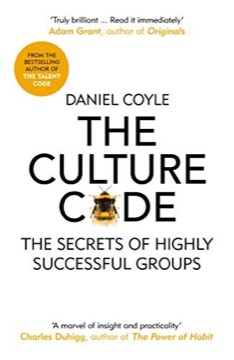
The Culture Code
Daniel Coyle's study of how high-performing groups actually generate cooperation, arguing that culture is not a set of stated values but a pattern of small, repeated signals — and that those signals can be identified and practised.
- First published
- 2018
- Publisher
- Penguin Random House
- Pages
- 280
- Shelf
- Leadership
- Level
- Entry
- ISBN-13
- 9780525492467
Record checked against
Only one source carried a publication date for this work, so the year is uncorroborated.
Catalogue note
- Reads as
- PracticalWritten to be applied, not only understood.
- Level
- Accessible / FoundationalNo prior reading assumed.
- Approach
- Practical
- Written for
- Managers, Newcomers to the subject
- Ideas
Saved in this browser only — no account, nothing sent anywhere. My library
Read this if
- You want to understand what makes people willing to follow a decision.
- You are responsible for other people's work as well as your own.
- You want something to apply, not only something to think about.
- You are starting from scratch here and want a way in that assumes no prior reading.
The core idea
Coyle's argument is that group performance is not the sum of individual talent but a property of the interactions between people — and that those interactions run on cues far smaller and more frequent than anyone tracks.
He organises the book around three skills: build safety, share vulnerability, and establish purpose. His claim is that these are learnable behaviours rather than personality traits or inherited culture.
Culture is not what a group believes. It is the pattern of small signals it keeps sending.
Devmark’s reading — not a quotation from the book
Belonging cues
The first skill is safety, and Coyle's mechanism is the belonging cue: small signals of proximity, attention and future relationship. Eye contact, turn- taking, physical orientation, the use of someone's name, energy in responding.
His point is that these are not pleasantries. They answer an ancient question — am I safe here, do I have a future with these people — and the answer determines whether someone contributes or protects themselves.
What research on group interaction suggests
Coyle draws on work measuring interaction patterns rather than content, including findings that how a team communicates — turn-taking balance, energy, side channels — predicts performance better than what they discuss.
This is the empirical spine of the first section, and it is genuinely interesting. It also carries a caution: much of the underlying research is correlational and drawn from specific settings, and the book presents it with more certainty than that supports.
Vulnerability comes first
The second skill inverts the usual assumption. Most people believe trust must precede vulnerability; Coyle argues the causation runs the other way — someone signals vulnerability, another responds, and trust is built by the exchange.
The practical consequence is that leaders must go first and must do it repeatedly, because a single admission is read as a technique while a pattern is read as a norm. His most useful specific is the leader who routinely says "this is where I could use help".
After-action review
The military practice Coyle examines most closely: a structured review conducted without rank, asking what was intended, what happened, why it differed, and what to do next time.
The detail that matters is the removal of hierarchy for the duration. The review works because the most junior person can say what they saw, and it stops working the moment it becomes an occasion for assigning blame.
Purpose as repeated signal
The third skill is narrower than it sounds. Coyle argues that purpose is not established by a statement of values but by constant, almost embarrassingly repetitive signalling of priorities — catchphrases, stories retold, the same handful of things said far past the point the leader is bored of saying them.
His observation is that leaders consistently underestimate the repetition required, because they hear themselves say it every time and the group hears it rarely.
You will be bored of saying it long before the group has finished hearing it.
Devmark’s reading — not a quotation from the book
Two kinds of purpose
A useful distinction: proficiency purpose, for work where consistent reliable execution matters, and creativity purpose, for work where the task is to find something new.
They need opposite signals. Proficiency wants clear standards and rapid correction; creativity wants autonomy, protection from premature judgement, and the removal of obstacles. Coyle's point is that most groups do both kinds of work and signal only one way.
Where it is limited
The evidence is a mix of research and reporting, and the reporting dominates. Coyle selects high-performing groups and looks for common features, which is vulnerable to survivorship — the groups that did all of this and failed are not in the book.
It is also light on conflict, power and disagreement. A culture built purely on safety and belonging can become one that cannot tolerate dissent, and the book has little to say about that failure mode.
How it sits against Lencioni
The two cover overlapping ground from different directions. Lencioni offers a model of dysfunction; Coyle offers a set of observable behaviours from functional groups.
Coyle is more concrete about what to actually do, and better grounded in research. Lencioni is better at naming what is going wrong. Read together they cover diagnosis and practice reasonably well.
What to take from it
Three practices transfer directly: notice and increase belonging cues, particularly toward the quietest person present; go first with vulnerability and keep going; and repeat priorities far past the point of personal boredom.
The fourth, and the most useful structurally, is the blameless after-action review — the single practice in the book most likely to change how a team learns.
What to take away
- 01Small signals carry the cultureTurn-taking, attention and orientation answer 'am I safe here' more effectively than any stated value.
- 02Vulnerability precedes trustThe exchange builds the trust; waiting for trust before being vulnerable inverts the causation.
- 03Repeat far past your own boredomYou hear yourself say it every time; the group hears it rarely, and leaders consistently underestimate the gap.
- 04Proficiency and creativity need opposite signalsMost groups do both kinds of work and signal only one way.
- 05Strip rank from the reviewThe after-action review works because the most junior person can speak, and stops working when blame enters.