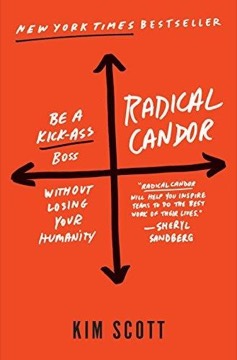
Radical Candor
Kim Scott's framework for management feedback, built on two axes — caring personally and challenging directly — and on the observation that most managers fail by doing the first without the second.
- First published
- 2017
- Publisher
- St. Martin's Press
- Pages
- 297
- Shelf
- Leadership
- Level
- Entry
- ISBN-13
- 9781509845385
Record checked against
Catalogue note
- Reads as
- PracticalWritten to be applied, not only understood.
- Level
- Accessible / FoundationalNo prior reading assumed.
- Approach
- Practical
- Written for
- Managers, Newcomers to the subject
Saved in this browser only — no account, nothing sent anywhere. My library
Read this if
- You keep fixing symptoms and want to see the structure producing them.
- You are responsible for other people's work as well as your own.
- You want to be understood the first time.
- You want something to apply, not only something to think about.
- You are starting from scratch here and want a way in that assumes no prior reading.
The two axes
Scott's model plots feedback on two dimensions. Care Personally means treating someone as a whole person rather than as a function. Challenge Directly means saying the difficult thing clearly.
Doing both is Radical Candor. The three failure quadrants are the useful part: Ruinous Empathy (care without challenge), Obnoxious Aggression (challenge without care), and Manipulative Insincerity (neither).
Two axes, four quadrants. The one most managers live in is the one that feels kindest.
Devmark’s reading — not a quotation from the book
Ruinous Empathy is the common failure
Scott's central claim is that the dominant management failure is not harshness but its opposite: withholding criticism to avoid discomfort, and calling that kindness.
Her argument is that the withholding is usually for the manager's benefit rather than the recipient's, and that its cost falls entirely on the person who is not being told — who continues, sometimes for years, and eventually learns the truth in a much worse way.
What the framework is not
Scott has spent considerable effort correcting a misreading, and it is worth stating first. Radical Candor is not licence to be blunt, and it is not measured by how it feels to deliver.
Her stated test is that it is measured at the listener's ear, not the speaker's mouth: if it did not land as caring, it was not radical candor regardless of the intent behind it. The most common misuse of the book is invoking it to justify something that landed as obnoxious aggression.
Guidance that works
Her practical rules are specific. Give praise and criticism in public and private respectively, with the caveat that individuals differ and should be asked. Be humble — describe what you observed and its effect rather than diagnosing the person. Help immediately rather than saving it for a review. Criticise in private, and quickly.
Her HIP acronym — Humble, Helpful, Immediate, and delivered In person where possible — is a usable checklist.
Soliciting before giving
The book's most valuable sequencing argument: a manager should get feedback before giving it, because a team that has never seen criticism accepted will not believe criticism is safe to offer.
Her recommended technique is a single default question asked repeatedly — something like "what could I do or stop doing that would make it easier to work with me?" — followed by embracing the discomfort of silence rather than filling it, and then visibly acting on whatever is said.
Get feedback before you give it. A team that has never watched you take it will not believe it is safe to give.
Devmark’s reading — not a quotation from the book
Rock stars and superstars
Scott's distinction between people on a steep growth trajectory who want advancement, and people on a stable trajectory who are excellent and do not want to move.
Her point is that both are valuable and that management systems systematically punish the second by treating every good performer as needing promotion. Naming the category is what makes it possible to reward someone for excellent, stable, unambitious work.
Get Stuff Done
Her operating cycle: listen, clarify, debate, decide, persuade, execute, learn. The stage most organisations skip is *persuade* — treating a decision as complete once made, rather than as requiring the people who will execute it to be brought along.
The cycle overlaps substantially with older management writing, and this is the least distinctive part of the book.
Where it is limited
The evidence is the author's experience at a small number of large technology companies, generalised confidently. There is no research base, and the examples come from an environment with high mobility, high salaries and considerable individual leverage.
The framework also assumes a degree of psychological safety and job security that many workplaces do not provide. Direct challenge from a position of precarity is a very different act, and the book does not engage with that asymmetry.
The power question
The deeper unaddressed issue is that the two axes read differently depending on who is speaking. A manager's direct challenge to a report and a report's to their manager carry different risk, and identical behaviour is received differently depending on the speaker's position and identity.
Scott has addressed some of this in later work. The original book largely treats candor as symmetric, which it is not.
What to take from it
Two things, and they are genuinely useful. The quadrant model gives a team shared language for diagnosing a feedback culture, and Ruinous Empathy in particular names something most people recognise instantly and had no word for.
And the sequencing instruction — solicit before you give, then visibly act on what you hear — is the single most reliable way to make the rest of it possible.
What to take away
- 01The kind-seeming failure is the common oneWithholding criticism to avoid discomfort is for the manager's benefit, and the cost falls on the other person.
- 02It is measured at the listener's earIf it did not land as caring, it was not candor, whatever the intent was.
- 03Solicit before you giveNobody believes criticism is safe to offer until they have watched you take some.
- 04Reward excellent people who do not want promotionSystems that treat every strong performer as needing advancement punish stability.
- 05Candor is not symmetricDirect challenge carries different risk depending on who is speaking, and the original framework assumes it does not.