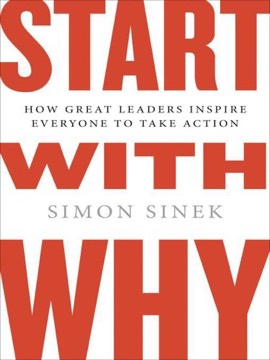
Start with Why
Simon Sinek's argument that organisations which can articulate why they exist — their purpose, not their product — inspire loyalty that competitors matching them on features cannot, and that most communication runs this order backwards.
- First published
- 2009
- Publisher
- Portfolio
- Pages
- 247
- Shelf
- Leadership
- Level
- Entry
- ISBN-13
- 9781514246764
Record checked against
Two sources agreed on 2009; a third reported differently (openlibrary 2009, wikidata 2011, wikipedia 2009).
Catalogue note
- Reads as
- PracticalWritten to be applied, not only understood.
- Level
- Accessible / FoundationalNo prior reading assumed.
- Approach
- Practical
- Written for
- Managers, Newcomers to the subject
Saved in this browser only — no account, nothing sent anywhere. My library
Read this if
- You are asking what you should be doing with your working life.
- You want to understand what makes people willing to follow a decision.
- You want to be understood the first time.
- You want something to apply, not only something to think about.
- You are starting from scratch here and want a way in that assumes no prior reading.
The core idea
Sinek's model is three concentric rings: What an organisation does, How it does it, and Why it exists. Most communicate from the outside in — here is the product, here is what makes it better, please buy it.
His claim is that organisations able to communicate from the inside out generate a different kind of response: agreement with a belief rather than evaluation of a feature. His formulation is that people do not buy what you do, they buy why you do it.
Most organisations lead with what they make. The argument is that this is the least interesting thing about them.
Devmark’s reading — not a quotation from the book
The Why is not a goal
An important clarification the book makes and most summaries lose. Why is not making money, which Sinek treats as a result rather than a purpose, and it is not an aspiration for the future.
It is a cause or belief that already exists and explains why the organisation got started at all. This makes Why archaeological rather than inventive — something found by looking backwards, not decided in a workshop.
The biological claim
Sinek supports the model by mapping the three rings onto brain structure: What corresponds to the neocortex, which handles language and analysis, while How and Why correspond to the limbic system, which governs feeling and decision but has no language capacity.
This is the book's weakest link and should be flagged clearly. It is a considerable oversimplification of how the brain works, and the model does not depend on it — the communication argument stands or falls on its own, and the neuroscience adds authority it has not earned.
The law of diffusion of innovations
Sinek borrows Rogers's adoption curve and argues that a Why is what reaches innovators and early adopters — people who buy on belief before there is evidence — and that the early majority follows them rather than the marketing.
This is the most practically useful section. The implication is that trying to persuade the majority directly is the wrong move, and that the work is to give the first fifteen per cent something to believe.
The Celery Test
His clearest decision-making tool. If your Why is known, then evaluating an opportunity is a filtering question rather than a judgement call: does this belong in the basket given what we say we are?
The value is that it makes inconsistency visible from outside. An organisation whose actions do not match its stated Why is legible to everyone watching, and the test simply asks it to notice.
Clarity, discipline, consistency
Sinek's operational requirement is that Why must be clear, that How must be disciplined into actual principles rather than adjectives, and that What must be consistent with both.
His point about How is the one most often skipped: values expressed as adjectives — integrity, innovation — are unusable, because nobody claims the opposite. Values expressed as verbs give an instruction, and only instructions can be followed or broken.
A value that is an adjective cannot be acted on. Nobody has ever claimed to value dishonesty.
Devmark’s reading — not a quotation from the book
The split, and succession
The later part of the book examines what happens when an organisation's Why becomes separated from its founder, arguing that this is the moment companies begin to drift into competing on What.
His argument that succession is fundamentally about transferring a cause rather than a job is the book's most substantive organisational observation, and it is the part most applicable to established companies rather than startups.
Where it is weak
Several things. The evidence is a small set of much-retold cases, selected because they fit, with no counter-examples of organisations that had a clear Why and failed — and there are many.
The neuroscience is unsound. The argument is also close to unfalsifiable: a successful company can always be described retrospectively as having had a clear Why, and an unsuccessful one as having lost it.
And the book is repetitive. The core argument is delivered in the first quarter and then restated.
Where it gets misused
The commonest misuse is producing a Why in a branding exercise and treating the resulting sentence as the work. Sinek's model requires the belief to already be true of the organisation; a manufactured one is discoverable and worse than none.
The second is applying it to a category where customers genuinely are choosing on specification and price, and where a purpose statement is noise.
What survives
Two things, and they are worth having. The first is the ordering observation: most organisations lead with the least distinctive thing they have, because it is the easiest to describe.
The second is the discipline about values as verbs. Both are useful regardless of whether you accept the surrounding model, and both can be applied the same afternoon — which is not true of most of what the book asserts.
What to take away
- 01Lead with the belief, not the specificationThe product is the least distinctive thing most organisations have and the first thing they describe.
- 02Why is found, not inventedIt explains why the organisation started. Manufacturing one in a workshop produces something detectable.
- 03Values must be verbsNobody claims to value dishonesty, so 'integrity' instructs nobody. An action can be followed or broken.
- 04Aim at the first fifteen per centThe early majority follows early adopters rather than marketing, so belief reaches them indirectly.
- 05Ignore the neuroscienceThe brain-structure claim is unsound and the communication argument does not need it.