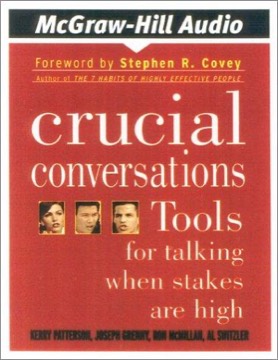
Crucial Conversations
Tools for Talking When Stakes are High
Kerry Patterson and colleagues' method for conversations where stakes are high, opinions differ and emotions are strong — built on the argument that people default to silence or violence precisely when dialogue matters most.
- First published
- 2001
- Publisher
- McGraw-Hill Companies, The
- Pages
- 272
- Shelf
- Leadership
- Level
- Core
- ISBN-13
- 9781260474183
Record checked against
Catalogue note
- Reads as
- PracticalWritten to be applied, not only understood.
- Level
- Core / BuildingAssumes general familiarity with the subject.
- Approach
- Practical
- Written for
- Managers, Readers with some grounding
Saved in this browser only — no account, nothing sent anywhere. My library
Read this if
- You want to be understood the first time.
- You want to get to an agreement without treating the other side as an obstacle.
- You want something to apply, not only something to think about.
- You know roughly how the subject works and want the fuller account.
What makes a conversation crucial
Their definition has three conditions: opposing opinions, strong emotions, and high stakes. When all three are present, people reliably perform worse than their ordinary capability.
Their observation is that the conversations most determining of outcomes are precisely the ones people handle worst, and that the failure is predictable enough to be trained against.
The conversations that decide the most are the ones people handle worst, reliably and predictably.
Devmark’s reading — not a quotation from the book
Silence and violence
Their names for the two failure modes. Silence includes masking, sidestepping and withdrawing. Violence includes controlling, labelling and attacking.
Their point is that both are attempts to manage the same discomfort, and that most people have a characteristic default under stress that they do not recognise as a choice.
The pool of shared meaning
Their central metaphor: dialogue is the free flow of meaning into a shared pool, and the quality of any decision depends on how much relevant information got into it.
The mechanism this explains is why decisions made without dialogue require so much re-litigation afterwards — the information that was withheld does not disappear, it surfaces later as resistance.
Start with heart
Their first discipline: before speaking, clarify what you actually want — for yourself, for the other person, and for the relationship.
Their most useful device is the question of what you would do differently if you genuinely wanted all three, which reliably exposes that the conversation as planned was aimed at winning rather than resolving.
Make it safe
Their central practical insight: when people move to silence or violence, the cause is almost always that they no longer feel safe, and the remedy is to restore safety rather than to press the content.
Their mechanism — step out of the conversation, rebuild safety, step back in — is counter-intuitive under pressure and is the skill the book is really teaching.
When someone goes quiet or aggressive, stop talking about the content and repair the safety. Then return.
Devmark’s reading — not a quotation from the book
Contrasting
Their specific repair technique: state what you do not intend, then what you do. "I don't want you to think I'm questioning your commitment. I do want to talk about the deadline."
It works because most safety failures come from a misreading of intent, and contrasting addresses the misreading directly without retreating from the substance.
Master my stories
Their treatment of the gap between observation and interpretation: we see something, tell ourselves a story about it, and feel an emotion about the story rather than about the facts.
Their three common stories — victim, villain, helpless — are recognisable and their counter-question, what am I pretending not to know about my own role, is the sharpest thing in the book.
STATE and AMPP
Their acronyms for speaking and listening. STATE: share facts, tell your story, ask for others' paths, talk tentatively, encourage testing. AMPP for listening: ask, mirror, paraphrase, prime.
The facts-first ordering is the most useful element — beginning with the interpretation rather than the observation is what makes a conversation defensive from the first sentence.
Where it is limited
The evidence is the authors' consulting practice rather than controlled research, and the effectiveness claims are assertions.
The method also assumes a degree of mutual good faith and comparable power. In a genuinely coercive relationship, or with someone acting in bad faith, the techniques address the wrong problem and the book says little about recognising that case.
What to take from it
The safety-before-content rule, which is the most reliable single intervention available in a difficult conversation and the one most people have exactly backwards — pressing harder on the substance at the precise moment the other person has stopped being able to hear it.
And the facts-before-story discipline, which changes the first sentence of a hard conversation and therefore usually changes the whole of it, because the opening sentence determines whether what follows is a conversation or a defence.
What to take away
- 01Silence and violence are the same moveBoth are attempts to manage discomfort, and most people have a default they do not recognise as a choice.
- 02Withheld information resurfaces as resistanceIt does not disappear; it comes back after the decision, which is why so much gets re-litigated.
- 03Repair safety before continuingWhen someone withdraws or attacks, stop pressing the content. This is the skill the book is actually teaching.
- 04Contrast the misread intentSay what you do not mean, then what you do. Most safety failures are misreadings of intention.
- 05Facts before the storyOpening with your interpretation rather than your observation makes the conversation defensive immediately.