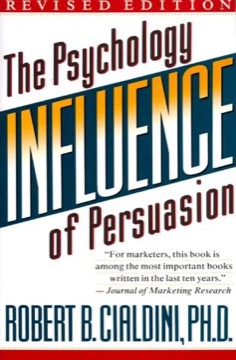
Influence
Robert Cialdini's study of compliance — why people say yes — built from three years spent inside sales, fundraising and advertising operations, and organised around a small set of psychological principles that professional persuaders had discovered long before psychologists formalised them.
- First published
- 1983
- Publisher
- Longman
- Pages
- 287
- Shelf
- Mind
- Level
- Core
- ISBN-13
- 9781886746763
Record checked against
Catalogue note
- Reads as
- FoundationThe standard first book on its subject.
- Level
- Core / BuildingAssumes general familiarity with the subject.
- Approach
- Balanced
- Written for
- Curious general readers, Readers with some grounding
Saved in this browser only — no account, nothing sent anywhere. My library
Read this if
- You want to be understood the first time.
- You want evidence about why people behave as they do, not folklore.
- You want the book people are sent to first on this subject.
- You know roughly how the subject works and want the fuller account.
The core idea
Cialdini's framing is that people cannot deliberate over every decision, so they rely on shortcuts that are usually reliable. Compliance professionals succeed by triggering those shortcuts, which produces a response appropriate to a situation that is not the actual situation.
He calls these click-whirr responses: fixed patterns that fire on a single cue. The book's purpose is partly descriptive and explicitly partly defensive — teaching readers to notice when a shortcut is being triggered artificially.
The shortcuts are usually right. Persuasion professionals make a living from the exceptions.
Devmark’s reading — not a quotation from the book
Reciprocation
The obligation to return a favour is close to universal across cultures, and Cialdini's observation is that it is uninvited-favour-proof: the debt is felt even when the gift was unwanted.
It also licenses unequal exchange, because the recipient wants to discharge the discomfort. The rejection-then-retreat sequence — an unreasonable request followed by a smaller one — works by presenting the concession as a favour that must be reciprocated.
Commitment and consistency
Once a position is taken, particularly in public and particularly in writing, people work to remain consistent with it — including by generating new reasons that were not present when the commitment was made.
The foot-in-the-door technique exploits this with a trivial initial agreement. Cialdini's sharpest example is the low-ball: securing a decision on favourable terms, then removing the advantage, and finding the decision survives because it has grown its own supports.
Social proof
People determine correct behaviour by observing what others do, and the effect strengthens under uncertainty and similarity. Cialdini's uncomfortable demonstration is bystander behaviour in emergencies, where everyone's inaction is read by everyone else as evidence that nothing is wrong.
The practical defence he offers is specific: in an emergency, remove the ambiguity by addressing one identifiable person directly, which reassigns the responsibility that the crowd diffused.
Liking
People say yes to people they like, and liking is manufacturable through physical attractiveness, similarity, compliments, familiarity through repeated contact, and association with something already pleasant.
Cialdini's warning here is unusually practical: since liking is the principle most easily produced artificially, the useful defence is not to resist it but to notice when you have come to like someone unusually quickly, and to separate that feeling from the offer on the table.
Do not try to resist liking someone. Notice when it arrived faster than it should have.
Devmark’s reading — not a quotation from the book
Authority
Deference to authority is efficient and largely rational, which is why the symbols of authority work on their own. Titles, clothing and trappings produce compliance in the absence of any actual expertise, because the cue is easier to read than the credential.
The recommended defences are two questions: is this authority genuinely an expert in this matter, and how truthful can this expert be expected to be given what they stand to gain?
Scarcity
Opportunities become more desirable as availability falls, driven partly by a heuristic that scarce things are valuable and partly by reactance — resistance to having a freedom removed.
Cialdini notes the effect is strongest when scarcity is newly imposed and when it results from competition with others. His defensive advice is to treat the surge of arousal as a signal to pause, and to ask whether you want the thing or want to win it.
Unity, the seventh principle
Later editions add unity: the persuasive power of shared identity, where the other party is not merely similar to you but of you — family, region, team, category.
Cialdini argues this is categorically different from liking because it operates on the boundary of the self rather than on affection. It is also the principle most visible in contemporary political persuasion, which makes its late arrival in the book slightly awkward.
How the evidence has held up
This is worth stating plainly. The core principles are supported by large literatures and have broadly held. Some specific studies the book cites — particularly in the social proof and priming areas — come from research programmes that the replication debates have since put under pressure.
The revised editions address some of this. A reader should hold the principles with reasonable confidence and individual studies more loosely, which is roughly how Cialdini now presents them himself.
How to use it honestly
The book is dual-use and Cialdini knows it. His own stated position is that the principles should be deployed only where they are genuinely present — highlighting real scarcity, real social proof, real expertise — and that manufacturing them is both unethical and, over time, self-defeating.
The most valuable reading is defensive. Named, these patterns become noticeable, and noticing is most of the remedy.
What to take away
- 01Shortcuts are the attack surfaceCompliance professionals do not defeat reasoning; they trigger the heuristics that replace it.
- 02Unwanted gifts still create debtReciprocation fires whether or not the favour was asked for, which is what makes it exploitable.
- 03Commitments grow their own supportsA decision, once made publicly, generates new justifications that outlive the original reason.
- 04Watch the speed of likingLiking arriving unusually fast is the signal, not the liking itself.
- 05Scarcity produces arousal, not judgementAsk whether you want the thing or want to win it — they feel identical in the moment.