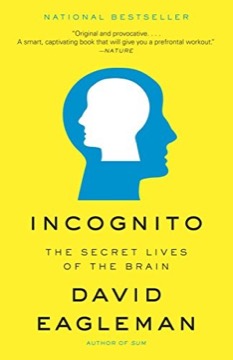
Incognito
David Eagleman's tour of the unconscious brain from a neuroscientist's perspective — how much runs without you, what happens when the machinery is damaged, and what this implies for responsibility and law.
- First published
- 2011
- Publisher
- Canongate Books
- Pages
- 304
- Shelf
- Mind
- Level
- Entry
- ISBN-13
- 9780857860477
Record checked against
Catalogue note
- Reads as
- ConceptualExplains how something works before what to do about it.
- Level
- Accessible / FoundationalNo prior reading assumed.
- Approach
- Theoretical
- Written for
- Curious general readers, Newcomers to the subject
- Ideas
Saved in this browser only — no account, nothing sent anywhere. My library
Read this if
- You are curious what is actually happening in the brain.
- You want to understand how it works before deciding what to do about it.
- You are starting from scratch here and want a way in that assumes no prior reading.
You are not the one driving
Eagleman's opening claim: the conscious mind has access to a tiny fraction of brain activity and is frequently the last to know what has been decided.
His framing is that consciousness is like a newspaper executive receiving summaries of operations they neither observe nor control — a metaphor that does real work in setting expectations for the rest of the book.
Consciousness receives a summary of decisions it did not observe and could not have attended.
Devmark’s reading — not a quotation from the book
The team of rivals
His central model, and his most useful contribution: the brain is not a single system but a collection of competing subsystems that arrive at different conclusions and negotiate an output.
This explains internal conflict without mysticism — wanting and not wanting the same thing simultaneously is not a paradox but a description of several circuits producing different answers.
Perception is a prediction
His treatment of vision as largely internally generated, with sensory input acting as a correction to an ongoing model rather than as the primary source.
The illustration that stays with readers is the sheer volume of processing required for the visual experience to feel effortless and instantaneous, and the extent to which what you see is assembled rather than received.
Expertise as unconscious competence
His account of skill acquisition: learning moves circuitry from conscious control to automatic execution, which is why experts frequently cannot explain what they do.
His examples from sport and music make the practical point — asking an expert to attend consciously to an automated skill degrades it, which is the mechanism behind performance anxiety.
When the machinery breaks
The book's most compelling material, drawn from neurology: what specific damage does to personality, decision-making and moral behaviour.
The cases are chosen to make a philosophical point — that behaviour we would attribute to character can be altered by a tumour, a medication, or a lesion, which unsettles the intuition that a person and their brain are separable things.
Culpability
His most consequential chapter, and the reason the book is cited outside neuroscience. If behaviour emerges from brain states the person did not choose, the question of blameworthiness becomes considerably harder.
His proposal is a forward-looking legal framework focused on modifiability and risk rather than on desert — and he is careful that this does not mean abandoning constraint, only changing its justification.
The question stops being whether they deserve it and becomes whether the behaviour can be changed.
Devmark’s reading — not a quotation from the book
Where he overstates
Eagleman is a vivid writer and the book's confidence sometimes outruns the evidence, particularly in the chapters linking specific neural findings to broad claims about selfhood.
Some of the neurolaw material is also more contested among legal scholars and philosophers than the book acknowledges — the inference from determinism to a particular legal framework is not as direct as presented.
The free will question
He takes a compatibilist-adjacent position: whether or not free will exists in a metaphysical sense, the practical questions concern how brains can be changed and how society should respond.
This is more measured than Sapolsky's later hard determinism, and readers interested in the argument would do well to read both, since they reach overlapping practical conclusions from different philosophical commitments.
How it reads
Fast, vivid and well structured, with a talent for the arresting example. It is considerably shorter and more accessible than *Behave* and covers some of the same ground with less rigour and more momentum.
It is a good first book on the unconscious brain and a poor last one — the depth is not there, deliberately.
What to take from it
The team-of-rivals model is genuinely useful for making sense of one's own inconsistency, and it removes the need to explain internal conflict as a failure of character.
And the culpability argument, which is worth sitting with whether or not you accept the conclusion, because the intuition it challenges is one most people have never examined.
What to take away
- 01The brain is a team of rivalsCompeting subsystems producing different answers, which makes internal conflict a description rather than a paradox.
- 02Perception corrects a modelSensory input adjusts an ongoing internal prediction rather than building the experience from scratch.
- 03Expertise is automationWhich is why experts cannot explain what they do, and why conscious attention degrades an automated skill.
- 04Character can be altered by a lesionThe cases unsettle the intuition that a person and their brain are separable things.
- 05Shift culpability to modifiabilityHis proposal changes the justification for constraint rather than removing it.