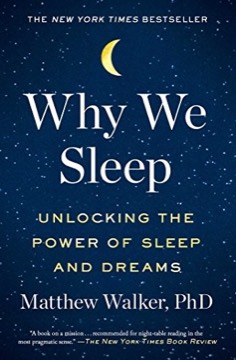
Why We Sleep
Matthew Walker's survey of sleep research, arguing that sleep is not a passive gap between days but an active biological process underpinning memory, learning, emotional regulation, metabolism and immune function — and that modern societies are chronically short of it.
- First published
- 2017
- Publisher
- Allen Lane (UK)
- Pages
- 360
- Shelf
- Mind
- Level
- Entry
- ISBN-13
- 9780141983776
Record checked against
Catalogue note
- Reads as
- ConceptualExplains how something works before what to do about it.
- Level
- Accessible / FoundationalNo prior reading assumed.
- Approach
- Theoretical
- Written for
- Curious general readers, Newcomers to the subject
Saved in this browser only — no account, nothing sent anywhere. My library
Read this if
- You are curious what is actually happening in the brain.
- You want to understand living things by how they came to be.
- You want to understand how it works before deciding what to do about it.
- You are starting from scratch here and want a way in that assumes no prior reading.
The core argument
Walker's claim is that sleep is not a state the body tolerates but one it depends on, and that the range of functions it supports is far wider than most people assume — consolidating memory, regulating emotion, clearing metabolic waste from the brain, and maintaining immune and endocrine function.
His polemical conclusion is that societies have normalised a level of sleep deprivation that would not be tolerated in any other health domain.
Sleep is not the absence of activity. It is a distinct biological process with its own work to do.
Devmark’s reading — not a quotation from the book
The two systems that set timing
Two independent mechanisms determine when you feel sleepy. The circadian rhythm is an internal roughly twenty-four-hour clock, entrained primarily by light. Sleep pressure is the accumulation of adenosine, which builds throughout waking and is cleared by sleep.
Their independence explains several familiar experiences — the afternoon dip, the second wind late at night, and why jet lag is a mismatch rather than simple tiredness.
Caffeine, alcohol and what they actually do
Walker's account here is the most immediately useful. Caffeine does not supply energy; it blocks adenosine receptors, masking accumulated pressure that is still accumulating — which is why the crash arrives when it clears.
His treatment of alcohol is more pointed: it is a sedative rather than a sleep aid, fragments sleep, and substantially suppresses REM. The general point is that several things people use to manage sleep degrade its structure while preserving its duration.
NREM, REM and what each does
Deep NREM sleep is associated with transferring memories into longer-term storage and with the physical restoration functions. REM is associated with integrating new material with existing knowledge, with emotional processing, and with dreaming.
Their distribution across the night is uneven — NREM dominates early, REM dominates late — which supports one of the book's more consequential claims: cutting sleep short at either end removes a different function, so a shortened night is not a proportionally smaller one.
Learning and memory
Walker presents sleep as serving learning twice: before, to prepare the capacity to absorb new material, and after, to consolidate it.
This is the research area closest to his own work and the material is handled with more nuance than elsewhere in the book. The practical implication — that sleep after study is part of the studying — is well supported and widely under-applied.
Where the book has been seriously challenged
This must be stated clearly. In 2019 the sleep researcher Alexey Guzey published a detailed critique identifying factual errors, a misrepresented graph, and claims stated with more confidence than the underlying evidence supports. Several points were substantive, and some were acknowledged.
Other researchers have noted that the book's most alarming assertions — on mortality, on specific disease risks, on the strength of causal claims — outrun what the literature establishes, and that correlation is at times presented as causation.
The central claim is well supported. Several of the book's most alarming specifics are not, and have been documented.
Devmark’s reading — not a quotation from the book
How to hold it
The reasonable position is that the core message is sound and the presentation is over-confident. That sleep matters far more than popular culture assumes, that it is an active process, and that chronic restriction carries real costs are all well supported.
The specific numbers, the strongest causal claims and the most dramatic comparisons should be treated as contested. This is a book to read for the argument and to check before citing.
The practical guidance
The sleep hygiene advice is conventional and mostly well evidenced: a consistent schedule including weekends; a cool, dark room; limiting caffeine after early afternoon; avoiding alcohol as a sleep aid; getting morning light; and leaving the bed if unable to sleep so the association is not degraded.
Walker is also clear that sleeping pills largely produce sedation rather than sleep, and that cognitive behavioural therapy for insomnia has better evidence than medication — which is the most actionable thing in the book.
On the societal argument
The later chapters extend to school start times, working hours, medical residency and transport safety. This is the book's most polemical material and also where it is on firmer ground than its critics sometimes allow — the case on adolescent school start times in particular is supported by multiple trials.
Whether the policy conclusions follow as cleanly as presented is a separate question the book does not really engage.
What to take from it
Treat sleep as a scheduled input rather than the residual left over after everything else. Protect consistency of timing more than total duration. Understand what caffeine and alcohol are actually doing rather than what they feel like they are doing.
And read the critique alongside it. A book worth taking seriously is worth checking, and this one rewards the check.
What to take away
- 01Two systems, not oneCircadian timing and adenosine pressure are independent, which is why the afternoon dip and the second wind both exist.
- 02Caffeine masks, it does not supplyBlocking the receptor does not stop the pressure accumulating, which is what the crash is.
- 03A short night is not a proportional oneNREM front-loads and REM back-loads, so cutting either end removes a different function entirely.
- 04Sleep after study is part of studyingConsolidation is a distinct process, and the best-supported practical finding in the book.
- 05Check it before citing itThe core claim holds; several documented specifics outrun the evidence and have been publicly disputed.