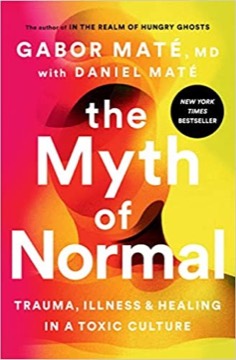
The Myth of Normal
Gabor Maté's argument that much chronic physical and mental illness in wealthy societies is a predictable response to a culture that damages people, not an individual malfunction.
- First published
- 2022
- Publisher
- Avery
- Pages
- 560
- Shelf
- Mind
- Level
- Core
- ISBN-13
- 9780735278363
Record checked against
Only one source carried a publication date for this work, so the year is uncorroborated.
Catalogue note
- Reads as
- ConceptualExplains how something works before what to do about it.
- Level
- Core / BuildingAssumes general familiarity with the subject.
- Approach
- Theoretical
- Written for
- Curious general readers, Readers with some grounding
Saved in this browser only — no account, nothing sent anywhere. My library
Read this if
- You want evidence about why people behave as they do, not folklore.
- You want to understand living things by how they came to be.
- You want to understand how it works before deciding what to do about it.
- You know roughly how the subject works and want the fuller account.
The argument
Maté, a physician with decades in addiction medicine, contends that what counts as normal in industrialised societies — chronic stress, suppressed emotion, isolation, insecure work — is itself pathological, and that the resulting illness is therefore adaptive rather than aberrant.
He draws heavily on trauma, defined broadly as what happens inside a person as a result of what happened to them, and on the interaction of stress with immune function.
His reframe: the illness is a normal response to abnormal conditions, not an abnormal response to normal ones.
Devmark’s reading — not a quotation from the book
What it covers
The book moves from childhood development and attachment through autoimmunity, addiction, ADHD, the medical system's own culture, and the politics of a society Maté considers structurally traumatising.
His account of addiction as an attempt at self-regulation rather than a disease of choice, developed over years in Vancouver's Downtown Eastside, is the most grounded section.
The contested parts
The claim that personality and suppressed emotion contribute causally to autoimmune disease and cancer is the most disputed, and the evidence Maté cites is weaker than his confidence implies. Critics have noted this risks implying patients contributed to their illness.
Maté explicitly rejects blame, but the tension is real. Read the addiction and trauma material as strong and the disease-causation chapters as a hypothesis presented too firmly.
The addiction chapters are grounded in decades of practice; the cancer chapters are not.
Devmark’s reading — not a quotation from the book
Trauma redefined
Maté's working definition is the book's hinge: trauma is not the event but the internal wound and the adaptation built around it, which means it is not confined to catastrophe. This widening is what lets him bring ordinary childhood conditions — emotional unavailability, chronic stress, the absence of attunement — into the same frame as violence, and it is also what critics say makes the category too large to do useful work.
Attachment against authenticity
The developmental claim underneath everything else is a forced choice: a child who cannot be both accepted and themselves will choose acceptance, because attachment is a survival requirement and authenticity is not. The suppression that follows is adaptive at five and costly at forty, and Maté treats it as the common root of much of what arrives later in a clinic.
A child who must choose between being loved and being themselves will choose being loved. Every time.
Devmark’s reading — not a quotation from the book
Addiction as a solution
His long experience in addiction medicine produces the book's most confident material. The reframe is to stop asking why the addiction and start asking what the pain was, treating the substance or behaviour as an effective short-term regulator of an unbearable internal state. It reorients treatment away from control and toward what the regulation was for.
The disease claims
The most contested argument extends this to physical illness: that chronic emotional suppression contributes causally to autoimmune conditions and some cancers. The stress-immunity literature supports a relationship in general terms; it does not support the specific and confident causal claims Maté makes about particular diseases and personality styles, and clinicians have objected sharply. Readers with such a diagnosis should be aware this section risks implying a responsibility the evidence does not establish.
Medicine's own blindness
Maté turns the analysis onto his profession: a training that separates mind from body by curriculum design, a system that rewards throughput, and a workforce whose own conditions produce the detachment patients experience as coldness. This is among the book's strongest passages because it is describing something he has been inside for decades.
The political turn
The later chapters widen from the clinic to the culture — work, inequality, consumption, the conditions of birth and early childhood — and argue that a society producing these outcomes at scale should be examined rather than its casualties. It is a coherent extension of the argument and it is where the book stops being clinical and becomes a polemic.
What to take from it
Take the reframe and leave the certainty. The questions Maté trains a reader to ask — what was this adaptation for, and what did it cost — are genuinely useful, and the account of addiction is the work of someone who has done it for decades. Treat the causal claims about specific physical diseases as the author's conviction rather than established fact.
What to take away
- 01Normal is the problemThe baseline conditions are treated as the pathology.
- 02Trauma defined broadlyWhat happened inside you, not only what happened to you.
- 03Addiction as self-regulationDeveloped over years of clinical work, and the book's strongest section.
- 04Medicine's own cultureThe training and conditions of doctors treated as part of the subject.
- 05Overstated on diseaseThe autoimmunity and cancer causation claims outrun their evidence.