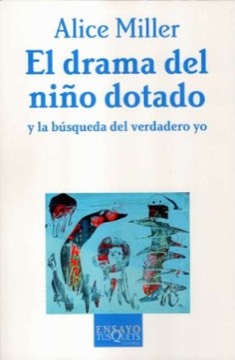
The Drama of the Gifted Child
Alice Miller's short, influential book about children who become exquisitely attuned to a parent's needs, are praised for it, and lose access to their own feelings in the process.
- First published
- 1981
- Publisher
- Basic Books
- Pages
- 155
- Shelf
- Mind
- Level
- Core
- ISBN-13
- 9780786743612
Record checked against
Only one source carried a publication date for this work, so the year is uncorroborated.
Catalogue note
- Reads as
- ConceptualExplains how something works before what to do about it.
- Level
- Core / BuildingAssumes general familiarity with the subject.
- Approach
- Theoretical
- Written for
- Curious general readers, Readers with some grounding
- Ideas
Saved in this browser only — no account, nothing sent anywhere. My library
Read this if
- You want evidence about why people behave as they do, not folklore.
- You want a life told honestly, at full length.
- You want to understand how it works before deciding what to do about it.
- You know roughly how the subject works and want the fuller account.
The argument
Miller's gifted child is not academically able but emotionally perceptive: a child who senses what a parent requires and supplies it, because the parent's own needs were never met and the child is the available resource.
The cost is that the child's genuine feelings — particularly anger and need — become unavailable, since expressing them threatened the only love on offer. The adult then presents with depression or grandiosity, which Miller treats as two faces of the same adaptation.
The child who was praised for being no trouble usually paid for it somewhere the praise did not reach.
Devmark’s reading — not a quotation from the book
Grandiosity and depression
Her central pairing: grandiosity is the state of being admired for the false self and sustaining it; depression is what arrives when the performance fails or is no longer required.
Both, on her account, are the same condition — the absence of an accessible true self — approached from opposite directions.
Her break with psychoanalysis
Miller was a practising analyst who left the profession over this material. Her objection was that analysis treated patients' accounts of childhood mistreatment as fantasy, following Freud's abandonment of the seduction theory, and thereby repeated the original denial.
That argument is the reason the book mattered: it insisted that what happened actually happened.
Her quarrel with her own profession was that it treated remembered mistreatment as fantasy.
Devmark’s reading — not a quotation from the book
How to read it
Very short, written in a declarative register with little hedging and almost no empirical apparatus. It reads as assertion, and readers who need evidence will find it frustrating.
Its influence on later trauma and attachment literature is substantial, and much of what it claims has since been investigated more rigorously by others. Treat it as an origin text rather than a current account.
What gifted means here
The title misleads almost every new reader. Miller's gifted child has no special ability except perceptiveness: an unusual capacity to read a parent's emotional state and supply what it requires. The gift is adaptive, it is rewarded, and her claim is that it is purchased by putting the child's own feelings out of reach — including out of the child's own reach.
Three essays, one argument
The book is short and built in three movements: the making of the attuned child, the adult pairing of grandiosity and depression that results, and the mechanism by which contempt is transmitted downward to the next generation. Each restates the same structure at a different stage of a life, which is why the book feels more like a single sustained claim than a set of chapters.
Contempt travels downwards
Her account of cruelty is developmental rather than moral: a person who was not allowed their own humiliation discharges it onto someone with less power, most conveniently a child, and experiences it as discipline. It is the part of the book with the widest reach, and it underwrites her later work on the cultural approval of harsh child-rearing.
The humiliation is not felt. It is passed on, and it is called discipline.
Devmark’s reading — not a quotation from the book
The witness
Against an otherwise bleak account she sets one protective factor: a single person, at any point, who registers what happened and does not deny it. Miller attaches considerable weight to this — not therapy necessarily, but the existence of someone who confirms the reality — and it is the closest the book comes to a prescription.
Her break with Freud
Miller was a practising psychoanalyst who left the profession over this material. Her objection was that the discipline had systematically converted real childhood mistreatment into the child's fantasy, and that the conversion served the adults. Her later books press the charge much harder; this one contains it in compressed form.
The complication of her own life
Her son has since written publicly about his childhood, describing a mother whose parenting did not resemble her books. That is a genuine and documented complication rather than gossip: it does not refute the argument, but it is relevant to a body of work whose authority rests substantially on its claim to have seen clearly.
What to take from it
Read it for the mechanism — the conversion of a child's attentiveness into a self they cannot access — which is described more precisely here than almost anywhere. Read it aware that it is assertion rather than evidence, written in a declarative register with no hedging, and that it is easiest to misapply to one's own history in exactly the flattering direction.
What to take away
- 01The attuned childEmotional perceptiveness developed to meet a parent's need.
- 02The false selfMaintained because the genuine one was not survivable.
- 03Two facesGrandiosity and depression as one adaptation from opposite sides.
- 04It actually happenedHer break with analysis over treating mistreatment as fantasy.
- 05Assertion, not evidenceAn origin text; the empirical work came later and from others.