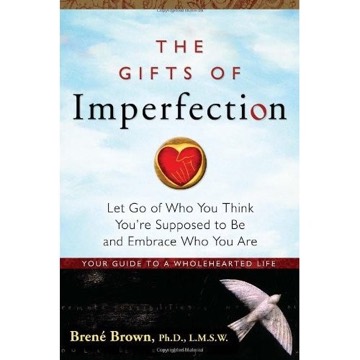
The Gifts of Imperfection
Brené Brown's short book on what she calls wholehearted living, drawn from her qualitative research on shame and vulnerability. Ten guideposts, each pairing something to cultivate with something to let go of.
- First published
- 2010
- Publisher
- not established
- Pages
- 202
- Shelf
- Mind
- Level
- Entry
- ISBN-13
- 9780593133583
Record checked against
Only one source carried a publication date for this work, so the year is uncorroborated.
Catalogue note
- Reads as
- PracticalWritten to be applied, not only understood.
- Level
- Accessible / FoundationalNo prior reading assumed.
- Approach
- Practical
- Written for
- Curious general readers, Newcomers to the subject
- Ideas
Saved in this browser only — no account, nothing sent anywhere. My library
Read this if
- You want evidence about why people behave as they do, not folklore.
- You want something to apply, not only something to think about.
- You are starting from scratch here and want a way in that assumes no prior reading.
Where it comes from
Brown is a social work researcher who spent years coding interviews about shame. She found a subgroup who described a strong sense of worthiness and set out to identify what they had in common.
The answer she reports is not achievement or circumstance but a set of practices: self-compassion, boundaries, permission to rest, and a willingness to be seen without guarantee.
The people who felt worthy were not the ones who had earned more. They were the ones who had stopped trying to.
Devmark’s reading — not a quotation from the book
The structure
Ten guideposts, each framed as a trade: cultivate authenticity, let go of what people think; cultivate self-compassion, let go of perfectionism; cultivate rest and play, let go of exhaustion as a status symbol.
The chapters are short and largely independent, which makes the book usable in pieces rather than as an argument that builds.
Its claims and its evidence
Brown's method is grounded theory — qualitative coding of interviews — and the book reports themes rather than measured effects. That is a legitimate research tradition and it is not the same as experimental evidence, which matters when reading confident statements about what causes what.
Her definition of shame as the fear of disconnection, distinct from guilt, is the most durable contribution and is broadly consistent with the wider literature.
Guilt is about what you did; shame is about what you are. The distinction does most of the work.
Devmark’s reading — not a quotation from the book
Shame and guilt are not the same
Brown's most durable distinction: guilt evaluates behaviour, shame evaluates the self. "I did something bad" leaves a route to repair; "I am bad" does not, and she reports that shame correlates with the behaviours people assume it prevents rather than with their absence. It is the finding most of her later work is built on.
Worthiness is not an achievement
The book's central claim is that the people who reported living wholeheartedly did not first earn the right to and then relax; they had decided worthiness was a starting condition. Everything in the ten guideposts follows from that reversal, and it is the reason the book resists being read as a programme of improvement.
Nobody in her interviews arrived at worthiness by achieving it. They began from it.
Devmark’s reading — not a quotation from the book
Foreboding joy
One of her more original observations is that many people flinch at good things — rehearsing disaster during a happy moment as a form of insurance. Her interviewees who did not do this were not more fortunate; they practised gratitude deliberately, which she presents as a learnable behaviour rather than a temperament.
Exhaustion as a status symbol
The guidepost on play and rest names something most productivity writing does not: that tiredness functions socially as evidence of worth, and that treating output as identity makes rest feel like a moral failure. The chapter is short and is frequently the one readers report recognising themselves in most sharply.
What grounded theory can show
Brown's method is qualitative coding of a large interview corpus, which is a legitimate research tradition and does a specific job: it generates categories and hypotheses from what people actually said. What it does not do is establish cause, effect size, or that the pattern generalises beyond the sample — and the book's confident register does not always convey that.
Where the register grates
The tone is warm, first-person and studded with affirmations, and readers who want the research will find it thin on the page even where it exists behind the writing. Her interview base also skews toward a particular demographic, which shapes what wholehearted living is taken to look like.
What to take from it
The shame-guilt distinction is worth the book on its own and transfers directly to how you speak to children, colleagues and yourself. The ten guideposts are best read as prompts for noticing rather than as a programme, and the book is short enough that taking two of them seriously is a better use than completing all ten.
What to take away
- 01Shame versus guiltGuilt attaches to behaviour, shame to the self; the difference is the book's foundation.
- 02Worthiness is not earnedHer interviewees stopped trying to qualify for it.
- 03Ten tradesEach guidepost pairs something to cultivate with something to release.
- 04Exhaustion as statusRest is treated as a practice rather than a reward.
- 05Qualitative researchGrounded theory reports themes; it is not experimental evidence.