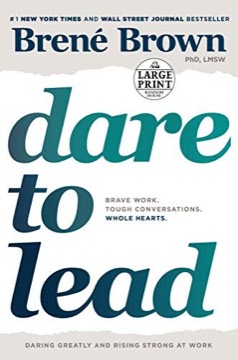
Dare to Lead
Brené Brown's application of her research on vulnerability and shame to workplace leadership — arguing that avoiding difficult conversations is the central leadership failure and that courage is a set of teachable skills rather than a trait.
- First published
- 2018
- Publisher
- Ebury Publishing
- Pages
- 320
- Shelf
- Leadership
- Level
- Entry
- ISBN-13
- 9781785042140
Record checked against
Catalogue note
- Reads as
- PracticalWritten to be applied, not only understood.
- Level
- Accessible / FoundationalNo prior reading assumed.
- Approach
- Practical
- Written for
- Managers, Newcomers to the subject
Saved in this browser only — no account, nothing sent anywhere. My library
Read this if
- You want to get to an agreement without treating the other side as an obstacle.
- You want to understand what makes people willing to follow a decision.
- You want something to apply, not only something to think about.
- You are starting from scratch here and want a way in that assumes no prior reading.
The central claim
Brown's position is that daring leadership requires the willingness to be vulnerable — to have hard conversations, to admit not knowing, to give and receive honest feedback, and to be seen getting things wrong.
Her definition of vulnerability is specific and often misunderstood: the uncertainty, risk and emotional exposure that accompany anything that matters. It is not disclosure, and it is not weakness.
Vulnerability is uncertainty, risk and emotional exposure. It is not disclosure, and the confusion is the main obstacle.
Devmark’s reading — not a quotation from the book
Armoured leadership
Her catalogue of protective behaviours: perfectionism, cynicism, numbing, knowing rather than learning, being a knower rather than a curious person, and using power over rather than power with.
Her diagnostic framing is useful because these behaviours are usually read as strength — the decisive leader who always has an answer is armoured, and the armour is what prevents the organisation telling them anything.
Rumbling with vulnerability
Her term for the difficult conversation, and her practical scaffolding for it: naming what you are observing, stating what you are making up about it, and asking directly.
Her phrase "the story I'm telling myself is..." is the single most adopted practical device from the book, because it separates observation from interpretation in a way that does not accuse.
Shame in organisations
Her distinction between guilt — I did something bad — and shame — I am bad — and her argument that shame is widespread in workplaces and universally destructive.
Her claim is that shame is used as a management tool more often than anyone would admit, through public criticism, comparison, and perfectionism, and that it reliably produces concealment rather than improvement.
Clear is kind
Her most quoted line and one of her most useful: unclear is unkind. Vague feedback, avoided conversations and unspoken expectations are kinder to the person delivering them and harm the person receiving them.
Her argument is that the discomfort of directness is paid once by the manager, while the cost of ambiguity is paid repeatedly by the person who does not know where they stand.
Clear is kind. Vagueness is comfortable for the person delivering it and expensive for the person receiving it.
Devmark’s reading — not a quotation from the book
Living into values
Her practice of identifying two core values — not a list of ten — and then naming the specific behaviours that operationalise them.
The insistence on two is the useful constraint, and the behavioural specification is what distinguishes this from the values exercise most organisations run and forget.
Braving trust
Her acronym for the components of trust: boundaries, reliability, accountability, the vault, integrity, non-judgement and generosity.
Its value is that it makes an abstract judgement discussable. Rather than "I don't trust them", a conversation can identify which specific component is missing, which is actionable in a way the general statement is not.
Where the evidence is contested
Brown's work is grounded in grounded-theory qualitative research, which generates rich descriptive categories and does not establish causal claims.
The leadership applications in this book go further than the research supports — the claim that vulnerability-based practices produce better organisational outcomes is plausible and is not demonstrated here.
The register
Warm, personal, heavy on anecdote and coined vocabulary. Readers who find this style welcoming get a great deal from it; readers who want precision find the acronyms and neologisms tiring.
It is also long for its content, and the workbook-style exercises make it feel more like a programme than a book, which suits some readers and not others.
What to take from it
"The story I'm telling myself is..." is worth the book on its own, because it makes it possible to raise an interpretation without asserting it as a fact.
And "clear is kind", applied as a check on your own avoidance: the conversation you are postponing is almost certainly costing the other person more than it would cost you.
What to take away
- 01Vulnerability is exposure, not disclosureUncertainty and risk in things that matter — the confusion with oversharing is the main obstacle to using it.
- 02Armour reads as strengthCertainty, perfectionism and having every answer are protective behaviours that stop anyone telling you anything.
- 03Say the story you are telling yourselfIt separates observation from interpretation and lets you raise something without accusing anyone.
- 04Unclear is unkindThe discomfort of directness is paid once by you; ambiguity is paid repeatedly by them.
- 05Two values, with behavioursA list of ten is decoration. Two, with the specific behaviours that operationalise them, is usable.