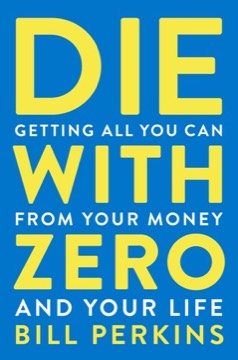
Die with Zero
Bill Perkins's argument that optimising for maximum wealth at death is a mistake, and that the goal should be maximum life experience across the years when you can still have it.
- First published
- 2020
- Publisher
- Houghton Mifflin Harcourt and Blackstone Publishing
- Pages
- 240
- Shelf
- Money
- Level
- Entry
- ISBN-13
- 9780358310280
Record checked against
Only one source carried a publication date for this work, so the year is uncorroborated.
Catalogue note
- Reads as
- PracticalWritten to be applied, not only understood.
- Level
- Accessible / FoundationalNo prior reading assumed.
- Approach
- Practical
- Written for
- Investors and savers, Newcomers to the subject
Saved in this browser only — no account, nothing sent anywhere. My library
Read this if
- You want to think clearly about risk before you think about returns.
- You have to choose what not to do, and want a way to think about it.
- You want something to apply, not only something to think about.
- You are starting from scratch here and want a way in that assumes no prior reading.
The argument
Perkins, a hedge fund manager, starts from an observation: most people who save diligently die with substantial unspent money, which represents hours of their life worked for nothing.
His counter-proposal is to treat experiences as investments that pay a "memory dividend" over time, and to spend deliberately during the decades when health permits the experience rather than deferring indefinitely.
Money unspent at death is hours of life you worked for and did not use.
Devmark’s reading — not a quotation from the book
Time-bucketing
His practical device is dividing remaining life into decades and asking what must happen in each, on the grounds that many experiences have a window: some things cannot be done at seventy that can at thirty.
He is explicit that health, not money, is the binding constraint for most people in later life, and that the standard savings pattern optimises for the period when the ability to use money is lowest.
Most retirement plans concentrate money in the decade you are least able to spend it well.
Devmark’s reading — not a quotation from the book
On inheritance and giving
The sharpest chapter argues that leaving money at death is bad timing: heirs typically receive it in their sixties, when it has least effect, and that giving earlier is strictly better if the intention is to help.
The same argument applies to charitable giving, and Perkins pushes it further than most readers expect.
Where to be careful
The book assumes a reader with surplus income and reasonable security, and its advice is genuinely risky for anyone without it. Perkins addresses longevity risk through annuities but treats it lightly.
Read it as a corrective to over-saving rather than as a plan, and note that the failure modes in the two directions are not symmetrical.
The memory dividend
Perkins's central construct is that an experience pays out twice: once when it happens, and repeatedly afterwards in recollection and in the retelling. The consequence is that experiences bought earlier have longer to compound, which inverts the usual advice to defer — a delayed trip is not the same trip taken later, it is a smaller total return.
The net worth peak
He argues that everyone has an age at which continuing to accumulate makes them worse off, and that almost nobody identifies it, so the curve keeps rising until death. His prescription is to locate that point deliberately and begin spending down afterwards, treating the decision as a calculation rather than a feeling.
There is an age after which more money buys less life. Almost nobody works out where theirs is.
Devmark’s reading — not a quotation from the book
Your personal interest rate
The book's most uncomfortable chapter observes that the capacity to enjoy most experiences declines with age at a rate that outpaces investment returns. Health, not money, becomes the binding constraint, and a great many things postponed to retirement are not available by then at any price.
Giving at the right time
His argument on inheritance is about timing rather than generosity: money arriving in a beneficiary's sixties, when their own position is settled, does far less than the same sum in their late twenties or thirties. He makes the same case for charitable giving — that delaying it to death delays the benefit for no reason other than the donor's comfort.
The objection he does answer
Running out of money is the obvious risk in a book called this, and Perkins addresses it with annuitisation: converting part of the pile into guaranteed lifetime income removes the uncertainty the hoarding was insuring against. It is a reasonable answer and it is given less space than the objection warrants.
The objection he does not
Long-term care is the gap. In systems where late-life care is privately funded, a large late expense is not a remote tail risk but a common outcome, and the book's framework does not seriously accommodate it. Combined with the assumption of surplus income throughout, this limits who the argument is actually for.
What to take from it
Its useful work is on sequencing rather than quantity: match spending to the decades in which each thing is still possible, front-load what deteriorates, and give while you can see it. Readers without surplus should take the time-bucket exercise, which costs nothing, and disregard the drawdown arithmetic.
What to take away
- 01The memory dividendExperiences treated as assets that pay out in recall over decades.
- 02Time-bucketingRemaining life divided by decade, with windows for each experience.
- 03Health is the constraintNot money, for most people, in the years they saved for.
- 04Give earlierInheritance at sixty is poor timing if the intention is help.
- 05Assumes securityGenuinely risky advice for a reader without surplus.