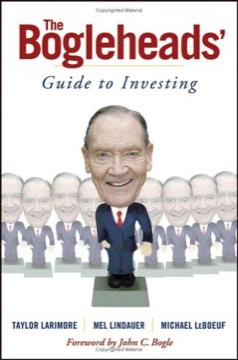
The Bogleheads' Guide to Investing
Taylor Larimore, Mel Lindauer and Michael LeBoeuf's practical manual for the investing approach developed by Vanguard founder John Bogle: low-cost index funds, held indefinitely, in a simple allocation.
- First published
- 2006
- Publisher
- Wiley
- Pages
- 307
- Shelf
- Money
- Level
- Entry
- ISBN-13
- 9780471730330
Record checked against
Only one source carried a publication date for this work, so the year is uncorroborated.
Catalogue note
- Reads as
- PracticalWritten to be applied, not only understood.
- Level
- Accessible / FoundationalNo prior reading assumed.
- Approach
- Practical
- Written for
- Investors and savers, Newcomers to the subject
- Ideas
Saved in this browser only — no account, nothing sent anywhere. My library
Read this if
- You want to think clearly about risk before you think about returns.
- You want something to apply, not only something to think about.
- You are starting from scratch here and want a way in that assumes no prior reading.
The approach
The Bogleheads position is that costs compound as reliably as returns do, that active management does not beat the market net of fees with any persistence, and that the correct response is to own the market cheaply and stop trading.
The recommended structure is a three-fund portfolio — domestic stocks, international stocks and bonds — rebalanced occasionally and otherwise left alone.
Own the whole market at the lowest available cost and then do nothing, deliberately, for decades.
Devmark’s reading — not a quotation from the book
What the book adds
Unlike most index-investing arguments, this one is written as a manual: how to open accounts, how to prioritise tax-advantaged space, how to choose an allocation by age and temperament, and how to handle inheritance and insurance.
It came out of the Bogleheads forum, which means the questions it answers are the ones real investors actually asked rather than the ones an author imagined.
What to know
US-specific throughout on account types and tax treatment, which is a substantial part of the content.
It is deliberately unexciting. The authors' position is that investing should be boring and that anything interesting about it is usually a cost. That is the strongest argument in the book and the hardest to act on.
The whole method is designed to be boring, on the grounds that interest is usually a fee in disguise.
Devmark’s reading — not a quotation from the book
The behavioural core
The technical content could fit in a pamphlet, and the authors know it. Most of the book's length goes to the harder problem, which is not knowing what to do but continuing to do it.
The chapters on market declines, on the urge to act during one, and on why performance-chasing is the most expensive common mistake are where the value sits. The strategy is trivially simple and extremely difficult, and the book is honest that those are not in tension.
Who the Bogleheads are
The book comes from an online community formed around the principles of the founder of Vanguard, written by long-standing forum members rather than by professionals selling anything. That origin matters: there is no product attached, and the absence of a commercial interest is the main reason the advice is as plain as it is.
Costs are the one certainty
The central argument is arithmetic rather than predictive: nobody knows what returns will be, but fees are known in advance and compound against the investor on exactly the curve returns compound for them. Over decades the difference between a low-cost and a typical managed fund is a large fraction of the final sum.
You cannot know the return. You can know the fee, and it compounds the same way.
Devmark’s reading — not a quotation from the book
The three-fund portfolio
The community's best-known recommendation is a portfolio of exactly three holdings: one total domestic stock fund, one total international stock fund and one total bond fund, rebalanced occasionally to the chosen proportions. Its appeal is that it is broadly diversified, extremely cheap to hold, requires almost no ongoing decisions, and is very difficult to mismanage during a market panic.
Asset location
A genuinely technical section covers which holdings belong in taxed and tax-advantaged accounts, since bonds and funds with high turnover generate taxable events that shelter poorly. It is the sort of detail that introductory books routinely omit, and getting it right is worth real money over a long horizon.
What they say about advisers
The book is direct about commission-based advice, about products sold as investments that are primarily insurance, and about the difference between a fiduciary and a salesperson. It does not argue that nobody needs an adviser, only that most people should know what they are paying and for what.
The dull part is the point
The strategy is designed to be boring, and the book says so: no timing, no stock selection, no reaction to news, and no expectation of beating anything. Its argument is that almost all investor underperformance comes from activity, and the discipline being taught is inactivity.
What to take away
- 01Costs compoundFees are the one variable an investor reliably controls.
- 02The three-fund portfolioDomestic stocks, international stocks, bonds — and nothing else.
- 03Written from a forumAnswers the questions real investors asked, not invented ones.
- 04Tax-advantaged space firstOrder of operations, explained concretely.
- 05Boring by designInterest in a portfolio is usually a cost wearing a disguise.