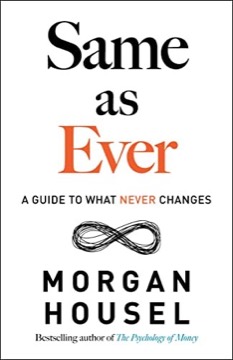
Same as Ever
Morgan Housel's short essays on what does not change: the behavioural patterns that recur across every era of markets, risk and expectation, regardless of technology.
- First published
- 2023
- Publisher
- Harriman House Publishing
- Pages
- 256
- Shelf
- Money
- Level
- Entry
- ISBN-13
- 9781804090633
Record checked against
Catalogue note
- Reads as
- StrategicAbout choosing between options under uncertainty.
- Level
- Accessible / FoundationalNo prior reading assumed.
- Approach
- Applied
- Written for
- Investors and savers, Newcomers to the subject
Saved in this browser only — no account, nothing sent anywhere. My library
Read this if
- You want to change what you do repeatedly, not just what you intend.
- You want to think clearly about risk before you think about returns.
- You make things, and want to understand the work rather than wait for inspiration.
- You are weighing options and want a way to think about the trade-offs.
- You are starting from scratch here and want a way in that assumes no prior reading.
The premise
Housel's argument is that forecasting what will change is nearly impossible and that forecasting what will stay the same is comparatively easy, because human behaviour under uncertainty is stable.
The book is twenty-three short chapters, each on one such constant: that risk is what you do not see, that expectations move faster than circumstances, that calm plants the seeds of crazy.
You cannot forecast what will change. You can forecast what will not, and that is most of it.
Devmark’s reading — not a quotation from the book
The strongest chapters
The one on risk being what remains after you have thought of everything, and the one on the gap between wealth and expectation, are the two most readers return to.
His treatment of how quickly the unthinkable becomes normal, and how completely people forget the previous normal, is the most historically grounded.
How it compares
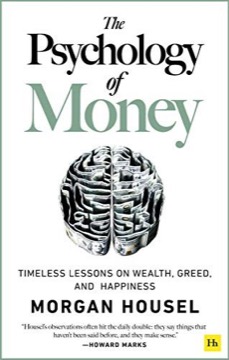
It is the companion to The Psychology of Money, which is already in this library, and is slighter: shorter chapters, less argument, closer to a collection than a book.
If you found the earlier one useful this extends it. If you have read neither, start with The Psychology of Money, which is the more complete statement.
The companion to his earlier book, and the less essential of the two.
Devmark’s reading — not a quotation from the book
What kind of book it is
Housel writes in aphorism and anecdote rather than in evidence, and the history is illustrative rather than demonstrative.
Its value is as a set of reminders, read slowly, rather than as an argument that builds toward anything.
Housel is a genuinely good writer of short prose, and the chapters work individually. What they do not do is accumulate, so reading it straight through produces less than reading it a chapter at a time.
Risk is the part you did not list
Housel's sharpest chapter argues that risk is by definition what remains after you have accounted for everything you thought of, and that the events which actually cause damage are the ones absent from the model. The practical consequence is to build slack for unspecified failure rather than better forecasts of specified ones.
Risk is what is left over after you have thought of everything. That is the whole definition.
Devmark’s reading — not a quotation from the book
Calm plants the seeds of crazy
He restates a well-known economic argument in plain terms: stability encourages the behaviour that ends stability, because a long quiet period makes leverage look safe and caution look expensive. The instability is therefore not an interruption of the calm but its product, which is why the pattern recurs rather than being learned from.
Expectations against circumstances
A recurring thread holds that happiness tracks the gap between conditions and what was anticipated rather than conditions themselves, which explains why material improvement so reliably fails to register. His example is generational: circumstances that would have been unimaginable prosperity two generations earlier are experienced as ordinary or as falling short.
Stress as the driver
Several chapters argue that the largest advances arrive under duress rather than in comfortable conditions, because urgency removes the objections that normally prevent action. It is an uncomfortable observation delivered without enthusiasm — he is not recommending crisis, only noting what the record shows about when things actually change.
Inefficiency as resilience
His argument against optimisation is that a system with no slack has no capacity to absorb anything unplanned, and that the removed inefficiency was frequently doing that job invisibly. He applies it to careers and schedules as well as to organisations, which is where it is most immediately usable.
The best story wins
He is direct that persuasion tracks narrative quality rather than evidential quality, that this applies to markets and politics equally, and that it is not fixable. The implication he draws is defensive: assume the most compelling account you encounter is compelling for reasons unrelated to its accuracy.
Bad news is sudden, good news is slow
One chapter accounts for the permanent sense that things are deteriorating: catastrophes happen on a timescale that fits a headline, while improvements accumulate over decades and are therefore never news on any particular day. The asymmetry is in the reporting cadence rather than in the world, and it means a well-informed person can hold a systematically pessimistic picture while every individual fact they know is accurate.
Disasters arrive on a schedule the news can carry. Progress does not.
Devmark’s reading — not a quotation from the book
What to take away
- 01Forecast the constantsWhat stays the same is predictable; what changes is not.
- 02Risk is the unseenWhat remains after you have listed everything you thought of.
- 03Expectations outrun circumstancesThe gap, not the level, determines how things feel.
- 04The unthinkable normalisesAnd the previous normal is forgotten completely.
- 05Read the other one firstThe Psychology of Money is the fuller statement.