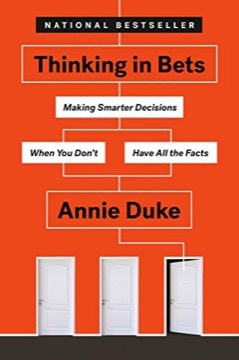
Thinking in Bets
Making Smarter Decisions When You Don't Have All the Facts
Annie Duke, a former professional poker player with a background in cognitive psychology, argues that most decisions are bets on uncertain outcomes — and that the habit of judging a decision by how it turned out is the single most expensive error people make.
- First published
- 2019
- Publisher
- Portfolio/Penguin
- Pages
- 276
- Shelf
- Money
- Level
- Entry
- ISBN-13
- 9786052314142
Record checked against
Only one source carried a publication date for this work, so the year is uncorroborated.
Catalogue note
- Reads as
- StrategicAbout choosing between options under uncertainty.
- Level
- Accessible / FoundationalNo prior reading assumed.
- Approach
- Applied
- Written for
- Investors and savers, Newcomers to the subject
Saved in this browser only — no account, nothing sent anywhere. My library
Read this if
- You want to decide better when the information is incomplete.
- You want to think clearly about risk before you think about returns.
- You are weighing options and want a way to think about the trade-offs.
- You are starting from scratch here and want a way in that assumes no prior reading.
Resulting
Duke's central term, borrowed from poker, names the error of evaluating the quality of a decision by the quality of its outcome.
Because outcomes are produced by decision quality *and* luck, a good decision can lose and a bad one can win. Judging backwards from the result therefore teaches the wrong lesson roughly as often as the right one, which makes experience an unreliable teacher without a correction.
A good decision can lose and a bad one can win. Grading yourself on outcomes teaches the wrong lesson.
Devmark’s reading — not a quotation from the book
Every decision is a bet
Duke reframes decisions as bets against alternative futures, whether or not money is involved. The frame does real work because it forces two questions that are otherwise skipped: how sure am I, and what am I risking?
It also reframes disagreement productively. Asking someone to state odds, or offering to bet, converts a confident assertion into a calibrated one — and people's confidence moves noticeably when they have to price it.
Two things, not one
Her decomposition is that outcomes come from decision quality and luck, and that almost all self-assessment collapses the two.
The asymmetry she identifies is self-serving: we attribute our wins to skill and our losses to luck, and reverse the attribution for other people. This is well established in the psychological literature and it quietly corrupts every lesson drawn from experience.
The truthseeking pod
Duke's most practical proposal is social. Because individual reasoning is motivated, she recommends forming a small group with an explicit charter: focus on accuracy over confirmation, take accountability for the reasoning rather than the result, and be open to divergent views.
Her rules for such a group are specific — express uncertainty in numbers, separate the decision from the outcome when reviewing, and avoid giving the result before asking for the assessment, since knowing it contaminates the judgement.
Beliefs form before vetting
Duke summarises research suggesting that we do not hear a claim and then evaluate it; we accept it on hearing and evaluate only if we bother.
The consequence is that beliefs arrive pre-installed and are then defended, and that motivated reasoning is not a failure of intelligence — smarter people are often better at it, because they are better at constructing justifications.
Temporal discounting and mental time travel
Her techniques for counteracting present bias are the most usable part of the book. The 10-10-10 question — how will I feel about this in ten minutes, ten months, ten years — brings the future self into a present decision.
She also recommends backcasting from an imagined success and premortem from an imagined failure, arguing that running both gives a more honest distribution of outcomes than either on its own.
Imagine it worked and ask why. Then imagine it failed and ask why. Doing only the first is planning; doing both is thinking.
Devmark’s reading — not a quotation from the book
Scenario planning over point prediction
Rather than predicting what will happen, Duke advocates enumerating what could happen and assigning rough probabilities — a habit that makes surprise less likely and makes the eventual outcome easier to learn from.
The related discipline is keeping a decision record: writing down the reasoning and the estimate at the time, so later review is against what you actually thought rather than what you now remember thinking.
Where it is limited
The poker frame, while genuinely illuminating, has boundaries Duke acknowledges less often than she might. Poker has known probabilities, rapid feedback, and repeated play — three conditions most consequential decisions lack entirely.
The book is also lighter on evidence than its confident tone suggests, and several psychological findings are reported without much qualification.
Where it gets misread
"Thinking in bets" is sometimes taken as an argument for more risk-taking. It is closer to the opposite: the frame is for calibrating confidence, and most of the techniques reduce the chance of acting on a belief that has not been examined.
It is also not an argument that outcomes do not matter. Duke's point is narrower — that a single outcome is weak evidence about a decision, and that patterns across many are much stronger.
What to take from it
Three habits transfer immediately. Separate decision quality from outcome when reviewing anything. State confidence as a number rather than a word. Write down your reasoning before you learn the result.
The last is the most underrated. Memory reconstructs prior beliefs to match what happened, so an unrecorded prediction is not available for learning from — which is why so much experience produces so little improvement.
What to take away
- 01Separate the decision from the resultOutcomes mix decision quality with luck; grading on outcomes teaches the wrong lesson about half the time.
- 02Say the numberConfidence expressed as a percentage is testable; confidence expressed as a word is not.
- 03Beliefs install before they are checkedWe accept on hearing and evaluate only if motivated — and cleverness mostly improves the justification.
- 04Run both directionsBackcast from success and premortem from failure; doing only the first is planning, not thinking.
- 05Record the reasoning firstMemory rewrites prior beliefs to match outcomes, so an unrecorded prediction cannot be learned from.