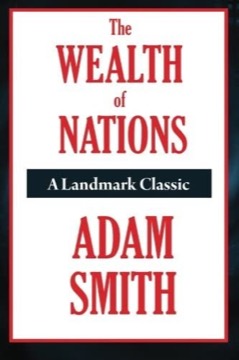
The Wealth of Nations
Adam Smith's 1776 inquiry into what makes nations prosperous — the founding text of economics, and a considerably stranger, more qualified and more morally engaged book than the free-market slogans extracted from it suggest.
- First published
- 1776
- Publisher
- W. Strahan and T. Cadell, London
- Pages
- 581
- Shelf
- Money
- Level
- Deep
- ISBN-13
- 9781432625467
Record checked against
Catalogue note
- Reads as
- ConceptualExplains how something works before what to do about it.
- Level
- Advanced / AdvancedAssumes you have read around the subject already.
- Approach
- Theoretical
- Written for
- Investors and savers, Specialists and serious readers
- Ideas
Saved in this browser only — no account, nothing sent anywhere. My library
Read this if
- You want to see the incentives underneath the headlines.
- You want to examine an assumption you have never examined.
- You want to understand how it works before deciding what to do about it.
- You have read around this already and want a book that assumes it.
What the book actually argues
Smith's question is why some nations grow rich, and his answer is productivity: the amount a society produces per worker, driven above all by the division of labour.
The famous pin factory opens the book for that reason. His point is not about factories but about specialisation — that dividing a task among workers multiplies output far beyond what the same people could achieve individually.
The subject is productivity, not markets. Markets appear as the mechanism that lets specialisation happen.
Devmark’s reading — not a quotation from the book
Division of labour and its limit
His crucial qualification, usually dropped from summaries: the division of labour is limited by the extent of the market. Specialisation is only possible where there are enough buyers to absorb the output.
This is why he cares about trade, transport and the size of markets — not as ends but as the conditions under which productivity can rise.
The invisible hand, in context
The phrase appears once in this book and is doing narrower work than its reputation. Smith's point is that a merchant preferring domestic to foreign investment, for reasons of his own security, may promote a public benefit he did not intend.
It is an observation about an unintended consequence in a specific case, not a general theory that markets always produce optimal outcomes. Smith would have rejected that reading, and much of the book documents cases where self-interest produces harm.
His actual view of merchants
Worth stating because it inverts the popular image. Smith is consistently suspicious of businessmen, warning that people of the same trade seldom meet without the conversation ending in a conspiracy against the public.
His argument for competition is precisely a distrust of sellers: competition is valuable because it constrains merchants, who will collude and seek privileges from government whenever they can.
He argues for competition because he distrusts merchants, not because he trusts them.
Devmark’s reading — not a quotation from the book
Labour, value and wages
His labour theory of value — that the real price of a thing is the toil of acquiring it — is foundational and was substantially revised by later economists.
His treatment of wages is more humane than expected: he argues that a society cannot be flourishing while the majority of its members are poor and miserable, and defends high wages as both just and productive.
The critique of mercantilism
A large and now under-read portion of the book attacks the prevailing system: trade restrictions, monopoly charters, colonial exclusivity, and the confusion of money with wealth.
His argument is that these arrangements serve the merchants who lobbied for them at the expense of consumers, and that a nation's wealth is its productive capacity rather than its stock of bullion.
The proper role of government
Another passage that surprises readers expecting doctrine. Smith assigns the state defence, justice, and the provision of public works and institutions that are valuable but unprofitable for individuals.
He explicitly includes public education, argues for it partly to offset the mental deterioration he thought repetitive specialised labour caused, and supports progressive taxation on the grounds that contribution should be proportional to ability.
The Theory of Moral Sentiments
Smith's other book, published seventeen years earlier and treated by him as part of the same project, argues that human behaviour is governed substantially by sympathy and the desire for the approval of an impartial spectator.
Reading *Wealth of Nations* without it produces the caricature. The so-called Adam Smith Problem — the apparent tension between the two — is largely an artefact of reading one and not the other.
How to actually read it
It is over nine hundred pages, digressive, and contains extended material on grain prices, silver, and the history of European agriculture that even specialists skim.
Book I on the division of labour and Book IV on mercantilism carry most of what a general reader wants. A good abridgement is a legitimate choice here, and the introductions in modern scholarly editions do real work.
What it is and is not
It is not a defence of business interests, not a theory of perfect markets, and not an argument against government. It is an argument against a specific system of privileges, in favour of productivity, made by a moral philosopher.
Both sides of the modern political argument quote it selectively. Reading it directly is the fastest way to notice how little either quotation resembles the book.
What to take away
- 01Wealth is productive capacityNot bullion, not trade surplus. The argument against mercantilism turns entirely on this.
- 02Specialisation is limited by market sizeThe qualification is always dropped, and it is why Smith cares about trade at all.
- 03Competition constrains sellersHe argues for it out of suspicion of merchants, who he expects to collude given any opportunity.
- 04He assigns the state real workDefence, justice, public works, education — and he argues for taxation proportional to ability.
- 05Read the other book tooThe caricature of Smith survives mainly by ignoring The Theory of Moral Sentiments.