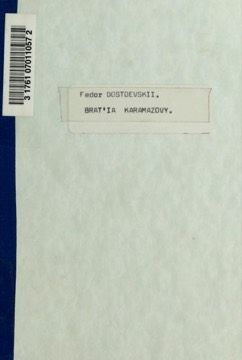
The Brothers Karamazov
Dostoevsky's final novel — a patricide, three brothers who each embody a way of confronting the question of God, and the most sustained argument about faith, suffering and freedom in nineteenth-century fiction.
- First published
- 1879
- Publisher
- The Russian Messenger'' (as serial)
- Pages
- 821
- Shelf
- Fiction
- Level
- Deep
- ISBN-13
- 9781467778084
Record checked against
Catalogue note
- Reads as
- ReflectiveChanges how you see rather than what you do.
- Level
- Advanced / AdvancedAssumes you have read around the subject already.
- Approach
- Theoretical
- Written for
- Readers of literature, Specialists and serious readers
Saved in this browser only — no account, nothing sent anywhere. My library
Read this if
- You read for the writing as much as for the argument.
- You want to examine an assumption you have never examined.
- You want a book that changes how you see things rather than what you do tomorrow.
- You have read around this already and want a book that assumes it.
The premise
Fyodor Karamazov is a dissolute and repellent father with three legitimate sons and a servant widely assumed to be a fourth. He is murdered. One son is charged.
The murder is the frame rather than the subject. Dostoevsky uses the investigation and trial to examine what each brother believes and what their beliefs commit them to when tested.
The murder is the frame. What each brother believes, and what the belief costs when tested, is the subject.
Devmark’s reading — not a quotation from the book
The three brothers
Dmitri is sensual, impulsive, honourable in his own terms and in debt. Ivan is an intellectual who cannot accept a world containing the suffering of children. Alyosha is a novice in a monastery, and the narrator calls him the hero.
The division is schematic and it works because each is fully drawn. They are positions and they are also people, and Dostoevsky does not let the allegory flatten them.
Ivan's rebellion
The novel's most famous argument, delivered to Alyosha in a tavern. Ivan does not deny God's existence; he refuses to accept a world in which children suffer, and returns his ticket to whatever harmony that suffering is supposed to purchase.
His catalogue of atrocities against children is drawn from newspaper reports Dostoevsky collected. The argument is the strongest statement of the problem of evil in any novel, and it is made so well that many readers find the book's answer insufficient.
The Grand Inquisitor
Ivan's invented poem, in which Christ returns during the Inquisition and is arrested by a cardinal who explains why the Church has corrected his work.
The Inquisitor's argument is that people do not want freedom, that they want miracle, mystery and authority, and that removing the burden of choice is a mercy. It is the most serious case against human freedom in literature, and Dostoevsky, who believed the opposite, made it as strong as he could.
He believed the opposite and wrote the case against freedom as powerfully as anyone has. That is the achievement.
Devmark’s reading — not a quotation from the book
Zosima's answer
The elder's teaching, delivered through his biography and final conversations: active love, universal responsibility, the claim that everyone is answerable for everything to everyone.
Dostoevsky wrote to his editor that this section was his response to Ivan, and he was anxious about whether it was adequate. Most readers find it moving and fewer find it a refutation, which is a problem the book's structure acknowledges.
Smerdyakov
The servant, epileptic, resentful, and Ivan's most attentive student.
He is the novel's demonstration of what an idea does when it moves from an intellectual who holds it theoretically to someone who applies it. Ivan's position that without immortality everything is permitted is abstract for Ivan and operational for Smerdyakov, and Ivan's collapse follows from recognising this.
The trial
The final section, in which the legal process assembles a coherent and wrong account from genuine evidence.
Dostoevsky's target is the confidence of modern procedure: the prosecutor and the defence both construct psychologically persuasive narratives, and the novel demonstrates that persuasiveness and truth are different properties.
The boys
The subplot involving Alyosha and a group of schoolboys, particularly the dying Ilyusha, which many first-time readers regard as a digression.
It is the novel's positive argument in practice rather than in doctrine, and the closing scene is deliberately placed to answer Ivan with something other than an argument. Dostoevsky planned a sequel following Alyosha and died before writing it.
Reading it
It is long, the Russian naming conventions are an obstacle, and the structure is digressive by design.
The Pevear and Volokhonsky translation is the most discussed modern version and is closer to Dostoevsky's deliberately awkward Russian; the Garnett and McDuff versions read more smoothly. Choose according to whether you want fluency or texture.
Its standing
It is regularly named among the greatest novels written, and its influence on philosophy — on Nietzsche, on the existentialists, on twentieth-century theology — is larger than its influence on fiction.
Its distinction is that it takes the strongest possible case against its own position and gives it the best writing in the book.
What to take away
- 01Ivan returns the ticketHe does not deny God; he refuses a harmony purchased with the suffering of children.
- 02The best case against freedomDostoevsky believed the opposite and wrote the Inquisitor's argument as strongly as it can be made.
- 03An idea changes when it is appliedWhat is theoretical for Ivan becomes operational for Smerdyakov, and Ivan collapses on recognising it.
- 04Persuasive and true are differentThe trial assembles a coherent, psychologically convincing and wrong account from real evidence.
- 05The answer is a scene, not an argumentThe closing pages respond to Ivan with something other than a counter-argument, deliberately.