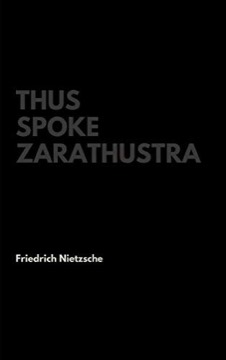
Thus Spoke Zarathustra
Nietzsche's philosophical novel in the register of scripture — the book he considered his most important, in which a prophet descends from a mountain to announce the death of God and the possibility of the overman.
- First published
- 1883
- Publisher
- Ernst Schmeitzner
- Pages
- 283
- Shelf
- Philosophy
- Level
- Deep
- ISBN-13
- 9781512298697
Record checked against
Published in parts: the first in 1883, the fourth in 1885. Sources reporting 1885 are dating the completed work rather than its first appearance.
Catalogue note
- Reads as
- ReflectiveChanges how you see rather than what you do.
- Level
- Advanced / AdvancedAssumes you have read around the subject already.
- Approach
- Theoretical
- Written for
- Reflective readers, Specialists and serious readers
Saved in this browser only — no account, nothing sent anywhere. My library
Read this if
- You read for the writing as much as for the argument.
- You want to examine an assumption you have never examined.
- You want a book that changes how you see things rather than what you do tomorrow.
- You have read around this already and want a book that assumes it.
What kind of book it is
Not a treatise. It is written as a sequence of speeches, parables, songs and encounters, in a deliberately archaic biblical style, following a character through four parts.
Nietzsche called it a book for everyone and no one. Its form is the main obstacle for readers: the arguments are embedded in imagery, the register is elevated throughout, and there is no summary anywhere in it of what it claims.
A book for everyone and no one, in his own description. The form is the first obstacle and it is deliberate.
Devmark’s reading — not a quotation from the book
God is dead
The announcement Zarathustra brings down from the mountain, and the most misunderstood sentence Nietzsche wrote.
It is not a triumphant atheism. It is a diagnosis of a cultural event that has already happened — the collapse of the shared framework that made European values intelligible — and it is delivered as a catastrophe whose consequences have not yet been understood. The question is what replaces the foundation, not whether to celebrate its loss.
The overman
His proposal for what humanity might become: not a biological superior but a person who creates values rather than inheriting them, who affirms this life rather than deferring to another.
His image of man as a rope stretched between animal and overman, over an abyss, is the compressed version. The concept has no political content in the text and the racial reading imposed on it later has no basis in what he wrote.
The three metamorphoses
His opening parable and the book's clearest structure: the spirit becomes a camel, which bears what it is given; then a lion, which destroys the thou shalt; then a child, which creates.
The sequence is the argument in miniature. Destruction of inherited values is necessary and is not sufficient; the lion cannot create, and something further is required. It is the most useful passage for a reader trying to find the book's skeleton.
The last man
His counter-image and his real target: the creature who has invented happiness, takes no risks, seeks comfort, blinks, and asks what is love, what is creation, what is longing.
The crowd to whom Zarathustra offers the overman responds by asking to be given the last man instead. It is the bleakest moment in the book and the most prescient.
Offered the overman, the crowd asks to be given the last man instead. It is the bleakest moment in the book.
Devmark’s reading — not a quotation from the book
Eternal recurrence
His hardest doctrine, presented as a thought that nearly destroys Zarathustra before he can affirm it: that everything you have lived you will live again, innumerable times, in every detail.
Whether he intended it as a cosmological claim or as a test of affirmation is disputed. As a test it is devastating and usable — it asks whether you could will your life exactly as it is, eternally, with nothing removed.
Amor fati and the affirmation
The disposition the book is arguing toward: not resignation to fate but love of it, wanting nothing to be other than it is, forward or backward or in all eternity.
This is the positive content beneath the destruction, and it is what distinguishes Nietzsche from the nihilism he is frequently accused of. He regarded nihilism as the danger, not the conclusion.
Style as substance
The biblical parody is doing philosophical work. By writing a scripture that announces the end of scripture, he makes the form enact the argument about creating values rather than receiving them.
It is also, by wide agreement including some of his admirers, frequently overwrought. The fourth part in particular is uneven, and Nietzsche himself initially circulated it only privately.
Where to start
Not here. Almost every scholar recommends reading *Beyond Good and Evil* or *On the Genealogy of Morals* first, where the same positions are argued rather than sung.
A reader who begins with this book usually extracts slogans, which is precisely how its most famous phrases came to be understood in ways the text does not support.
Its influence
Its effect on twentieth-century literature, psychology and music was enormous, and it reached a far wider audience than any of his argued works.
That reach is also how the distortions spread. The book most responsible for Nietzsche's cultural presence is the one least suited to establishing what he actually claimed.
What to take away
- 01God is dead is a diagnosis, not a boastA shared framework has collapsed and the consequences have not been faced, which is the problem he poses.
- 02Camel, lion, childBearing, then destroying, then creating. The lion cannot create, which is why a third stage is needed.
- 03The last man is the real targetComfortable, riskless, incurious — and the crowd prefers him when offered the alternative.
- 04Eternal recurrence as a testCould you will this life again in every detail, eternally, with nothing removed.
- 05Read the argued books firstBeginning here produces slogans, which is how the famous phrases came to mean what the text does not say.