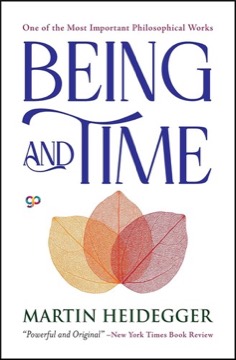
Being and Time
Martin Heidegger's unfinished masterwork on the question of being — an analysis of human existence as being-in-the-world, and one of the most influential and most difficult books in modern philosophy.
- First published
- 1927
- Publisher
- SCM Press
- Pages
- 589
- Shelf
- Philosophy
- Level
- Deep
- ISBN-13
- not established
Record checked against
Catalogue note
- Reads as
- ReflectiveChanges how you see rather than what you do.
- Level
- Advanced / AdvancedAssumes you have read around the subject already.
- Approach
- Theoretical
- Written for
- Reflective readers, Specialists and serious readers
- Ideas
Saved in this browser only — no account, nothing sent anywhere. My library
Read this if
- You want to examine an assumption you have never examined.
- You want a book that changes how you see things rather than what you do tomorrow.
- You have read around this already and want a book that assumes it.
The question it asks
Heidegger opens by claiming that the question of the meaning of being has been forgotten — that philosophy since the Greeks has investigated beings of every kind while taking for granted what it means for anything to be at all.
His route to the question is through the one entity for whom its own being is an issue: us. He calls this entity Dasein, literally being-there, to avoid the assumptions carried by words like subject, consciousness or person.
He calls us Dasein to avoid what 'subject' and 'consciousness' smuggle in. The vocabulary is a deliberate barrier.
Devmark’s reading — not a quotation from the book
Being-in-the-world
His first major move: the subject-object split that has organised philosophy since Descartes is a derived and distorting description. We are not minds confronting an external world; we are already engaged in a world of activities, purposes and relations before any observation occurs.
The hyphenation is doing work. Being-in-the-world is a single phenomenon, not three things joined, and treating it as composite is precisely the error he is diagnosing.
Ready-to-hand and present-at-hand
His most accessible and most borrowed analysis. A hammer in use is not encountered as an object with properties; it withdraws into the activity and is transparent to the user.
It becomes present-at-hand — an object with observable properties — when it breaks, is missing, or gets in the way. His claim is that theoretical detached observation, which philosophy has treated as primary, is actually a deficient mode that arises when engaged coping breaks down. This section has had enormous influence on design and human-computer interaction.
Das Man and inauthenticity
His account of the anonymous they: we do what one does, say what one says, find shocking what one finds shocking. This is not a moral failing but the ordinary condition of social existence and the background against which anything else is possible.
Inauthenticity in his sense is not falseness. It is absorption in the prevailing interpretation, which is where we all start and where we mostly remain.
Anxiety
His distinction between fear, which has a definite object, and anxiety, which does not. In anxiety the world's ordinary significance drains away and nothing in particular is threatening.
His claim is that this is disclosive rather than merely unpleasant: it reveals that the meanings we inhabit are not given by the world, and therefore that we are responsible for how we exist. It is the hinge between the two halves of the book.
Being-toward-death
His most famous analysis. Death is not an event at the end of life but a possibility that structures existence throughout — one's own, certain, indefinite as to when, and not to be outstripped.
His argument is that confronting it rather than fleeing into the they's management of it — one dies, but not yet — individuates a person and makes an authentic existence possible. It is the passage that shaped existentialism, frequently in ways he rejected.
Death is not an event at the end but a possibility that shapes existence throughout, and cannot be delegated.
Devmark’s reading — not a quotation from the book
Care and temporality
His unifying concept: the being of Dasein is care — we are always already thrown into a situation, projecting onto possibilities, and absorbed in the present.
His resolution is that these three structures are the three dimensions of time, and that temporality is the meaning of care. The claim that we are fundamentally temporal rather than existing in time is the book's destination.
What was never written
The published work is a fragment. The planned second half, which would have answered the question of being itself rather than analysing the entity that asks it, was never completed.
This matters for reading it. What exists is preparatory analysis for an argument that does not arrive, which is why the book is so often read as philosophical anthropology despite Heidegger's explicit denials.
The Nazi question
It cannot be omitted. Heidegger joined the Nazi party, served as a university rector under the regime, and his private notebooks published long afterward contain antisemitic material.
The book predates this by several years, and scholars divide over whether its philosophy contains the seeds of the politics or is separable from it. Readers should know the facts and encounter the debate rather than either of the easy positions.
Reading it
It is genuinely hard, and the difficulty is partly unavoidable and partly his own construction: he invents terminology to escape inherited assumptions, and the reader must learn a vocabulary before any argument becomes visible.
Most readers need a companion volume. Hubert Dreyfus's commentary on the first division is the standard English-language route, and the ready-to-hand analysis is the section most useful to readers outside philosophy.
What to take away
- 01The subject-object split is derivedWe are engaged in a world before we observe it, and treating observation as primary is the error.
- 02Tools disappear in useA hammer becomes an object with properties only when it breaks, which reverses philosophy's usual starting point.
- 03Anxiety disclosesIt has no object, and what it reveals is that our meanings are not given by the world.
- 04Death cannot be delegatedIt is one's own, certain and indefinite, and confronting it is what individuates.
- 05The book is half a bookThe section answering the question of being was never written, which is why it reads as anthropology.