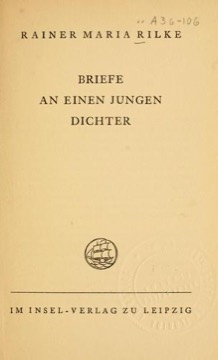
Letters to a Young Poet
Ten letters Rainer Maria Rilke wrote between 1903 and 1908 to a nineteen-year-old military cadet who had asked whether his poems were any good. Published in 1929, after Rilke's death.
- First published
- 1929
- Publisher
- El Cid/Argentina
- Pages
- 101
- Shelf
- Philosophy
- Level
- Entry
- ISBN-13
- 9780679642329
Record checked against
Catalogue note
- Reads as
- ReflectiveChanges how you see rather than what you do.
- Level
- Accessible / FoundationalNo prior reading assumed.
- Approach
- Theoretical
- Written for
- Reflective readers, Newcomers to the subject
- Ideas
Saved in this browser only — no account, nothing sent anywhere. My library
Read this if
- You make things, and want to understand the work rather than wait for inspiration.
- You want a book that changes how you see things rather than what you do tomorrow.
- You are starting from scratch here and want a way in that assumes no prior reading.
What it is
Franz Xaver Kappus sent his verses to Rilke, then twenty-seven, asking for judgement. Rilke declined to give one, on the grounds that nobody outside can tell you whether to write, and then wrote ten letters about how to live if you intend to.
Kappus published them after Rilke died, including only Rilke's side. The absence of the other half is part of the book's effect.
He was asked to grade a young man's poems and answered a different question entirely.
Devmark’s reading — not a quotation from the book
The argument
The first letter contains the instruction the book is known for: go into yourself, find the reason you write, and ask whether you would have to if you were forbidden. Everything else follows from that test.
The rest concerns solitude, which Rilke treats as the working condition of art rather than as a hardship; patience with unresolved questions; and the refusal of irony as a defence against difficulty.
The test he offers is whether you would still have to write if you were forbidden to.
Devmark’s reading — not a quotation from the book
How to read it
It is short, aphoristic and easy to over-quote. The letters are most useful read slowly and in order, because the argument develops rather than repeating.
Rilke was twenty-seven and not yet the poet he became, which is worth holding: this is advice from someone in the middle of the problem, not from the far side of it.
Who Kappus was
The correspondent was a nineteen-year-old at a military academy — the same kind of institution Rilke had been sent to as a boy and had been miserable in, which is why he answered at all. Kappus went on to a military career and a modest writing life, and published the letters decades later, after Rilke's death, with his own side left out.
On solitude
The recurring instruction is to stop looking outward for confirmation, and Rilke means something more demanding than working alone. His claim is that the desire for an audience's verdict corrupts the work at the point of making it, and that the capacity to be unwitnessed is not a hardship of the vocation but its precondition.
On love
The letters on love are the most argued-over. Rilke's position is that most relationships are two people using each other to escape solitude, that this is why they fail, and that the harder alternative is two people who protect each other's aloneness. Read generously it is a serious ethic of attention; read sceptically it is a solitary man theorising about a life he did not successfully live.
Two solitudes that border and protect each other — not one solitude dissolved into another.
Devmark’s reading — not a quotation from the book
On difficulty and sadness
He asks Kappus to treat sadness as information rather than malfunction: the moments when something unfamiliar has entered and has not yet been assimilated, during which the sensible response is patience rather than diagnosis. It is a pre-therapeutic account of distress and is the part of the book that has aged most interestingly.
On not reading criticism
Rilke advises avoiding critical writing almost entirely, on the grounds that it produces either partisan quarrels or a borrowed vocabulary for judging work that should be judged from inside. The same letters warn against irony as a habit — usable as a tool, corrosive as a default stance, and a standard refuge for young writers afraid of being caught meaning something.
Where it is limited
It is one side of a conversation, addressed to a particular anxious young man, by a poet in his twenties who had not yet written the work he is now known for. The advice is aphoristic and easily detached into consolation, and Rilke is more useful on the interior conditions of making than on anything practical about craft, publication or a working life.
What to take from it
The durable instruction is the first one: establish whether you would still do the work if no one ever saw it, and answer honestly. Everything else in the letters follows from that test, and the book is best read slowly, in order, and not mined for quotations — which is exactly what its afterlife has done to it.
What to take away
- 01A refused judgementRilke will not say whether the poems are good, on principle.
- 02The testWould you still have to write if it were forbidden.
- 03Solitude as working conditionNot hardship, but the environment the work requires.
- 04Live the questionsPatience with what cannot yet be answered is the recurring instruction.
- 05Written from insideRilke was twenty-seven and unformed, which changes how it reads.