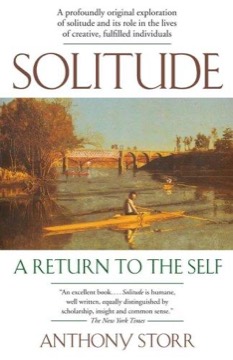
Solitude
a return to the self
Anthony Storr's 1988 argument that psychiatry has overstated intimate relationships as the source of a good life, and that the capacity to be alone is equally central to health and to creative work.
- First published
- 1988
- Publisher
- Harpercollins Pub Ltd
- Pages
- 216
- Shelf
- Habits
- Level
- Core
- ISBN-13
- 9780029316207
Record checked against
Only one source carried a publication date for this work, so the year is uncorroborated.
Catalogue note
- Reads as
- PracticalWritten to be applied, not only understood.
- Level
- Core / BuildingAssumes general familiarity with the subject.
- Approach
- Practical
- Written for
- Anyone changing how they work, Readers with some grounding
Saved in this browser only — no account, nothing sent anywhere. My library
Read this if
- You want evidence about why people behave as they do, not folklore.
- You make things, and want to understand the work rather than wait for inspiration.
- You want something to apply, not only something to think about.
- You know roughly how the subject works and want the fuller account.
The argument
Storr, a psychiatrist, writes against a consensus in his own field: that mental health is measured chiefly by the quality of a person's close relationships, and that solitude signals pathology.
His counter-case draws on Winnicott's concept of the capacity to be alone as a developmental achievement, and on the biographies of writers, composers and thinkers whose work required extended isolation.
He is arguing against his own profession's assumption that a good life is measured in close relationships.
Devmark’s reading — not a quotation from the book
The evidence he uses
Case histories of figures including Kafka, Beethoven, Kant, Wittgenstein and Beatrix Potter, many of whom had poor or absent intimate relationships and produced work of the first order.
He is careful that this is not an argument that isolation causes genius, but that the standard model has no place for these lives and therefore misdescribes them as damaged.
The developmental claim
The most substantial chapter follows Winnicott: the ability to be alone develops in a child who has been alone in the presence of a trusted adult, and is therefore a product of secure attachment rather than a failure of it.
That reframe — solitude as evidence of security — is the book's durable contribution and is broadly consistent with later attachment research.
The capacity to be alone is a product of secure attachment, not a symptom of its absence.
Devmark’s reading — not a quotation from the book
Its limits
Storr's examples are overwhelmingly male, European and canonical, and the book does not examine whether the solitude available to those figures was available to anyone else.
It also predates the loneliness research of the last two decades, which has established real health costs to involuntary isolation. Storr is writing about chosen solitude, and the distinction matters more now than it did.
Against the therapeutic consensus
Storr wrote deliberately against a psychoanalytic orthodoxy in which intimate relationships were the measure of health and their absence was treated as pathology. His claim is that a substantial number of people organise their lives around work, ideas or art instead, and that this is a legitimate arrangement rather than a defensive one.
The assumption that a good life is measured by its relationships is an assumption, not a finding.
Devmark’s reading — not a quotation from the book
The creative lives
Much of the argument is carried by biography: writers, composers and thinkers who were solitary by temperament, difficult to live with, or bereaved early, and whose work is inseparable from that condition rather than achieved in spite of it. Storr uses these lives as evidence that the capacity to be alone is genuinely productive rather than merely something to be endured until company arrives.
The capacity to be alone
He draws on the developmental idea that a child learns to be comfortably alone in the presence of a reliable adult, and that this becomes an internal resource for life. It is a genuinely useful formulation: solitude as an achievement produced by early security rather than as its failure.
The third period
One of the book's better sections concerns late work — artists whose final compositions became more inward, austere and less concerned with an audience — and Storr connects this to a natural movement away from social preoccupation with age. It is an unusually calm account of what getting older does to ambition.
Bereavement and forced solitude
He distinguishes carefully throughout between solitude that is chosen and isolation that is imposed, and writes about bereavement and imprisonment as conditions in which the internal resources he has been describing are genuinely tested rather than comfortably enjoyed. The distinction is what stops the book collapsing into a simple defence of being alone, and it is the reason it still reads as serious rather than consoling.
Where it is dated
It is a work of 1988 and the psychiatric framework of that moment shows throughout: the diagnostic categories used, the heavy reliance on biographical interpretation in place of data, and a number of assumptions about temperament and about women that would now be stated a good deal more carefully. The central argument has aged considerably better than the apparatus surrounding it.
What to take away
- 01Against the consensusWritten by a psychiatrist disputing his field's measure of health.
- 02Winnicott's capacityBeing alone develops from having been alone safely in company.
- 03Solitude as securityReframed as evidence of secure attachment rather than its failure.
- 04Lives that do not fitCanonical figures whose work required isolation the model cannot describe.
- 05Chosen, not imposedThe distinction from involuntary loneliness matters more now.