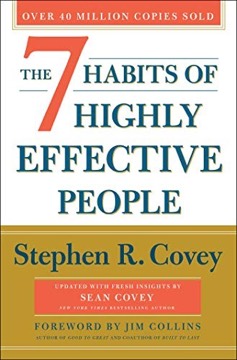
The 7 Habits of Highly Effective People
Stephen Covey's 1989 framework, built on the claim that lasting effectiveness comes from character rather than technique, and organised as a progression from dependence through independence to interdependence.
- First published
- 1989
- Publisher
- Free Press
- Pages
- 374
- Shelf
- Habits
- Level
- Core
- ISBN-13
- 9789576214615
Record checked against
Catalogue note
- Reads as
- PracticalWritten to be applied, not only understood.
- Level
- Core / BuildingAssumes general familiarity with the subject.
- Approach
- Practical
- Written for
- Anyone changing how they work, Readers with some grounding
- Ideas
Saved in this browser only — no account, nothing sent anywhere. My library
Read this if
- You want to think harder about what is actually right.
- You want something to apply, not only something to think about.
- You know roughly how the subject works and want the fuller account.
The character ethic
Covey's framing argument comes from a survey of American success literature since 1776. He claims the first century and a half emphasised character — integrity, humility, patience, courage — and that the period after the First World War shifted to what he calls the personality ethic: technique, image and social skill.
His position is that technique layered over poor character is eventually detected, and that the personality ethic produces short-term gains and long-term erosion of trust.
Technique applied on top of unreliable character is detected eventually, and then it costs more than it earned.
Devmark’s reading — not a quotation from the book
Paradigms
Before the habits, Covey argues that we see through maps we did not choose and rarely examine, and that significant change requires altering the map rather than trying harder inside it.
His term is a paradigm shift, borrowed loosely from Kuhn. The illustration — that you cannot navigate Chicago with a map of Detroit however positive your attitude — is the clearest statement of the book's central method.
Habits 1–3: from dependence to independence
**Be proactive.** Covey's strongest single idea: between stimulus and response is a space, and the freedom to choose lives there. He pairs it with the circle of concern and circle of influence, arguing that effective people spend effort on the smaller circle they can affect, which then grows.
**Begin with the end in mind.** Personal leadership — deciding what you are actually for before optimising how you execute. His funeral exercise is crude but effective at surfacing an answer.
**Put first things first.** Personal management, organised around the now-ubiquitous urgent/important matrix, whose real content is his claim that Quadrant II — important and not urgent — is where everything that matters lives and is the only quadrant nothing forces you into.
The maturity continuum
The structure is a sequence, and the sequencing is the argument. Habits 1–3 move a person from dependence to independence; habits 4–6 move from independence to interdependence; habit 7 renews the capacity for all of them.
Covey's claim is that the order cannot be skipped — that attempts at collaboration by someone who has not achieved independence produce dependence dressed as teamwork. This is the part of the framework most often ignored and probably its most defensible structural claim.
Habits 4–6: working with other people
**Think win/win.** Covey treats this as a character trait rather than a tactic, requiring abundance mentality, and he is explicit that the honest alternative is not win/lose but no deal — an agreement neither party believes in is worse than none.
**Seek first to understand, then to be understood.** Empathic listening, which he distinguishes carefully from listening in order to reply. This is the most immediately practical habit and the one with the clearest behavioural instruction.
**Synergise.** Creative cooperation, which is the vaguest of the seven and the hardest to act on directly. It is best read as a consequence of 4 and 5 rather than a separate practice.
Habit 7: Sharpen the saw
Renewal across four dimensions — physical, mental, social/emotional and spiritual — on the argument that capacity is an asset requiring maintenance and that neglecting it is a Quadrant II failure.
The woodcutter metaphor is old, and Covey's contribution is treating renewal as a habit with a schedule rather than something done when exhausted. It is the habit most people agree with and least often implement.
Renewal is the one thing nothing will ever force you to do, which is exactly why it needs a schedule.
Devmark’s reading — not a quotation from the book
The P/PC balance
A genuinely useful piece of vocabulary. P is production — the results you want. PC is production capability — the asset that produces them.
Covey's argument is that almost every sustainability failure, in a body, a relationship or an organisation, is over-harvesting P at the expense of PC. It is the same insight as technical debt, stated forty years earlier and in a broader domain.
Where it is weak
The evidence is assertion and anecdote; there is no research base. The prose is dated and often preachy, and the corporate examples are of their period.
It is also long for its content, and readers frequently report that the first hundred pages of framing are the hardest part of the book. The spiritual dimension of habit 7 is explicitly religious in origin and presented as universal, which some readers find unearned.
Where it gets flattened
The seven habits are routinely reduced to the urgent/important matrix and "win/win", losing the sequencing argument that makes them a framework rather than a list.
The proactivity habit is also frequently reduced to positive thinking, which inverts it. Covey's claim concerns the space between stimulus and response and the discipline of spending attention where you have influence — not optimism about outcomes.
What survives
Three things have entered general practice so thoroughly that their origin is forgotten: the circle of influence, the urgent/important distinction, and the instruction to understand before being understood.
The deeper argument — that effectiveness is a consequence of character and that the sequence from independence to interdependence cannot be skipped — is unproven and, in the experience of most people who have worked in organisations, approximately right.
What to take away
- 01Spend attention inside your influenceThe circle you can affect grows when worked on; the circle you merely worry about does not.
- 02Quadrant II is never forced on youImportant-and-not-urgent is where everything that matters lives and the only quadrant with no alarm attached.
- 03No deal beats a bad agreementThe honest alternative to win/win is not win/lose; it is declining to agree.
- 04Listen to understand, not to replyThe most actionable of the seven, and the one with the clearest behavioural test.
- 05Protect the capability, not just the outputAlmost every sustainability failure is over-harvesting results at the expense of what produces them.