The Almanack of Naval Ravikant
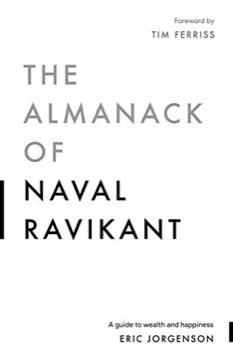
Eric Jorgenson's compilation of Naval Ravikant's writing and interviews on wealth and happiness, assembled with permission and released free as well as in print.
- First published
- 2020
- Publisher
- Magrathea Publishing
- Pages
- 242
- Shelf
- Habits
- Level
- Entry
- ISBN-13
- 9781544514215
Record checked against
Only one source carried a publication date for this work, so the year is uncorroborated.
Catalogue note
- Reads as
- PracticalWritten to be applied, not only understood.
- Level
- Accessible / FoundationalNo prior reading assumed.
- Approach
- Practical
- Written for
- Anyone changing how they work, Newcomers to the subject
- Ideas
Saved in this browser only — no account, nothing sent anywhere. My library
Read this if
- You want to see the incentives underneath the headlines.
- You want to examine an assumption you have never examined.
- You want something to apply, not only something to think about.
- You are starting from scratch here and want a way in that assumes no prior reading.
What it is
Not written by Ravikant. Jorgenson collected a decade of tweets, podcast transcripts and essays from the AngelList founder and arranged them into two parts, wealth and happiness, with Ravikant's cooperation.
The form is aphoristic throughout, which is a consequence of the sources rather than a stylistic choice.
It is assembled rather than written, and the sources were tweets and podcasts.
Devmark’s reading — not a quotation from the book
The wealth argument
His central distinction is between wealth and money: wealth is assets that earn while you sleep, money is transferred value. From that follow his more quoted positions — seek leverage rather than effort, and prefer the two forms of permissionless leverage, code and media.
Also: specific knowledge that cannot be trained, only apprenticed or discovered; accountability as a requirement for equity; and the argument that you will not get rich renting out your time.
You will not get rich renting out your time, because it does not scale and it does not compound.
Devmark’s reading — not a quotation from the book
The happiness argument
The second half is a broadly Buddhist and Stoic position: that happiness is the absence of desire rather than the satisfaction of it, that peace is a skill, and that most suffering is the gap between expectation and the present.
It is less original than the wealth material and Ravikant does not claim otherwise.
How to take it
Aphorism is efficient and unfalsifiable in equal measure. There is no evidence here and very little argument; the value is compression of a particular worldview by someone who acted on it successfully.
It is also survivorship in concentrated form: one very successful investor's account of what worked. Read it as a perspective rather than a method, and note that it is available free from the publisher.
One successful investor's worldview, compressed. Read it as a perspective rather than a plan.
Devmark’s reading — not a quotation from the book
Leverage
The idea doing most of the work is a hierarchy of multipliers: labour, which requires people and permission; capital, which requires investors and permission; and code and media, which reproduce at no marginal cost and require neither. His claim that the last category is permissionless is the book's most genuinely useful observation about the present economy.
Labour and capital need someone's approval. Code and media do not.
Devmark’s reading — not a quotation from the book
Specific knowledge
His term for expertise that cannot be trained by a curriculum — acquired by pursuing genuine curiosity, closer to an obsession than a skill, and therefore hard to compete away or automate. It is a real observation about scarcity and it is also close to circular: specific knowledge is identified largely by its having turned out to be valuable.
Long-term games with long-term people
A recurring principle holds that nearly all returns — financial, reputational, relational — come from compounding, and that compounding requires repetition with the same counterparties. Its practical consequence is a strong argument against extracting value from any single interaction, and it is the most conventionally sound advice in the book.
Desire as a contract
The happiness half turns on a single formulation: a desire is an agreement you have made with yourself to be unhappy until you get something. The recommendation is not to eliminate desire but to hold very few at a time and to choose them deliberately, which is a usable compression of a much older argument.
Where the survivorship is
The advice comes from a successful technology investor writing after the outcome, and the book contains no cases where following the same principles produced nothing. Judgement, specific knowledge and taking equity rather than salary are all identifiable in retrospect; the number of people who did exactly this and are not being interviewed is unknown and is the missing denominator.
On reading
The most repeated practical advice is to read what genuinely interests you until reading becomes automatic, to prefer old books to new ones, and to build foundations in mathematics and science rather than accumulating titles. It is permission-giving rather than prescriptive and is among the parts readers most often report acting on.
What to take from it
Aphorism is efficient and unfalsifiable in the same breath, and this is a compilation rather than an argument. Take leverage, which is a concrete claim about how the economy now works, and the reading advice, which costs nothing. Treat the rest as one intelligent person's compressed opinions, which is what the compiler says it is.
What to take away
- 01Wealth versus moneyAssets that earn while you sleep against transferred value.
- 02Permissionless leverageCode and media, which need nobody's approval to deploy.
- 03Specific knowledgeWhat cannot be trained, only apprenticed into or found.
- 04Happiness as skillPeace treated as practice rather than circumstance.
- 05Compiled, and freeAssembled by Jorgenson and available at no cost.