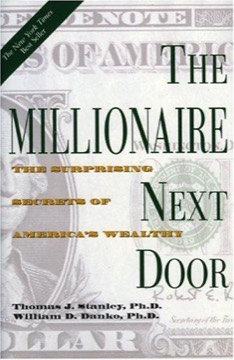
The Millionaire Next Door
Thomas Stanley and William Danko's survey research into American households with high net worth, finding that the typical millionaire looked nothing like the popular image — and that accumulation correlated with consumption habits far more than with income.
- First published
- 1996
- Publisher
- Gallery Books
- Pages
- 258
- Shelf
- Money
- Level
- Entry
- ISBN-13
- 9780743517829
Record checked against
Catalogue note
- Reads as
- PracticalWritten to be applied, not only understood.
- Level
- Accessible / FoundationalNo prior reading assumed.
- Approach
- Practical
- Written for
- Investors and savers, Newcomers to the subject
Saved in this browser only — no account, nothing sent anywhere. My library
Read this if
- You want to think clearly about risk before you think about returns.
- You want to see the incentives underneath the headlines.
- You want something to apply, not only something to think about.
- You are starting from scratch here and want a way in that assumes no prior reading.
The research and its finding
Stanley and Danko surveyed and interviewed high-net-worth households directly, and their central finding was demographic rather than financial: the typical millionaire lived in a modest house, drove an older car, had never bought an expensive watch, and was frequently self-employed in an unglamorous business.
The people visibly consuming at a high level were, in their data, more often high earners with low net worth than the reverse.
The people who look wealthy and the people who are wealthy turned out to be substantially different populations.
Devmark’s reading — not a quotation from the book
Income is not wealth
The book's most important distinction and the one most often collapsed. Income is a flow; wealth is a stock. A high income spent entirely accumulates nothing, and a modest income with a high savings rate accumulates steadily.
Their expected-net-worth formula — age times pre-tax income divided by ten — is crude and has been criticised for it, but its function is to separate people who accumulate well relative to their earnings from those who do not.
PAWs and UAWs
Their terminology: Prodigious Accumulators of Wealth and Under Accumulators of Wealth, relative to what their income and age would predict.
The comparison is the useful part. It stops the analysis being about income level and makes it about the rate at which income is converted into assets, which is the variable an individual actually controls.
The seven factors
Their summary of what accumulators had in common: living below their means, allocating time and money efficiently toward building wealth, valuing financial independence over social status, receiving no economic support from parents, raising self-sufficient children, exploiting market opportunities, and choosing an occupation well.
The third is the thesis in one line — the trade-off between visible status and actual independence is made constantly, and most people make it in the direction that feels better now.
Economic outpatient care
Their term for ongoing financial support from parents to adult children, and one of the book's more uncomfortable findings: recipients in their data accumulated less than comparable non-recipients, not more.
Their proposed mechanism is that subsidised consumption establishes a standard of living the recipient's own income does not support, and that the habit outlasts the subsidy.
Subsidised consumption establishes a standard the recipient's own income cannot sustain. The habit outlasts the money.
Devmark’s reading — not a quotation from the book
Occupation and self-employment
A striking share of their millionaires were self-employed in ordinary businesses — contractors, suppliers, services — rather than in prestigious professions.
Their explanation is partly control over income and partly the absence of an occupational culture that requires visible consumption, which several high-status professions do.
The methodological problems
These are substantial and should be stated. The sample is of survivors — people who succeeded at accumulation — with no comparison group of people who lived identically and did not, which is the same selection problem that affects most books of this shape.
The research is also cross-sectional and correlational, so the direction of causation between frugality and wealth is not established by the data.
Where it has dated
The research was conducted largely in the 1980s and 1990s, and the economic environment has changed considerably: housing costs relative to income, the decline of defined-benefit pensions, student debt, and healthcare costs all alter the arithmetic.
The finding that a million dollars represents substantial wealth has also weakened with inflation, which affects the threshold the whole study is built on.
What it under-acknowledges
The book largely treats accumulation as a matter of choice, and gives comparatively little weight to inherited advantage, geography, discrimination and the structural factors that determine how much surplus a household has to allocate at all.
Its advice presumes a surplus exists. For a household without one, the seven factors describe a situation rather than offering a route.
What survives
The income/wealth distinction is genuinely important and genuinely under-appreciated, and the observation that visible consumption and actual net worth are often inversely related is worth internalising.
Read it for that reframing and hold the specific numbers, the causal confidence and the implicit politics considerably more loosely.
What to take away
- 01Income is a flow, wealth is a stockA large income spent entirely accumulates nothing, and the two are constantly conflated.
- 02Measure accumulation against incomeThe useful question is the rate at which earnings become assets, which is what you control.
- 03Status and independence trade against each otherThe choice is made constantly, and mostly in the direction that feels better immediately.
- 04Subsidy can suppress accumulationSupport establishes a standard of living the recipient's own income does not sustain.
- 05Note the survivor sampleNo comparison group of people who lived the same way and did not accumulate.