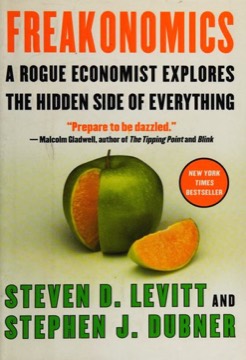
Freakonomics
Steven Levitt and Stephen Dubner's collection of applied economic analyses of subjects economics does not usually touch — built on the premise that incentives explain behaviour and that data can answer questions people assume are matters of opinion.
- First published
- 2005
- Publisher
- HarperLargePrint
- Pages
- 320
- Shelf
- Money
- Level
- Entry
- ISBN-13
- 9780061238536
Record checked against
Catalogue note
- Reads as
- ConceptualExplains how something works before what to do about it.
- Level
- Accessible / FoundationalNo prior reading assumed.
- Approach
- Theoretical
- Written for
- Investors and savers, Newcomers to the subject
Saved in this browser only — no account, nothing sent anywhere. My library
Read this if
- You want to see the incentives underneath the headlines.
- You want to decide better when the information is incomplete.
- You want to know how we know things, and how that goes wrong.
- You want to understand how it works before deciding what to do about it.
- You are starting from scratch here and want a way in that assumes no prior reading.
What the book actually is
Not a theory of anything. Levitt is an empirical microeconomist with a talent for finding natural experiments in unlikely data, and Dubner is a journalist who turned that work into narrative.
The authors say outright that the book has no unifying theme. Its organising principle is a method — find a measurable question hidden inside a contested one, then find data that isolates it.
There is no thesis. There is a method: find the measurable question hiding inside the argued-about one.
Devmark’s reading — not a quotation from the book
Incentives, and their three kinds
The nearest thing to a thesis: people respond to incentives, often in ways the incentive's designer did not intend.
Their distinction between economic, social and moral incentives is useful, as is their repeated demonstration that adding one kind can destroy another — the day-care fine that increased late pickups by converting a moral obligation into a purchasable service is the canonical case.
Information asymmetry
Their analysis of experts — estate agents, car salesmen, financial advisers — rests on the observation that professionals hold information their clients do not and face incentives that do not align with the client's.
The estate agent analysis is the strongest: comparing how agents sell clients' houses with how they sell their own, and finding a systematic difference in time on market and price achieved.
Cheating, measured
Their work detecting cheating in sumo wrestling and by schoolteachers is the clearest demonstration of the method: identify a pattern that honest behaviour would not produce, then look for it in the data.
The teacher analysis — looking for improbable answer-string patterns in standardised tests — is a genuinely elegant piece of detection and the part of the book most likely to change how a reader thinks about evidence.
The abortion-crime chapter
The book's most controversial argument: that legalised abortion in the United States contributed substantially to the crime decline of the 1990s.
This requires care. The finding has been seriously contested — including a prominent critique identifying a coding error in the original paper, which Levitt acknowledged, and subsequent disagreement over whether the corrected result holds. It should be presented as a disputed empirical claim, not a settled finding, and the book's confident framing does not do that.
Conventional wisdom, examined
A recurring move is to take a widely believed claim and check whether the data supports it — parenting inputs and test scores, the effect of a child's name, the economics of crack dealing.
The drug-dealing chapter, drawn from Sudhir Venkatesh's fieldwork, is the most memorable: the finding that most street-level sellers earned very little, and that the structure resembled a franchise with a tournament payoff at the top.
Most of the people in the trade earned less than minimum wage. The structure was a tournament, not a business.
Devmark’s reading — not a quotation from the book
The parenting chapter
Their analysis separating what parents *are* from what parents *do* — finding that characteristics correlated with outcomes tended to be ones established before the child arrived rather than things done afterwards.
The finding is correlational and the book is not always careful to say so. It is best read as a caution against confident causal claims about parenting technique, which is how Levitt himself frames it.
Where the method has limits
Natural experiments are found rather than designed, which means the questions answered are the ones the available data happens to permit, not the ones that matter most.
Several findings in the book have also weakened under re-examination, which is normal for empirical social science and sits awkwardly with the confident register in which they were presented.
Its influence, and the cost of it
It created a genre and made economics popularly legible, which is a real contribution. It also helped establish a style — counter-intuitive finding, confident telling, minimal uncertainty — that the replication debates of the following decade treated harshly.
A reader today should enjoy the method and check any specific claim before repeating it.
What to take from it
The transferable skill is the reframing: when a question is being argued as a matter of values, ask whether there is a measurable sub-question inside it, and what data would separate the explanations.
And the incentive-design caution — that adding an economic incentive can destroy a moral one — which is among the most practically useful findings in applied economics.
What to take away
- 01Find the measurable sub-questionInside most contested opinion questions there is a narrower one that data can actually settle.
- 02Economic incentives can destroy moral onesThe fine that converts an obligation into a purchasable service reliably increases the behaviour.
- 03Look for patterns honesty would not produceThe cheating detection method — improbable answer strings, improbable win rates — generalises widely.
- 04Expert and client interests divergeCompare how a professional handles your transaction with how they handle their own.
- 05Check the specific claimsSeveral findings, including the most controversial, have been seriously contested since publication.