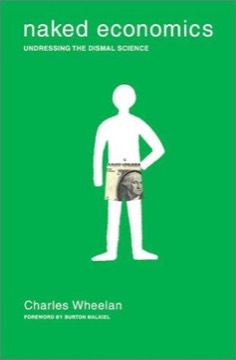
Naked Economics
Charles Wheelan's introduction to economics for the general reader — an attempt to convey how economists think without equations, graphs or the apparatus that makes an introductory course unpleasant.
- First published
- 2002
- Publisher
- W. W. Norton & Company
- Pages
- 322
- Shelf
- Money
- Level
- Entry
- ISBN-13
- 9780393356496
Record checked against
Catalogue note
- Reads as
- ConceptualExplains how something works before what to do about it.
- Level
- Accessible / FoundationalNo prior reading assumed.
- Approach
- Theoretical
- Written for
- Investors and savers, Newcomers to the subject
- Ideas
Saved in this browser only — no account, nothing sent anywhere. My library
Read this if
- You want to see the incentives underneath the headlines.
- You want to understand how it works before deciding what to do about it.
- You are starting from scratch here and want a way in that assumes no prior reading.
The approach
Wheelan's method is to explain the intuition behind each concept and leave the formalism out entirely. There is no mathematics, and the graphs that dominate a first-year textbook are absent.
His argument is that the useful part of economics is a way of thinking about incentives, trade-offs and unintended consequences, and that the apparatus is a professional tool that obscures this for everyone else.
The useful part is a way of thinking about trade-offs. The apparatus is a professional tool that hides it.
Devmark’s reading — not a quotation from the book
Incentives and the price system
His opening chapters make the case that prices carry information — about scarcity, preference and cost — that no central planner could assemble, and that this is the market's principal achievement.
He is careful to pair this with where it fails: externalities, public goods, information asymmetries and monopoly, each of which he treats as a specific identifiable condition rather than a general objection.
Government, handled evenly
His treatment of the state is notably balanced for an introductory book: markets do certain things well and specific things badly, and government is the mechanism for the second category while being subject to its own failure modes.
He avoids both the market-solves-everything and market-failure-justifies- anything positions, which makes the book usable across the political spectrum.
Information problems
His chapters on asymmetric information — adverse selection, moral hazard, signalling — are the clearest short explanations available to a non-specialist.
The insurance examples in particular make immediately intelligible why certain markets behave strangely, and why some products exist mainly to solve an information problem rather than a material one.
Human capital and productivity
His explanation of why productivity is the only durable source of rising living standards, and why human capital dominates the long-run picture, is the section with the most policy content.
He is direct that this implies education and health are economic infrastructure rather than consumption, which is an argument he makes without partisan framing.
Productivity is the only durable route to a higher standard of living. Everything else redistributes.
Devmark’s reading — not a quotation from the book
Financial markets, demystified
A practical chapter explaining what financial markets are for — raising capital, storing value, insuring against risk, speculating — and why the first three are socially valuable regardless of what one makes of the fourth.
His investing advice is conventional and correct: diversify, minimise fees, ignore forecasts, and be sceptical of anyone promising to beat the market.
Trade and globalisation
He makes the standard economic case for trade — comparative advantage, gains from specialisation — and is more candid than most introductions about the distributional problem: the gains are diffuse and the losses are concentrated.
His position is that this is an argument for compensating losers rather than for blocking trade, and he acknowledges that the compensation has generally not happened.
Development economics
The later chapters ask why some countries are rich and others poor, surveying institutions, geography, corruption, property rights, the rule of law and the quality of governance — and noting how little of the variation any single factor explains.
This is the most speculative section in the book and the one where professional economists disagree most sharply with each other. Wheelan represents that disagreement reasonably rather than picking a side, which is the right call for an introduction but leaves the reader without a conclusion to carry away.
Where it is limited
Breadth without depth is the trade, and it is made deliberately. No topic gets enough space to be genuinely understood, and a reader who wants to follow an argument will need a real textbook.
The editions also carry their period: the financial-crisis and globalisation material has been revised but the framing still reflects a more confident pre-2008 consensus in places.
Who it is for
The right first economics book for someone who has never studied it and does not intend to — a journalist, a manager, a voter.
The wrong book for someone who wants to be able to do anything with the concepts. Its honest function is to make economic reasoning legible so that arguments about policy can be followed rather than merely felt.
What to take away
- 01Prices carry informationA price aggregates scarcity, preference and cost in a way no planner could assemble.
- 02Name the specific market failureExternalities, public goods, asymmetric information and monopoly are identifiable conditions, not a general objection.
- 03Productivity is the only durable leverEverything else redistributes an existing amount; only productivity increases it.
- 04Trade's gains are diffuse, losses concentratedWhich is the whole political problem, and the compensation economists assume has largely not happened.
- 05Read it to follow argumentsIt makes policy debate legible. It does not equip you to do economics.