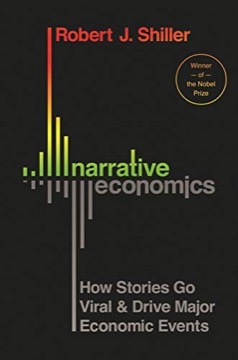
Narrative Economics
Robert Shiller's argument that economic events are driven substantially by stories that spread like epidemics, and that economics should study them with the tools used for contagion.
- First published
- 2019
- Publisher
- Princeton University Press
- Pages
- 400
- Shelf
- Money
- Level
- Core
- ISBN-13
- 9780691212074
Record checked against
Only one source carried a publication date for this work, so the year is uncorroborated.
Catalogue note
- Reads as
- ConceptualExplains how something works before what to do about it.
- Level
- Core / BuildingAssumes general familiarity with the subject.
- Approach
- Theoretical
- Written for
- Investors and savers, Readers with some grounding
Saved in this browser only — no account, nothing sent anywhere. My library
Read this if
- You want to see the incentives underneath the headlines.
- You want to be understood the first time.
- You want to understand how it works before deciding what to do about it.
- You know roughly how the subject works and want the fuller account.
The argument
Shiller, a Nobel laureate, proposes that popular narratives — about bitcoin, about housing always rising, about technological unemployment — are causal economic forces rather than commentary on them.
His method borrows directly from epidemiology: narratives have infection rates, recovery rates and susceptibility, and can be tracked through text frequency in newspapers and books over long periods.
He proposes treating a story about the economy as a pathogen, with an infection rate you can measure.
Devmark’s reading — not a quotation from the book
The case studies
The Great Depression as substantially driven by a narrative of thrift and contraction; the Laffer curve's spread via a drawing on a napkin; bitcoin as a narrative-first asset; recurring panics about machines taking work, traceable through more than a century of newspaper text.
The historical text-frequency charts are the book's most novel evidence.
Where it is limited
Shiller is clearer about the phenomenon than about the mechanism. Identifying that a narrative spread alongside an economic event does not establish which caused which, and the book is more suggestive than demonstrative on that point.
He acknowledges this and frames the work as an agenda for a field rather than a finished theory, which is the honest framing.
He presents it as a research programme rather than a result, which is the correct claim to make.
Devmark’s reading — not a quotation from the book
Why it is worth reading
It is a serious economist arguing that the discipline's models omit something large, from a position that cannot be dismissed as outsider complaint.
The argument became considerably more visible after the meme-stock and crypto episodes that followed publication.
It is also unusually readable for an economics book, because the evidence is stories and the stories are interesting in themselves regardless of whether the methodological programme succeeds.
Stories as epidemics
Shiller's methodological proposal is to treat economic narratives with the tools used for infectious disease: a contagion rate, a recovery rate, and curves that can be fitted to the frequency of phrases in printed and digital archives. It is the book's most original move and the one that makes the argument empirical rather than anecdotal.
Which stories he tracks
He follows a set of recurring narratives across a century and more: speculative manias and the certainty that prices only rise, thrift as a patriotic duty during downturns, technological unemployment and machines taking the jobs, the gold standard, real estate as a sure thing, and cryptocurrency as the latest instance of an old pattern.
The Depression case
His most developed application argues that the severity of the 1930s contraction was amplified by a narrative of thrift and belt-tightening that spread widely and caused people to cut spending together, converting a downturn into a collapse. It is a claim about coordination through story rather than through price signals.
A story that everyone hears at once can make everybody cut spending in the same month.
Devmark’s reading — not a quotation from the book
Why economics excluded this
He is direct that his own discipline's models assume preferences arrive from outside and stay fixed, which makes contagious changes in what people believe literally invisible to them. His argument is that this is a modelling convenience that has hardened into an assumption about the world.
The measurement problem
The weakest part is causality. Counting how often a phrase appears demonstrates that a narrative spread; it does not establish that the narrative moved the economy rather than the economy generating the narrative. Shiller acknowledges this and does not resolve it, which leaves the central claim suggestive rather than demonstrated.
What he wants built
His practical proposal is infrastructure: systematic collection of what people are actually saying and believing about the economy, in the way that price and output data are already collected, so that narratives could be tracked in real time rather than reconstructed afterwards. It is a modest and plausible ask.
What to take from it
It is a Nobel laureate arguing that his field's models omit something important, which is worth attention regardless of whether the proposed solution works. Read it for the reframe — that what people are telling each other is an economic variable — and hold the specific historical attributions loosely.
What to take away
- 01Narratives as causesStories treated as economic forces rather than commentary.
- 02Epidemiological methodInfection and recovery rates applied to ideas.
- 03Text frequency as evidenceLong-run newspaper and book data as the empirical base.
- 04Recurring machine panicsThe same story about automation, traceable for a century.
- 05An agenda, not a theoryShiller frames it as a programme for the field.