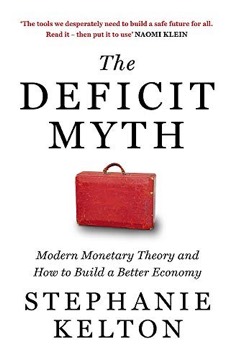
The Deficit Myth
Stephanie Kelton's introduction to Modern Monetary Theory: the argument that a country issuing its own floating currency faces an inflation constraint rather than a funding one.
- First published
- 2020
- Publisher
- Hodder & Stoughton
- Pages
- 336
- Shelf
- Money
- Level
- Core
- ISBN-13
- 9781541736191
Record checked against
Catalogue note
- Reads as
- StrategicAbout choosing between options under uncertainty.
- Level
- Core / BuildingAssumes general familiarity with the subject.
- Approach
- Applied
- Written for
- Investors and savers, Readers with some grounding
Saved in this browser only — no account, nothing sent anywhere. My library
Read this if
- You want to see the incentives underneath the headlines.
- You have to choose what not to do, and want a way to think about it.
- You are weighing options and want a way to think about the trade-offs.
- You know roughly how the subject works and want the fuller account.
The argument
Kelton's core claim is that a currency-issuing government does not need to collect taxes or borrow before it spends — it spends by crediting accounts, and taxes and bonds serve other purposes. The binding constraint is real resources and inflation, not revenue.
From this she derives that the household analogy for public finance is category error, and that the deficit is a poor measure of fiscal responsibility.
Her claim is not that money is free. It is that the limit is inflation rather than revenue.
Devmark’s reading — not a quotation from the book
What she proposes
A federal job guarantee as an automatic stabiliser, replacing unemployment as the mechanism that disciplines inflation. Assessment of spending against capacity rather than against a deficit target.
She also reframes the deficit as the private sector's surplus by accounting identity, which is arithmetic rather than theory and is often the part that changes how a reader sees the debate.
The dispute
MMT is a minority position. Mainstream economists including Summers, Rogoff and Krugman have objected that the inflation constraint binds far earlier and less controllably than MMT implies, and that political economy makes the proposed discipline unworkable.
The inflation of 2021-23 was read by critics as a demonstration of the objection and by MMT economists as consistent with their framework. That argument is unresolved.
The 2021-23 inflation was claimed by both sides as evidence, which tells you the dispute is live.
Devmark’s reading — not a quotation from the book
How to read it
It is written as advocacy for a general reader, not as a balanced survey, and Kelton was economic adviser to Bernie Sanders.
Read it as the clearest available statement of a serious heterodox position, with a mainstream response alongside. The accounting identities are not in dispute; the policy conclusions very much are.
Issuer and user
Everything in the book rests on one distinction: a government that issues its own floating-rate currency is in a categorically different position from a household, a company, a state government, or a country borrowing in someone else's currency. Kelton's argument is that most public debate applies the second set of intuitions to the first case, and that nearly every subsequent confusion follows from that.
What taxes are for
In her account taxes do not fund spending; they create demand for the currency by requiring it for settlement, remove purchasing power to make room for public spending without inflation, and redistribute. The sequencing claim — that government spending logically precedes the tax receipt rather than depending on it — is the part readers find most counter-intuitive and is central to everything else.
The question is never whether the money exists. It is whether the real resources do.
Devmark’s reading — not a quotation from the book
One sector's deficit is another's surplus
She uses the accounting identity that the government's deficit is, by construction, the non-government sector's surplus. It follows that a sustained drive to balance the public books removes financial assets from households and firms, and she presents historical episodes where surplus periods preceded private-sector distress.
Inflation as the real constraint
The book is at pains to deny that MMT means unlimited spending. The limit is real resources — labour, materials, capacity — and the binding indicator is inflation rather than a debt ratio. The policy consequence is that budgets should be assessed against available capacity rather than against a deficit target.
The job guarantee
Her main proposal is a standing offer of public employment at a fixed wage, which she argues would function as an automatic stabiliser — expanding in downturns, contracting in booms — and would set a wage and price anchor. Critics regard the administrative demands and the wage-floor effects as substantially underestimated.
What the critics say
MMT is a minority position and the objections are serious: that the inflation constraint is acknowledged but not operationalised, that the political economy of withdrawing stimulus is unrealistic, that exchange-rate and capital-flow effects are underplayed, and that the framework does not apply to the many countries borrowing in foreign currency. The inflationary period of the early 2020s has been read by critics as a test and by proponents as a supply-side event; that argument is unresolved.
The question it replaces
The book's practical effect on a reader is to change the question asked of any public proposal. Instead of how it will be paid for, which Kelton argues is a category error for a currency issuer, the question becomes whether the real resources exist — the workers, the materials, the capacity — and what would have to be given up to free them. That reframing survives even for readers who reject the rest of the framework.
Not where will the money come from, but do the workers and the materials exist.
Devmark’s reading — not a quotation from the book
What to take away
- 01Inflation, not fundingThe constraint on a currency issuer is real resources.
- 02The household analogy failsA currency issuer is not a currency user.
- 03Deficits as private surplusAn accounting identity, often the most persuasive part.
- 04The job guaranteeProposed as an automatic stabiliser replacing unemployment.
- 05Heterodox and contestedA minority position; read with a mainstream reply.