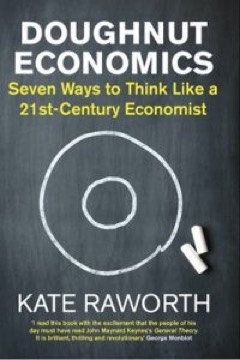
Doughnut Economics
Kate Raworth's argument that twentieth-century economics is built on outdated diagrams and assumptions, and her proposal for a new central image: a space between a social foundation nobody should fall below and an ecological ceiling nobody should exceed.
- First published
- 2017
- Publisher
- Chelsea Green Publishing
- Pages
- 347
- Shelf
- Money
- Level
- Core
- ISBN-13
- 9781603586757
Record checked against
Only one source carried a publication date for this work, so the year is uncorroborated.
Catalogue note
- Reads as
- ConceptualExplains how something works before what to do about it.
- Level
- Core / BuildingAssumes general familiarity with the subject.
- Approach
- Theoretical
- Written for
- Investors and savers, Readers with some grounding
Saved in this browser only — no account, nothing sent anywhere. My library
Read this if
- You want to see the incentives underneath the headlines.
- You want to understand a place, or what we are doing to one.
- You keep fixing symptoms and want to see the structure producing them.
- You want to understand how it works before deciding what to do about it.
- You know roughly how the subject works and want the fuller account.
The diagram as the argument
Raworth's method is to attack economics through its pictures, on the grounds that the diagrams students internalise — supply and demand crossing, the circular flow, the Kuznets curve — do more to shape thinking than any equation.
Her replacement is the doughnut: an inner ring of social foundations (food, water, health, education, political voice) and an outer ring of planetary boundaries, with the safe and just space between them.
She attacks the diagrams rather than the equations, on the grounds that the pictures are what students keep.
Devmark’s reading — not a quotation from the book
Change the goal
Her first proposition: replace GDP growth as the objective with meeting human needs within planetary means.
Her argument is that GDP was never designed as a welfare measure — its originators said so explicitly — and that its adoption as the primary objective was an accident of measurement convenience that has driven policy for eighty years.
See the bigger picture
Her critique of the circular-flow diagram: it shows households and firms exchanging and omits the energy and materials entering the system, the waste leaving it, the unpaid household labour sustaining it, and the commons.
Her embedded economy diagram places the market inside society inside the living world, which is a claim about dependency rather than about preference.
Nurture human nature
Her attack on rational economic man: self-interested, calculating, fixed in preference, isolated. She marshals evidence from behavioural and experimental work that people are none of these reliably.
Her sharper claim is that the model is performative — that studying economics has been shown to shift behaviour toward the model, so the assumption partly creates the reality it claims to describe.
Get savvy with systems
Her replacement for equilibrium thinking, drawing on Meadows: the economy is a complex adaptive system with feedback loops and thresholds, not a mechanism tending toward a resting point.
The practical consequence is a different relationship to policy — stewarding a system whose behaviour cannot be precisely predicted rather than calculating an optimum and implementing it.
An economy with tipping points cannot be steered by calculating an optimum. It has to be stewarded.
Devmark’s reading — not a quotation from the book
Design to distribute and to regenerate
Two propositions that follow. Distribution should be designed into the structure of an economy — through ownership of land, enterprise, technology and money creation — rather than redistributed afterwards through tax.
Regeneration similarly: rather than growing and cleaning up, design material flows to be circular from the start. Both are arguments about architecture rather than correction.
Be agnostic about growth
Her most contested proposition. She does not argue for degrowth, but for designing economies that can thrive whether or not they grow — noting that current structures require growth to remain stable, which makes the question undiscussable.
Her observation that we have economies that need to grow whether or not they make us thrive, and need instead to thrive whether or not they grow, is the book's central formulation.
Where economists object
Several objections are substantive. The book is stronger at critique than at mechanism: it says relatively little about how a growth-agnostic economy would handle debt, employment or pensions, which are structurally growth-dependent.
Critics also argue it treats mainstream economics as more monolithic and more static than it is, and that much of what she proposes is being worked on within the discipline rather than outside it.
Where it is strong
The diagrammatic critique is genuinely original and lands. So does the observation about GDP's origins, and the framing of distribution as a design property rather than a corrective one.
The doughnut itself has been adopted as a practical planning framework by several city governments, which is more real-world uptake than most books of this kind achieve.
How to read it
As a manifesto and a teaching tool rather than a technical economics text. It is accessible, well illustrated and argumentative, and it makes no pretence of neutrality.
Best read alongside a conventional introduction — Wheelan, for instance — so that the thing being criticised is legible. Read alone it will leave a reader confident about a critique of something they have not encountered.
What to take away
- 01The pictures do the teachingStudents keep the diagrams long after the equations, which is why she attacks the diagrams.
- 02GDP was never a welfare measureIts own originators said so; its adoption as the objective was a measurement convenience.
- 03The model is partly performativeStudying the self-interested agent has been shown to shift behaviour toward it.
- 04Design distribution in, do not correct it afterOwnership of land, enterprise and money creation is structural; tax is a correction applied downstream.
- 05Growth-dependence makes the question undiscussableStructures that require growth to stay stable cannot examine whether growth is desirable.