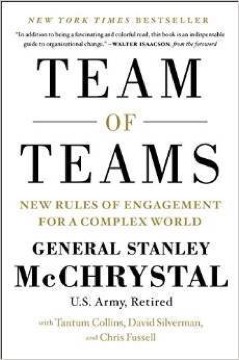
Team of Teams
New Rules of Engagement for a Complex World
Stanley McChrystal's account of restructuring a military task force that was losing to a less-resourced adversary — and his argument that efficiency-optimised hierarchies fail against networked opponents in complex environments.
- First published
- 2015
- Publisher
- Penguin Books, Limited
- Pages
- 297
- Shelf
- Leadership
- Level
- Core
- ISBN-13
- 9781611763720
Record checked against
Only one source carried a publication date for this work, so the year is uncorroborated.
Catalogue note
- Reads as
- ConceptualExplains how something works before what to do about it.
- Level
- Core / BuildingAssumes general familiarity with the subject.
- Approach
- Theoretical
- Written for
- Managers, Readers with some grounding
Saved in this browser only — no account, nothing sent anywhere. My library
Read this if
- You are responsible for other people's work as well as your own.
- You keep fixing symptoms and want to see the structure producing them.
- You want to understand how power is taken, kept and lost.
- You want to understand how it works before deciding what to do about it.
- You know roughly how the subject works and want the fuller account.
The problem they faced
McChrystal's task force was better trained, better equipped and better resourced than its opponent, and was losing. His diagnosis is that the opponent was faster, more adaptable and organised as a network rather than a hierarchy.
His conclusion is that the structure built for efficiency in a predictable environment was the wrong structure for an unpredictable one — and that the resource advantage could not compensate.
Better trained, better equipped, better resourced, and losing. The structure was the variable.
Devmark’s reading — not a quotation from the book
Complicated versus complex
The book's most useful conceptual distinction. A complicated system has many parts and is predictable — an engine, a factory. A complex system has interdependent parts whose interactions produce emergent, unpredictable behaviour.
Their claim is that management practice is built for complicated systems, and that applying it to complex ones produces confident plans that are obsolete before execution.
Against optimised efficiency
Their attack on the Taylorist inheritance: that optimising each component for efficiency produces a system that is fast at what it was designed for and incapable of anything else.
Their alternative is deliberately trading some efficiency for adaptability — accepting duplication, slack and redundancy because they are what permit response to the unforeseen.
Shared consciousness
The first half of their solution: systematic, radical transparency of information across the whole organisation, so that anyone can understand the overall situation.
Their mechanism was a daily operations and intelligence briefing involving thousands of participants — expensive, apparently wasteful, and justified on the grounds that the cost of everyone understanding was lower than the cost of nobody being able to act without permission.
Empowered execution
The second half, and the one that requires the first. Decision authority is pushed down to people who now have the context to use it well.
Their sequencing is the argument: empowerment without shared consciousness produces incoherent local decisions, and shared consciousness without empowerment produces a well-informed organisation that still cannot act. Both, together, are the mechanism.
Empowerment without shared context produces chaos. Shared context without empowerment produces informed paralysis.
Devmark’s reading — not a quotation from the book
The gardener, not the chess master
McChrystal's reframing of his own role: not directing moves but creating the conditions in which good decisions can be made by others.
His account of deliberately withdrawing from decisions he was capable of making well, because making them was preventing the organisation from learning to make them, is the most personally candid material in the book.
Where it should be read carefully
The book is about a military counter-terrorism campaign, and it discusses organisational effectiveness in a context with serious moral and political dimensions that it largely brackets.
A reader can take the organisational argument while noticing that the book does not engage with the wider questions about the campaign, and that this omission is a choice.
Where it is limited as evidence
It is a single organisation's transformation, narrated by its commander, with outcomes attributed to the restructuring.
The transparency prescription is also genuinely costly, and the book underweights the cases where information sharing has real risks — security, privacy, competitive exposure — that a military task force could largely disregard internally.
The form
It alternates between the operational narrative and broader material on systems theory, organisational history and complexity science, some of which is thin and some of which is padding drawn from secondary sources.
The historical digressions — Taylorism, the Prussian general staff, the Apollo programme — are the weakest part and the least necessary. A reader losing patience can follow the task-force narrative alone and skip them entirely without losing any part of the argument, which is a fair indication of how much work they were doing.
What to take from it
The complicated/complex distinction, applied as a test: does your planning process assume the environment will hold still long enough for the plan to be executed?
And the sequencing insight — that you cannot delegate authority to people who do not have the context, and that building the context is the expensive part everyone tries to skip.
What to take away
- 01Complicated and complex need different managementPractice built for predictable many-part systems produces plans obsolete before execution in emergent ones.
- 02Trade efficiency for adaptabilityOptimising each component produces a system fast at one thing and incapable of anything else.
- 03Context before authorityEmpowerment without shared understanding produces incoherent decisions, which is why the order matters.
- 04Withdraw from decisions you could makeMaking them well is what prevents the organisation from learning to make them at all.
- 05Transparency was the expensive partThe daily briefing looked wasteful and was cheaper than an organisation that could not act without permission.