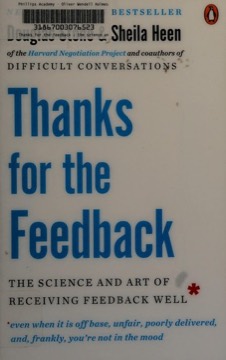
Thanks for the Feedback
The Science and Art of Receiving Feedback Well
Douglas Stone and Sheila Heen's book about the receiving end of feedback — on the argument that almost all advice addresses the giver, while the person who actually controls whether feedback does anything is the one hearing it.
- First published
- 2014
- Publisher
- Penguin Audio
- Pages
- 348
- Shelf
- Leadership
- Level
- Core
- ISBN-13
- 9789861343693
Record checked against
Only one source carried a publication date for this work, so the year is uncorroborated.
Catalogue note
- Reads as
- PracticalWritten to be applied, not only understood.
- Level
- Core / BuildingAssumes general familiarity with the subject.
- Approach
- Practical
- Written for
- Managers, Readers with some grounding
Saved in this browser only — no account, nothing sent anywhere. My library
Read this if
- You keep fixing symptoms and want to see the structure producing them.
- You want to be understood the first time.
- You want something to apply, not only something to think about.
- You know roughly how the subject works and want the fuller account.
The shift in perspective
Their premise is that organisations have spent decades training people to give feedback better, with limited effect, because the receiver holds the real control: they decide what to let in, what to reject, and what it means.
Their conclusion is that receiving well is a learnable skill, and that learning it makes you less dependent on the quality of the delivery — which is fortunate, because the delivery is usually poor.
You cannot control how it is delivered. You can control whether anything useful survives the delivery.
Devmark’s reading — not a quotation from the book
Three kinds of feedback
Their most useful distinction. Appreciation says I see you and value what you do. Coaching says here is how to improve. Evaluation says here is where you stand relative to a standard.
Most feedback conversations fail because the two parties are in different categories — one offering coaching, the other hearing evaluation. Naming which kind is on the table before the conversation resolves a surprising share of the friction.
Truth triggers
The first of three reactions that block reception: the feedback seems wrong, unhelpful or simply untrue, so attention goes to refuting it.
Their remedy is to shift from "that's wrong" to "tell me more" — separating the data the other person has from the interpretation they drew, since the interpretation may be wrong while the observation behind it is real.
Relationship triggers
The second: the feedback is rejected because of who delivered it, or what they have done, or what you think they are really after.
Their term for the resulting derail is switchtracking — two conversations happening at once, one about the feedback and one about the relationship, with neither party noticing the switch. Their instruction is to name both topics and take them in sequence rather than letting them contaminate each other.
Identity triggers
The third and hardest: the feedback threatens the story you tell about who you are, which produces a disproportionate emotional response that feels like a judgement on your whole self.
Their practical work here is the best in the book — dismantling all-or- nothing self-description, distinguishing between fixed and growth identity, and building enough resilience that a piece of criticism is information rather than a verdict.
Criticism lands hardest when it threatens the story about who you are, not when it is about what you did.
Devmark’s reading — not a quotation from the book
Wiring and baseline
Their material on individual differences in emotional response — that people vary substantially in baseline, in how sharply they swing, and in how fast they recover.
Knowing your own pattern is the practical use: someone who swings hard and recovers slowly can learn to delay their response rather than assume their first reaction is their considered view.
The gap map
Their tool for locating disagreement: our intentions are invisible to others, who see only our impact; their story about us is built from that impact plus assumptions about our motives.
Working the gap between intention and impact explicitly is what turns a disputed piece of feedback into a solvable problem rather than a contest over character.
Boundaries
Their chapter on declining feedback is unusual and necessary. You are allowed to reject feedback, and doing it explicitly — naming what you will and will not change — is better than absorbing it silently or arguing endlessly.
They are also clear about the cost: a person who consistently refuses feedback should understand what that will do to the relationship, and decide with that in view.
Where it is limited
The evidence base is the authors' practice at the Harvard Negotiation Project rather than controlled research, and the effectiveness claims are assertions.
The method also assumes a workplace in which feedback is offered in good faith. Where it is being used as a tool of harassment or as pretext, the techniques address the wrong problem, and the book says little about distinguishing the two.
What to take from it
Ask which of the three kinds is being offered before responding, because most of the friction in feedback conversations comes from a mismatch nobody has noticed.
And the switchtracking observation — that a conversation about feedback has quietly become a conversation about the relationship — which is the single most common way a useful discussion stops being one.
What to take away
- 01The receiver holds the controlDecades of training givers has had limited effect because the person hearing it decides what survives.
- 02Name the kind firstAppreciation, coaching and evaluation are different conversations, and most friction is a mismatch between them.
- 03Separate the data from the interpretationThe conclusion may be wrong while the observation behind it is real and worth having.
- 04Watch for switchtrackingWhen feedback becomes a conversation about the relationship, both topics need naming and sequencing.
- 05Identity threat produces the overreactionCriticism hurts most when it challenges the story about who you are rather than what you did.