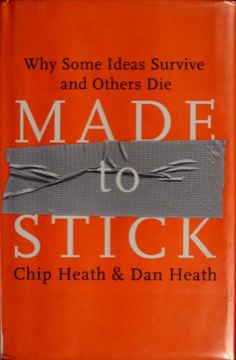
Made to Stick
Chip and Dan Heath's study of why some ideas survive being retold and most do not, organised around six properties that memorable ideas share — and a diagnosis of the one habit that destroys more communication than any other.
- First published
- 2007
- Publisher
- Random House
- Pages
- 291
- Shelf
- Communication
- Level
- Entry
- ISBN-13
- 9780812982008
Record checked against
Two sources agreed on 2007; a third reported differently (openlibrary 1998, wikidata 2007, wikipedia 2007).
Catalogue note
- Reads as
- PracticalWritten to be applied, not only understood.
- Level
- Accessible / FoundationalNo prior reading assumed.
- Approach
- Practical
- Written for
- Writers and speakers, Newcomers to the subject
Saved in this browser only — no account, nothing sent anywhere. My library
Read this if
- You want to be understood the first time.
- You make things, and want to understand the work rather than wait for inspiration.
- You want something to apply, not only something to think about.
- You are starting from scratch here and want a way in that assumes no prior reading.
The core idea
The Heaths' question is not what makes an idea true or good but what makes it survive transmission. Urban legends and proverbs spread without any budget; carefully prepared corporate messages do not survive the lift back to the desk.
Their answer is six principles, and their claim is that stickiness is a property of how an idea is constructed rather than of the talent of whoever is communicating it.
The question is not whether an idea is good. It is whether it survives being retold by someone who half-remembers it.
Devmark’s reading — not a quotation from the book
The Curse of Knowledge
The book's most valuable single concept, and the reason for everything else in it. Once you know something, you cannot easily imagine not knowing it, and you systematically overestimate how much of your meaning is reaching other people.
The Heaths present it as the central villain: experts do not communicate badly through carelessness but because their knowledge has made the gaps invisible to them. Every one of the six principles is a workaround for this one problem.
Simple
Simple here means finding the core — the single most important thing — and being ruthless about it, not dumbing down. Their standard is the proverb: a short statement carrying a deep idea.
The hardest part is what they call the inverted pyramid discipline: leading with the most important thing and accepting that everything after it may not be read. Most organisational communication fails here by refusing to rank.
Unexpected
Attention is captured by breaking a pattern, and held by opening a gap in someone's knowledge that they now want closed.
The Heaths' most actionable advice is to identify the counter-intuitive element of your message and lead with it, then close the gap you opened. Their warning is equally useful: surprise that is merely gimmicky spends attention without buying anything.
Concrete
The principle most violated in professional settings. Abstract language is the natural output of expertise, and it is nearly unmemorable — concrete detail is what lets two people be sure they mean the same thing.
Their test is whether the idea can be examined with the senses. "World-class customer service" is abstract; a specific thing an employee actually did is concrete, and only one of them will be retold.
If two people cannot picture the same thing, they have not yet agreed about anything.
Devmark’s reading — not a quotation from the book
Credible
Credibility rarely comes from statistics, which are hard to hold and easy to dispute. The Heaths catalogue what works better: authority and anti-authority sources, vivid detail that implies first-hand knowledge, human-scale statistics, and testable claims the audience can check themselves.
Their advice on numbers is the most immediately useful: put a statistic in a form a person can feel, since a number nobody can picture communicates nothing regardless of its accuracy.
Emotional and Stories
People care about people rather than about abstractions, and the Heaths argue that the most reliable route to feeling is the concrete individual rather than the aggregate.
For stories they offer three plots that recur in ideas that spread — challenge, connection and creativity — and a practical note that matters: you are more often finding a story that already exists in your organisation than inventing one.
Where it is limited
The framework is descriptive rather than predictive. SUCCESs is derived from examining ideas that already spread, which makes it vulnerable to survivorship: the ideas that had all six properties and vanished are not in the sample.
The acronym is also a little forced, and the book is longer than its argument requires — the core is delivered early and then illustrated at length, which is a common shape in the genre.
The ethical edge
The Heaths note that stickiness is amoral: urban legends, conspiracy theories and successful propaganda all score well on these principles, which is precisely why they were studied.
The book does not dwell on this, and a reader should. The same six properties that make a true idea survive make a false one survive, and the techniques are considerably more effective in the hands of someone unconstrained by accuracy.
What to take from it
The Curse of Knowledge alone justifies the book. Knowing that expertise makes your own gaps invisible changes how you prepare anything for someone else.
Practically: find the core, lead with the counter-intuitive part, replace an abstraction with something a person can picture, and put every number into a form that can be felt. Those four cover most of the value.
What to take away
- 01Expertise hides your own gapsYou cannot un-know something, so you systematically overestimate how much of your meaning arrives.
- 02Find the core and rank ruthlesslyMost organisational communication fails because it refuses to say what matters most.
- 03Concrete is a precondition for agreementIf two people cannot picture the same thing, no agreement has actually been reached.
- 04Make numbers feelableA statistic nobody can picture communicates nothing, however accurate it is.
- 05Stickiness is amoralThe same six properties work just as well for something false, and better without the accuracy constraint.