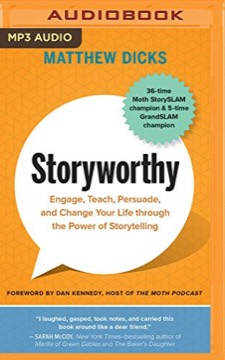
Storyworthy
Matthew Dicks's method for finding and telling true personal stories — developed through competitive storytelling, and built on the claim that the material is already in your life and the problem is retrieval, not invention.
- First published
- 2018
- Publisher
- Brilliance Audio
- Pages
- 348
- Shelf
- Communication
- Level
- Entry
- ISBN-13
- 9781608685486
Record checked against
Catalogue note
- Reads as
- PracticalWritten to be applied, not only understood.
- Level
- Accessible / FoundationalNo prior reading assumed.
- Approach
- Practical
- Written for
- Writers and speakers, Newcomers to the subject
Saved in this browser only — no account, nothing sent anywhere. My library
Read this if
- You want to be understood the first time.
- You make things, and want to understand the work rather than wait for inspiration.
- You want something to apply, not only something to think about.
- You are starting from scratch here and want a way in that assumes no prior reading.
Homework for Life
His central practice and the most valuable thing in the book. Every evening, record in one line the most story-worthy moment of the day — the moment that was different from the rest of it.
His claim is that the practice does two things: it accumulates a large searchable inventory of material within months, and it changes how you attend to your own days, because knowing you will look for the moment makes you notice it while it is happening. The second effect is the one people report as life-altering rather than merely useful.
The practice changes attention, not just memory. Knowing you will look for the moment makes you notice it live.
Devmark’s reading — not a quotation from the book
Every story is about five seconds
His structural claim: a real story is about a single moment of change in the teller, and everything else exists to make that moment land.
His test is that you should be able to name the five-second transformation before you begin writing. A story without one is an anecdote — entertaining perhaps, but it does not move anyone, because nothing happened to the person telling it.
Stories must be about change
His related and stricter rule: the change must be in the teller, and it must be a movement between two opposite states — afraid to brave, certain to doubting, connected to alone.
His insistence that stories about someone else changing do not work, and that stories where the teller is already wise at the start do not work either, eliminates most of what people offer as stories and is the book's sharpest editorial instrument.
First and last
His technique for construction: identify the final moment first, then find the opening scene that shows the teller in the opposite state.
Working backward from the end is the practical method the whole book turns on, because a story whose destination is known can be assembled, and one whose destination is unknown wanders. He is explicit that this is how competitive storytellers work under time pressure.
Elephants, backpacks, breadcrumbs and hourglasses
His named techniques for managing attention. The elephant is the thing the audience knows is coming, named early so they wait for it. The backpack is the load of anticipation carried into a scene. Breadcrumbs are hints dropped early that pay off later. The hourglass is slowing time at the moment of maximum tension.
The vocabulary is idiosyncratic and the techniques are real. They are attention-management tools rather than narrative theory, and they are usable immediately.
Present tense and scene
His advice on delivery language: tell in the present tense, place the audience in a specific physical location, and open in a scene rather than with exposition.
His argument that the audience needs to know where they are standing within the first few sentences is the most concrete piece of storytelling instruction in the book and fixes the most common failure, which is beginning with context nobody has a reason to care about yet.
Truth and its handling
His position is that the story must be true, that the teller may compress time and omit people but may not invent events, and that audiences detect invention more reliably than tellers expect.
His treatment of this is more rigorous than most storytelling books, which tend to permit embellishment. His reasoning — that the entire effect depends on the audience believing this happened to you — is sound and worth holding onto in professional contexts where the temptation to improve a story is constant.
The whole effect rests on the audience believing it happened. Invention costs more than it gains.
Devmark’s reading — not a quotation from the book
Stakes without drama
His argument that the most affecting stories are usually small: a conversation, a moment of embarrassment, a realisation in a supermarket.
His point that dramatic events make poor stories, because the drama does the work and the teller has nothing to add, is counterintuitive and holds up. The five-second change is easier to locate in an ordinary day than in a catastrophe.
Where it is limited
It is written from and for live personal storytelling — competitions, open-mic events, personal performance — and the translation to business contexts is left to the reader.
Its advice also assumes a teller willing to be genuinely vulnerable in public, which is not always appropriate and which the book treats as a straightforward good rather than a choice with consequences.
What to take from it
Homework for Life, which is the highest-return practice in the book and costs a minute a day. Even people who never tell a story report the attentional effect.
And the five-second rule, applied as an editorial test: if you cannot name the moment of change, you do not yet have a story and no amount of polish will produce one.
What to take away
- 01One line a day, every dayIt builds a searchable inventory and changes how you attend to the day while it is happening.
- 02Name the five-second change firstIf you cannot, you have an anecdote, and no amount of craft converts one into a story.
- 03The change must be in the tellerStories about someone else changing, or about an already-wise narrator, do not move an audience.
- 04Work backward from the final momentA story with a known destination can be assembled; one without wanders.
- 05Small beats dramaticIn a catastrophe the events do the work; in an ordinary day the teller has to, which is what makes it land.