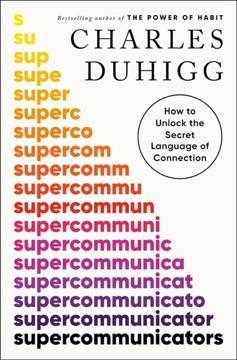
Supercommunicators
Charles Duhigg's book on what distinguishes people who consistently connect — the argument that every conversation is one of three kinds, and that most failures come from two people having different kinds at the same time.
- First published
- 2024
- Publisher
- Random House Publishing Group
- Pages
- not established
- Shelf
- Communication
- Level
- Entry
- ISBN-13
- 9798890980809
Record checked against
No page count is recorded, so no reading estimate is shown for the book itself.
Catalogue note
- Reads as
- PracticalWritten to be applied, not only understood.
- Level
- Accessible / FoundationalNo prior reading assumed.
- Approach
- Practical
- Written for
- Writers and speakers, Newcomers to the subject
Saved in this browser only — no account, nothing sent anywhere. My library
Read this if
- You want to be understood the first time.
- You want to get to an agreement without treating the other side as an obstacle.
- You want something to apply, not only something to think about.
- You are starting from scratch here and want a way in that assumes no prior reading.
The matching principle
Duhigg's central claim, drawn from work on conversational alignment: a conversation succeeds when both people are engaged in the same type of conversation, and fails when they are not.
His framing explains a specific and common frustration — one person seeking comfort while the other supplies solutions, both acting in good faith and both leaving unsatisfied. The failure is structural rather than a matter of warmth or skill.
Both people acting in good faith and both leaving unsatisfied. The failure is structural, not personal.
Devmark’s reading — not a quotation from the book
The three conversations
His taxonomy: practical conversations about decisions and plans, emotional conversations about how we feel, and social conversations about who we are and how we relate to others.
His point that these shift within a single exchange, sometimes several times, is what makes the model useful rather than merely tidy. The skill is detecting the switch, which most people miss entirely.
What do you want from this conversation
His most practical instruction: establish, explicitly or implicitly, what kind of exchange this is before proceeding.
Asking directly whether someone wants help solving a problem or wants to be heard sounds artificial and works reliably. His examples show it being used in medical, workplace and family settings with the same effect.
Deep questions
His treatment of what makes a question productive: it asks about values, beliefs or experiences rather than facts, and it invites the other person to describe something they care about.
The underlying research on self-disclosure and closeness is robust, and his observation that people consistently underestimate how willing others are to answer a substantial question is well supported and directly actionable.
Proving you are listening
His argument that listening silently is insufficient — the other person has to observe evidence of it. His technique is looping for understanding: ask, repeat back in your own words, then check whether you got it right.
The third step is the one people omit and the one that does the work, because it converts a summary into a request for correction.
Emotional conversations and reciprocal vulnerability
His chapters on why emotional exchanges follow different rules: matching the other person's emotional register, and the finding that disclosure invites disclosure at a similar depth.
His account of how therapists, negotiators and effective managers use this deliberately is the strongest section, and it gives a mechanism for something usually described as chemistry.
Who are we: identity in conversation
His treatment of social identity conversations — the ones about group membership, background and status — including conversations across political or cultural difference.
His guidance is to acknowledge identity explicitly rather than avoid it, to control for the environment rather than the people, and to establish equality of contribution. His case material includes structured dialogues on contested subjects, which is the most demanding test available.
Online and at scale
His chapters on why text-based communication fails more often: absent tonal cues, an audience changing the incentives, and the difficulty of detecting which conversation the other person is having.
His practical advice — more explicit signalling of intent, more over-communication of tone — is modest, and he is honest that the medium makes the matching principle much harder to apply.
The evidence and the storytelling
Duhigg's method is his usual one: narrative case studies interleaved with research summaries. The underlying work on alignment, self-disclosure and active listening is real and reasonably well established.
The stories are selected to illustrate rather than to test, and the neural synchrony research he draws on is genuine but young and more preliminary than the confident narration suggests.
The alignment and disclosure research is solid. The neural synchrony material is young and narrated confidently.
Devmark’s reading — not a quotation from the book
What to take from it
Ask what kind of conversation this is, which is the single highest-return move in the book and prevents the most common failure outright.
And looping for understanding with the confirmation step included, because a summary offered for correction demonstrates listening in a way that nodding cannot.
What to take away
- 01Match the conversation typePractical, emotional or social. Two people in different ones both leave unsatisfied.
- 02Ask what they want from thisIt sounds artificial and works, and it prevents the advice-when-comfort-was-wanted failure entirely.
- 03Loop, then checkRepeating back is not enough; asking whether you got it right is what converts summary into listening.
- 04Deep questions are welcomed more than expectedPeople consistently underestimate others' willingness to answer something substantial.
- 05Text makes matching harderAbsent tone and a watching audience are why the same exchange fails in writing and works in person.