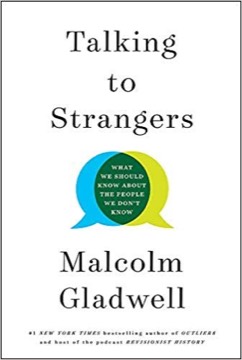
Talking to Strangers
Malcolm Gladwell on why we are bad at reading people we do not know, built around cases where that failure had severe consequences.
- First published
- 2019
- Publisher
- Hachette Audio
- Pages
- 386
- Shelf
- Communication
- Level
- Entry
- ISBN-13
- 9781549100024
Record checked against
Catalogue note
- Reads as
- ConceptualExplains how something works before what to do about it.
- Level
- Accessible / FoundationalNo prior reading assumed.
- Approach
- Theoretical
- Written for
- Writers and speakers, Newcomers to the subject
Saved in this browser only — no account, nothing sent anywhere. My library
Read this if
- You want to decide better when the information is incomplete.
- You read for the writing as much as for the argument.
- You want to understand how it works before deciding what to do about it.
- You are starting from scratch here and want a way in that assumes no prior reading.
The argument
Gladwell proposes three mechanisms. Default to truth: we are built to believe people, and the alternative would make society impossible. Transparency: we assume demeanour reveals interior state, and it does not. Coupling: behaviour is tied to context far more tightly than we assume.
The cases run from Neville Chamberlain misreading Hitler, through Amanda Knox, Bernie Madoff, the Sandusky and Nassar cases, to the traffic stop that led to Sandra Bland's death.
His claim is that defaulting to trust is not a flaw. It is the setting that makes society possible, with a cost attached.
Devmark’s reading — not a quotation from the book
What holds up
The transparency material — that we systematically over-read faces, and that mismatched demeanour gets innocent people convicted and guilty people believed — is the strongest and best evidenced part.
Tim Levine's truth-default research, which underpins the first mechanism, is solid and is not widely known outside the field.
The objections
Gladwell has been criticised, sometimes sharply, for the Sandusky and Knox chapters, where reviewers argued he understated available evidence to fit the framework.
His method — a strong thesis illustrated by dramatic cases — is the standard critique of his work generally, and it applies. Read it for the mechanisms and check the cases independently.
The mechanisms are better supported than the case studies chosen to demonstrate them.
Devmark’s reading — not a quotation from the book
What it is really arguing
Underneath the case studies is a claim about institutions rather than individuals. Gladwell's position is that police training, judicial procedure and campus discipline systems are all built on the assumption that a trained person can read another person accurately.
If that assumption is false, the failures are not lapses by the people involved but predictable outputs of procedures designed around a capacity nobody has. That is the argument worth taking from the book.
Default to truth
The first mechanism, drawn from a psychologist's research programme, is that people are built to believe others and only abandon that belief when doubts become overwhelming. Gladwell's argument is that this is not a flaw to be corrected: a society of suspicious people functions worse, and the occasional catastrophic deception is the cost of a setting that is usually right.
Transparency
The second is that we read demeanour as a window into feeling, and that the correspondence is much weaker than assumed. People whose outward behaviour does not match their inner state — the nervous innocent, the calm guilty — are systematically misjudged, including by professionals who believe themselves skilled at it.
We read faces as though they were windows. For a substantial minority of people they are not.
Devmark’s reading — not a quotation from the book
Coupling
The third and most counter-intuitive is that behaviours are frequently tied to specific places and circumstances rather than portable. He applies it to suicide and to crime, arguing that removing a particular means or policing a particular few streets reduces the behaviour overall rather than displacing it, which contradicts most intuition about determined intent.
The frame
The book opens and closes with a routine traffic stop that escalated and ended with a woman's death in custody days later. Gladwell uses it to argue that each of his three mechanisms was operating — a misread demeanour, a policing doctrine derived from a misapplied experiment, an encounter that should never have been extended — and that no individual villain is required to explain it.
Where it was attacked
The chapters applying default-to-truth to institutional failures in child abuse cases, and the reconsideration of a widely covered murder conviction, drew serious criticism — that the framework functions as exculpation for people who had specific warnings, and that the treatment of sexual assault underweights the accounts of victims. The criticism is substantive and a reader should seek it out.
The institutional argument
Underneath the case studies is a claim that is less about individuals than it sounds: that institutions design procedures on the assumption that trained people can read strangers accurately, that this assumption is false, and that the procedures should therefore be built to fail safely rather than to depend on judgement.
What to take from it
The transparency material is the best supported and the most immediately useful: the confidence you have in your reading of a stranger is not evidence about its accuracy. Treat the case studies as arguments being made rather than as settled accounts, particularly the two that attracted the most objection.
What to take away
- 01Default to truthBelieving people is the setting that lets society function.
- 02The transparency illusionDemeanour does not reveal interior state, and we assume it does.
- 03CouplingBehaviour is tied to place and circumstance more than to character.
- 04Mismatched demeanourThe innocent who look guilty and the guilty who look fine.
- 05Contested casesSeveral chapters drew substantive criticism for selective evidence.