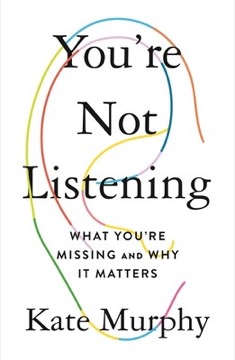
You're Not Listening
What You're Missing and Why It Matters
Kate Murphy's reported argument that listening is a skill most people have never been taught, are getting worse at, and consistently overrate in themselves.
- First published
- 2020
- Publisher
- VINTAGE
- Pages
- 288
- Shelf
- Communication
- Level
- Entry
- ISBN-13
- 9781250297204
Record checked against
Catalogue note
- Reads as
- PracticalWritten to be applied, not only understood.
- Level
- Accessible / FoundationalNo prior reading assumed.
- Approach
- Practical
- Written for
- Writers and speakers, Newcomers to the subject
- Ideas
Saved in this browser only — no account, nothing sent anywhere. My library
Read this if
- You want to be understood the first time.
- You want something to apply, not only something to think about.
- You are starting from scratch here and want a way in that assumes no prior reading.
The argument
Murphy, a journalist, interviewed people whose work depends on listening — CIA agents, hostage negotiators, bartenders, focus group moderators, a priest, a furniture salesman — and reports what they do differently.
The consistent finding is that good listeners are not passive. They ask questions that advance rather than redirect, tolerate silence, and resist the urge to relate the speaker's experience to their own.
The shift-response — turning what someone said back to yourself — is the most common failure and the least noticed.
Devmark’s reading — not a quotation from the book
The research underneath
She draws on Graham Bodie's listening research, on the well-documented gap between speech rate and thought rate that creates room for distraction, and on studies showing that people in close relationships listen worse to each other than to strangers.
That last finding — the closeness-communication bias — is the book's most uncomfortable and best supported.
What to take
The practical content is small and specific: ask questions you do not know the answer to, let a pause run, notice when you are preparing a reply rather than listening, and treat the desire to correct as a signal rather than an instruction.
It is a reported book rather than a manual, and the case studies carry more than the advice does.
We listen worst to the people we know best, which is the finding most readers resist.
Devmark’s reading — not a quotation from the book
Conversational narcissism
The framework Murphy leans on hardest comes from the sociologist Charles Derber, who separated responses that turn attention toward the speaker from those that keep it on them. Both are ordinary and both feel supportive from the inside; the difference is whether the next sentence asks for more or supplies your equivalent experience. Once named, the pattern is difficult to stop noticing in your own conversation.
Why it is never taught
Murphy's observation is that schools and workplaces invest heavily in speaking — debate, presentation training, public-speaking courses — and almost nothing in the other half. The asymmetry is the book's explanation for why a skill everyone claims to value is so unevenly distributed, and why competent adults routinely rate themselves well above their demonstrated ability at it.
Every institution teaches you to speak. Almost none teaches you to listen.
Devmark’s reading — not a quotation from the book
Assuming you already know them
The research on closeness-communication bias is among the book's more uncomfortable material: people are frequently worse at predicting the preferences and opinions of a spouse or long-term friend than of a stranger, because familiarity replaces attention with a stored model. The practical implication is that long relationships need more deliberate listening rather than less, which is the opposite of how most people run them.
Listening across disagreement
Murphy makes a case for listening to people you disagree with that is neither a call for civility nor a promise of persuasion. Her argument is informational: you cannot know what someone actually thinks, as opposed to what their category is supposed to think, without hearing it. She is realistic that this is effortful and that most conversational setups are designed to prevent it.
What silence does
Among the more concrete findings is the treatment of pauses. Professional interviewers, negotiators and focus-group moderators use silence as an instrument, because the discomfort of an unfilled gap tends to be resolved by the other person, usually with the more considered thing they had not planned to say. Most people close the gap themselves within a second or two and never reach that material.
Where it is limited
It is a work of reporting rather than a method, and readers who want a protocol will not find one. There are no exercises, no framework to apply on Monday, and the interview-led structure means the strength of the evidence varies section to section — some chapters rest on published research, others on a single practitioner's account. It is best read as a case for paying attention, not a training manual.
What to take from it
The durable takeaways are small and behavioural: notice whether your reply returns attention to the speaker, ask a question whose answer you cannot predict, let a pause last longer than is comfortable, and treat the urge to correct as a signal that you stopped listening a sentence ago. None of it requires agreeing with anyone.
What to take away
- 01The shift responseTurning a disclosure back to yourself, the default failure mode.
- 02Closeness-communication biasWe assume we already know what intimates mean, and stop listening.
- 03Silence is a toolProfessionals in the book let pauses run where amateurs fill them.
- 04Speech rate versus thought rateThe gap that creates the room for drifting.
- 05Reported, not instructionalThe interviews do more work than the advice.