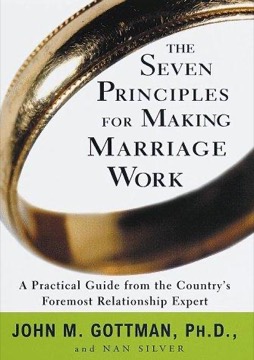
The Seven Principles for Making Marriage Work
John Gottman's summary of decades of observational research on couples, including the behaviours that predict divorce with unusual accuracy, and the practices that distinguish stable marriages.
- First published
- 1999
- Publisher
- Tantor Audio
- Pages
- 288
- Shelf
- Love
- Level
- Entry
- ISBN-13
- 9788499084480
Record checked against
Catalogue note
- Reads as
- PracticalWritten to be applied, not only understood.
- Level
- Accessible / FoundationalNo prior reading assumed.
- Approach
- Practical
- Written for
- Anyone thinking about how people attach, Newcomers to the subject
- Ideas
Saved in this browser only — no account, nothing sent anywhere. My library
Read this if
- You want to understand why people attach to each other the way they do.
- You want something to apply, not only something to think about.
- You are starting from scratch here and want a way in that assumes no prior reading.
The research
Gottman's laboratory recorded couples in conversation, coded facial expression and physiology second by second, and followed them for years. From that he reports being able to predict divorce from short samples of conflict with high accuracy.
The predictive power has been debated — the models were built and tested on overlapping data in early work — but the behavioural findings have held up better than the specific percentages.
The prediction rates are contested. The behaviours the research identified are not.
Devmark’s reading — not a quotation from the book
The Four Horsemen
Criticism, defensiveness, stonewalling and contempt. Gottman identifies contempt — eye-rolling, mockery, moral superiority — as the single strongest predictor of dissolution, and as corrosive in a way anger is not.
The distinction between a complaint about behaviour and a criticism of character is the most immediately useful thing in the book.
Anger is survivable. Contempt is the one that predicts the ending.
Devmark’s reading — not a quotation from the book
What the stable couples do
Build detailed maps of each other's inner life. Turn toward small bids for attention rather than away. Maintain a high ratio of positive to negative interaction during conflict, which he puts around five to one.
His most counterintuitive finding is that most conflict is perpetual and never resolves, and that stable couples manage disagreements rather than solving them.
How to use it
Written as a workbook with questionnaires and exercises. The research is observational rather than experimental, so the causal claims are weaker than the descriptive ones.
It is the standard popular text on the subject and the exercises are genuinely usable without a therapist.
The questionnaires are genuinely worth completing rather than skimming, because Gottman's method depends on noticing specific recurring behaviours rather than on holding a general view of the relationship.
The Love Lab
Gottman's claims rest on observing couples in an apartment laboratory while recording speech, facial movement and physiology — heart rate, skin conductance — then following them for years. It is an unusual evidence base for a relationship book and is the main reason this one is taken seriously.
Bids
The smallest unit in his system is a bid for attention — a comment about a bird outside the window — and whether the partner turns toward it, away from it or against it. His data associates the routine rate of turning toward with stability years later, and it is the most actionable finding in the book.
Somebody mentions a bird. What happens in the next two seconds is the thing that predicts.
Devmark’s reading — not a quotation from the book
Most problems are never solved
A substantial proportion of the conflict in stable, happy marriages is perpetual: rooted in difference of personality or values, and recurring in recognisable form for decades. Gottman's advice is therefore not resolution but dialogue, since the problem is not going to be solved. The couples who manage these well have found a way to keep discussing them with humour and affection rather than sliding into gridlock and avoidance.
Repair attempts
The measurable difference between couples who survive and those who do not is not the absence of argument but the presence of attempts to de-escalate mid conflict — a joke, an apology, a change of tone — and crucially whether the partner accepts them. Gottman treats the acceptance as the skill.
Love maps
The first principle is simply knowing the ordinary content of a partner's life: their current worries, the names of their colleagues, what they are quietly dreading this week, what they would order if you were sent to get lunch. It is unglamorous, it decays steadily without deliberate maintenance, and Gottman's data treats it as genuinely foundational rather than as a sentimental extra.
The prediction claim
The widely repeated figure about predicting divorce from a short conversation with very high accuracy has been seriously criticised: the models were fitted to the same couples they were tested on, and independent prospective replication has been weaker. The behavioural findings are more robust than the headline statistic.
What to take away
- 01The Four HorsemenCriticism, defensiveness, stonewalling and contempt.
- 02Contempt is decisiveThe strongest single predictor, and different in kind from anger.
- 03Turning toward bidsSmall moments of attention, accumulated, predict stability.
- 04Perpetual problemsMost conflict never resolves; stable couples manage it.
- 05Contested prediction ratesThe percentages are disputed; the behaviours are not.