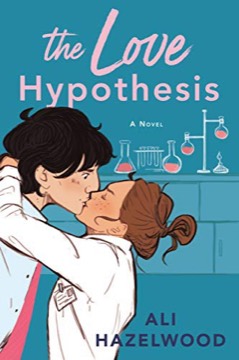
The Love Hypothesis
Ali Hazelwood's romance about a third-year PhD candidate who kisses a professor to convince her friend she is dating someone, and then has to keep it up. A fake-dating comedy set inside the real politics of an academic lab.
- First published
- 2021
- Publisher
- The House of Books
- Pages
- 398
- Shelf
- Love
- Level
- Entry
- ISBN-13
- 9780593336823
Record checked against
Catalogue note
- Reads as
- ReflectiveChanges how you see rather than what you do.
- Level
- Accessible / FoundationalNo prior reading assumed.
- Approach
- Theoretical
- Written for
- Anyone thinking about how people attach, Newcomers to the subject
Saved in this browser only — no account, nothing sent anywhere. My library
Read this if
- You want to understand why people attach to each other the way they do.
- You read for the writing as much as for the argument.
- You want a book that changes how you see things rather than what you do tomorrow.
- You are starting from scratch here and want a way in that assumes no prior reading.
The premise
Olive Smith is a biology PhD student at Stanford whose best friend is interested in Olive's ex. To prove she has moved on, Olive kisses the first person she sees in the corridor. That person is Adam Carlsen, a young professor with a reputation for making graduate students cry.
He agrees to the arrangement, for reasons of his own, and the two of them proceed to fake a relationship in a department where everyone is watching.
Fake dating works as a form because it forces two people to rehearse intimacy until the rehearsal stops being one.
Devmark’s reading — not a quotation from the book
How it works as a romance
The book is a clean execution of a well-understood structure: an external reason to be close, a slow reversal of a first impression, and a misunderstanding placed where it will hurt most. Hazelwood's additions are the setting and the specificity — grant deadlines, conference politics, the economics of a lab.
The comedy comes from Olive's interiority. She is confident about science and hopeless at reading Adam, and the gap between what the reader can see and what she concludes is the engine of most scenes.
What it is actually about
Underneath the comedy the novel is about power in academia, and it takes that seriously in the final third. Hazelwood has a PhD in neuroscience, and the book's treatment of how a woman's work gets attributed, dismissed or traded on is drawn from a real structure rather than invented for drama.
That is also the source of its sharpest tension: the relationship the plot requires is one the institution would have every reason to scrutinise, and the book does not pretend otherwise.
The romance is light. The thing the romance is standing on is not.
Devmark’s reading — not a quotation from the book
Academia as the setting
The novel is specific about graduate life: funding that depends on one supervisor, the precarity of a project that can be ended by a committee, conference politics, and the power a senior academic holds over a junior career. The stakes come from that structure rather than from invention.
The power imbalance, addressed
Hazelwood is a working academic and the book conspicuously does not ignore the obvious objection to a professor-and-student romance. He is not her supervisor, he sits on no committee that decides her future, the institutional lines are stated explicitly on the page, and the plot eventually requires the remaining imbalance to be disclosed and dealt with formally rather than quietly hand-waved away.
The novel names the problem with its own premise, and then makes the plot deal with it.
Devmark’s reading — not a quotation from the book
Harassment
A serious subplot concerns a senior figure's long-standing conduct toward junior women, the open secret among people who have been warned informally, and the institutional machinery that protects him because he brings in funding. It is by far the least romantic material in the book and it is the reason a great many readers working in science reported recognising the situation immediately.
Fake dating, done properly
The fake-dating trope works here because both parties have a concrete and separately stated reason to maintain the pretence, so neither has to behave unreasonably to keep the plot running, and because the misunderstandings arise from information the reader holds and the characters do not. It is competent genre construction rather than contrivance, which is why the book is used as an example of the form.
Where it started
It began life as fan fiction with entirely different names attached and was substantially rewritten for commercial publication, which is not concealed and which is now a well-established route into mainstream publishing rather than an embarrassment. Readers familiar with the source sometimes report detecting the origin in the characterisation of the male lead, who arrives more fully formed than the plot strictly earns.
Olive's friendships
The friendship group around the heroine — a fellow graduate student, a housemate, and the woman the initial deception exists to protect — is drawn with considerably more care than the genre strictly requires, and the novel's opening problem is an act of loyalty rather than of self-interest. That changes what the reader is willing to forgive her for later on.
What it is
It is a contemporary romance with explicit content, a happy ending guaranteed in advance by the conventions of the genre, and jokes that land more often than they miss. It is not in any meaningful sense a novel about science — the actual research is set dressing and is barely described — and its real interest is in the workplace, the hierarchy and the precarity surrounding it.
What to take away
- 01Fake dating, done properlyThe device exists to make two people practise closeness with a cover story for it.
- 02Specificity earns the comedyGrants, conferences and lab hierarchies give the jokes something real to push against.
- 03Power is the real subjectThe last third is about what women in science are asked to tolerate.
- 04Interiority as engineOlive misreads everything, and the distance between her reading and yours is the pleasure.
- 05Written from insideHazelwood's own academic background shows in what the book knows about labs.