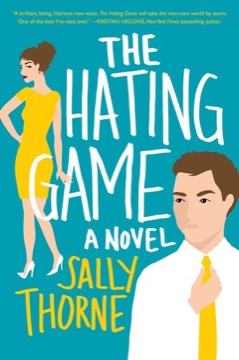
The Hating Game
Sally Thorne's office romance about two executive assistants at a merged publishing house who have spent a year at facing desks refining their dislike of each other.
- First published
- 2016
- Publisher
- Avon Books
- Pages
- 379
- Shelf
- Love
- Level
- Entry
- ISBN-13
- 9781504735865
Record checked against
Catalogue note
- Reads as
- ReflectiveChanges how you see rather than what you do.
- Level
- Accessible / FoundationalNo prior reading assumed.
- Approach
- Theoretical
- Written for
- Anyone thinking about how people attach, Newcomers to the subject
Saved in this browser only — no account, nothing sent anywhere. My library
Read this if
- You want to understand why people attach to each other the way they do.
- You read for the writing as much as for the argument.
- You want a book that changes how you see things rather than what you do tomorrow.
- You are starting from scratch here and want a way in that assumes no prior reading.
The premise
Lucy Hutton and Joshua Templeman work for the co-CEOs of a publisher formed from a hostile merger. Their desks face each other. They have invented a set of private games — staring, mirroring, the HR game — that are ostensibly hostility.
Then a promotion opens that only one of them can take, and the arrangement stops being stable.
Enemies-to-lovers works when the enmity is already an intimacy, and this one is.
Devmark’s reading — not a quotation from the book
Why it works as a romance
The games are the craft. Thorne establishes an elaborate private language between two people before either admits to anything, which does the work that lesser books do with declarations.
It is narrated by Lucy in first person and close present, so the reader is locked into her reading of Josh, which is comprehensively wrong. The comedy and the eventual reversal both come from that.
They built a private language for a year while insisting it was hostility.
Devmark’s reading — not a quotation from the book
What it is about underneath
Lucy's difficulty is that she has organised her whole professional identity around being liked, and the promotion requires her to be something else.
Josh's arc is quieter and better handled than the genre usually manages — the novel gives him an actual reason for how he behaves that is not revealed as a flourish.
Its place
It was Thorne's debut and became one of the reference points for the contemporary office romance, widely imitated since.
It is light, funny and confined almost entirely to two locations, which is part of the appeal: the constraint keeps the attention on the two people.
The games
The two assistants have developed a private catalogue of competitions — the staring game, the mirror game, the how-you-doing game — that nobody else in the office can see. It is an efficient device: it establishes intimacy and hostility as the same behaviour from the first chapter.
Nobody else in the building can see that they are playing anything.
Devmark’s reading — not a quotation from the book
One desk, facing
Almost the entire novel takes place in one shared office containing two desks positioned directly opposite each other, so that each of them spends every working day looking at the other across a metre of desk. The physical arrangement does all the work of forced proximity without requiring any contrivance at all, and the confinement of that single room is effectively the plot.
The merger
The setting is two publishing houses recently and badly combined into one, with duplicate staff in every role, visible factions left over from the original companies, and a single promotion available that only one of the two assistants can take. The professional stakes are real, specific and continuously present, which gives the antagonism a solid reason to exist beyond mutual temperament.
One narrator
It is told entirely from Lucy's point of view, so Joshua's behaviour reaches the reader only through her interpretation of it, and the reader is invited fairly early to notice the specific things she is consistently and confidently misreading. The gap between what he is plainly doing and what she concludes about it is the source of very nearly all of the book's comedy.
The sick day
The extended sequence in which one of them cares for the other while ill is the hinge, and it is the point at which the novel's real subject — being looked after by someone who has paid close attention — becomes visible. It is the passage readers most often cite.
Its position
It is generally credited with reviving the contemporary office romance as a commercial category and sits at the head of a substantial wave of enemies-to-lovers workplace novels published in the years after it. It is explicit, comic, short, tightly constructed, and entirely uninterested in being anything other than extremely well-executed genre fiction, which is precisely why it is worth reading.
What to take away
- 01A private languageA year of invented games doing the work of intimacy.
- 02A locked first personLucy's reading of Josh is wrong, and the reader is stuck inside it.
- 03Likeability as a trapHer professional identity depends on something the promotion forbids.
- 04A real reasonJosh's behaviour is explained rather than revealed as a trick.
- 05Confined on purposeTwo locations, two people, and the constraint is the point.