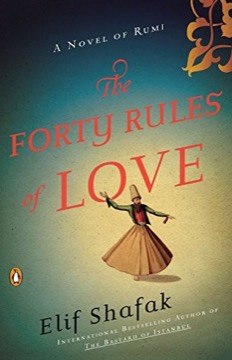
The Forty Rules of Love
Elif Shafak's novel braiding a contemporary American housewife's life with the thirteenth-century meeting of Rumi and the wandering dervish Shams of Tabriz.
- First published
- 2009
- Publisher
- Penguin Books
- Pages
- 368
- Shelf
- Love
- Level
- Core
- ISBN-13
- 9780143118527
Record checked against
Catalogue note
- Reads as
- ReflectiveChanges how you see rather than what you do.
- Level
- Core / BuildingAssumes general familiarity with the subject.
- Approach
- Theoretical
- Written for
- Anyone thinking about how people attach, Readers with some grounding
Saved in this browser only — no account, nothing sent anywhere. My library
Read this if
- You read for the writing as much as for the argument.
- You want a book that changes how you see things rather than what you do tomorrow.
- You know roughly how the subject works and want the fuller account.
The premise
Ella Rubinstein, forty and in a hollow marriage in Massachusetts, takes a job reading manuscripts for a literary agency. The first is Sweet Blasphemy, a novel about Shams of Tabriz, the dervish who transformed Rumi from a respected jurist into a poet.
She begins corresponding with its author. The two narratives run in parallel, and the historical one is much the stronger.
Two stories about the same thing: what a person becomes after meeting someone who will not leave them alone.
Devmark’s reading — not a quotation from the book
The historical strand
Shafak narrates thirteenth-century Konya through many voices — Shams, Rumi, Rumi's sons, a beggar, a harlot, a zealot — each brief, each giving a different account of what the friendship did to the city.
The forty rules of the title are Shams's, distributed through the book, and they are the material most readers take away.
The contemporary strand
Ella's story is thinner and more conventional, and is the most common criticism of the book: a mid-life awakening that reads as a device for delivering the historical material.
Shafak is a serious novelist and this is not her most accomplished book. It is, however, her most read, and the Sufi material is handled with genuine knowledge rather than decoration.
The historical half is the reason to read it; the contemporary half is the frame it arrives in.
Devmark’s reading — not a quotation from the book
What it carries
It introduced a very large international readership to Sufi thought and to Rumi as a historical figure rather than a source of decontextualised quotations.
Shafak writes in both Turkish and English and has faced prosecution in Turkey over her fiction, which is context worth having.
Two books braided
One strand follows an unhappy American housewife in her forties who takes a job reading manuscripts for a literary agency; the other strand is the manuscript she is reading, set in thirteenth-century Konya. Shafak alternates them so that the historical material continuously comments on the contemporary without either narrator ever noticing the correspondence, and that braiding is the novel's principal structural device.
Shams and Rumi
The historical strand concerns the arrival of a wandering dervish who interrupts an established scholar's life and transforms him into a poet. It is based on a real and consequential meeting, and Shafak treats the friendship as the more interesting love story of the two she is telling.
The love story that changes everything in this book is between two men, and it is not romantic.
Devmark’s reading — not a quotation from the book
Many narrators
The medieval sections rotate through a large cast — a beggar, a harlot, a zealot, Rumi's sons, a killer — each speaking in the first person for a few pages. The chorus lets Shafak show a city's reaction to something it cannot categorise, and it keeps a long historical strand moving.
The rules themselves
Forty numbered aphorisms about love, ego, surrender, suffering and the divine are distributed through the text and attributed within the fiction to Shams of Tabriz. They are Shafak's own composition rather than translated historical sayings, which readers very frequently assume otherwise and then quote as though they were. They function as the book's devotional spine and as its most reproduced content.
Sufism for a general reader
The novel is an introduction to Sufi ideas — the beloved, annihilation of the self, the whirling as practice — delivered through narrative rather than exposition. It simplifies a large and internally varied tradition, and it does so deliberately for readers who would not otherwise encounter it.
The contemporary strand's weakness
Ella's storyline is the more criticised half: her transformation is rapid, her marriage is sketched thinly, and the correspondence that changes her life strains plausibility. Most readers find the thirteenth century considerably more alive than the twenty-first, which is an odd result for a book structured this way.
What to take away
- 01Two braided storiesContemporary Massachusetts and thirteenth-century Konya.
- 02Many voicesThe historical strand narrated by a dozen minor figures in turn.
- 03The forty rulesShams's precepts, distributed through the book.
- 04An uneven braidThe historical half is much stronger than the contemporary.
- 05Rumi in contextPresented as a historical person rather than a quotation source.