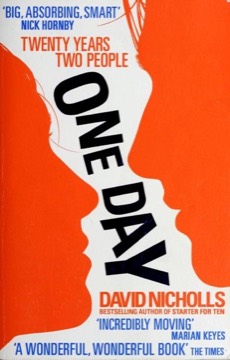
One Day
David Nicholls's novel that revisits two people on the same date — 15 July — every year for twenty years, from the night they meet at graduation in Edinburgh in 1988.
- First published
- 2009
- Publisher
- Vintage Español
- Pages
- 437
- Shelf
- Love
- Level
- Entry
- ISBN-13
- 9780307743770
Record checked against
Catalogue note
- Reads as
- ReflectiveChanges how you see rather than what you do.
- Level
- Accessible / FoundationalNo prior reading assumed.
- Approach
- Theoretical
- Written for
- Anyone thinking about how people attach, Newcomers to the subject
Saved in this browser only — no account, nothing sent anywhere. My library
Read this if
- You read for the writing as much as for the argument.
- You want a book that changes how you see things rather than what you do tomorrow.
- You are starting from scratch here and want a way in that assumes no prior reading.
The structure
One chapter per year, each on St Swithin's Day, following Emma Morley and Dexter Mayhew from 1988 onward. Everything between the dates is inferred from the gaps.
The constraint is the whole design. The reader arrives each year to find things changed and has to reconstruct how, which reproduces the experience of a friendship maintained across distance.
You only ever see one day a year, and the reconstruction is what the book is doing to you.
Devmark’s reading — not a quotation from the book
The two of them
Emma is clever, principled and stuck in jobs beneath her. Dexter is charming, privileged and drifts into television and then into decline. Their trajectories cross in the middle of the book, which is the point of the design.
Nicholls is sharp about class and about the particular waste of the early-nineties graduate with no plan, and the period detail is precise without being nostalgic.
Why it works
The annual snapshot format means every chapter has to establish a whole year in a scene, which forces economy and produces the book's best writing.
It is also very funny for long stretches, which is what earns the turn it takes. The comedy is not decoration; it is the reason the later material lands.
The comedy is load-bearing. Without twenty years of it, the ending would be sentiment.
Devmark’s reading — not a quotation from the book
What to know
There is a development late in the book that divides readers permanently — some consider it the honest choice, others a manipulation. It is worth approaching unspoiled.
Two screen adaptations exist. The novel's structure is the thing the adaptations find hardest, and it is the reason to read it rather than watch.
The fifteenth of July
The novel visits the same calendar date once a year for twenty years, and the constraint is the whole design: everything that matters happens between chapters and arrives as consequence. The reader assembles two lives from twenty annual samples, which is both the trick and the emotional mechanism.
You only ever see one day a year. Everything that matters happens in the gaps.
Devmark’s reading — not a quotation from the book
Two failures
Both characters spend most of the book failing: Emma in a Mexican restaurant and then a mediocre teaching job, Dexter in a television career built on being briefly fashionable and then not. Nicholls is unusually good on the long middle stretch in which nothing works out.
Dexter's decline
The extended sequence covering his drinking, his genuine awfulness as a television presenter, and one particular visit to his dying mother while he is still drunk from the night before is the best writing in the book and by some distance the hardest to read. Nicholls fully commits to making a charming character actively unlikeable for a sustained stretch rather than merely gesturing at a bad patch.
The period detail
The twenty-year span is tracked through carefully chosen specifics: answering machines and landlines, Edinburgh on graduation night in 1988, the particular texture of nineties television and magazine jobs, the clothes and the music and what things cost. The accumulation quietly does the work of a social history of a generation running alongside the romance, and it is a large part of why the book endures.
The turn
Roughly four-fifths of the way through, the novel makes a decision that many readers experience as a betrayal and others as the thing that lifts it above its genre. It is not disclosed here; readers should know only that the book is constructed to earn it and that opinion remains divided.
Where it is dated
Emma is written with a degree of authorial condescension about her taste and her politics that has aged less well than the rest, and the book's treatment of her is noticeably less generous than its treatment of Dexter. It is worth noticing while reading rather than afterwards.
What to take away
- 01One day a yearTwenty chapters, twenty 15 Julys, everything else inferred.
- 02Crossing trajectoriesHer stalled competence against his declining charm.
- 03Economy by constraintEach chapter must establish a year in a single scene.
- 04Comedy as foundationThe humour is what makes the later material work.
- 05A divisive turnLate development that readers split on; best met unspoiled.