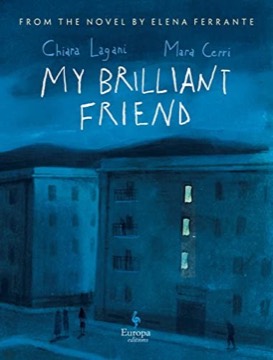
My Brilliant Friend
Elena Ferrante's first Neapolitan novel, about two girls growing up in a poor neighbourhood outside Naples in the 1950s, and a friendship that is also a competition neither will name.
- First published
- 2011
- Publisher
- Europa Editions
- Pages
- 256
- Shelf
- Fiction
- Level
- Core
- ISBN-13
- 9781609459468
Record checked against
Two sources agreed on 2011; a third reported differently (openlibrary 2023, wikidata 2011, wikipedia 2011).
Catalogue note
- Reads as
- ReflectiveChanges how you see rather than what you do.
- Level
- Core / BuildingAssumes general familiarity with the subject.
- Approach
- Theoretical
- Written for
- Readers of literature, Readers with some grounding
Saved in this browser only — no account, nothing sent anywhere. My library
Read this if
- You read for the writing as much as for the argument.
- You want a book that changes how you see things rather than what you do tomorrow.
- You know roughly how the subject works and want the fuller account.
The premise
Elena Greco narrates, as an adult, after her friend Lila has deliberately erased herself from every record. The book goes back to their childhood in a violent working-class rione and follows them to sixteen.
Lila is the more brilliant of the two and is taken out of school. Elena continues, partly on her own ability and partly because Lila's absence makes room. Neither of them says this.
The narrator became a writer partly because her friend was stopped from becoming one, and the book knows it.
Devmark’s reading — not a quotation from the book
What makes it unusual
Ferrante writes female friendship with the full range of competition, envy, sabotage and love intact, and refuses to resolve them into a single feeling.
The prose is plain and fast — closer to reportage than to literary style — which is deliberate. The effect is that the emotional violence arrives without cushioning.
The prose is deliberately unliterary, so that nothing softens what is being described.
Devmark’s reading — not a quotation from the book
The context
The neighbourhood is drawn precisely: which family holds the loan-sharking, who was compromised under fascism, what the Solara brothers are and why nobody opposes them. Class and violence are the water the whole book is in.
Dialect versus Italian is a running marker. Who speaks what, and when, tracks power in every scene.
The series and the author
This is the first of four; the quartet is one continuous novel and this volume does not resolve. Ferrante is a pseudonym and the author's identity has been pursued by journalists in ways she has described as violating, which is a fact about the books' reception.
The library holds the first volume as the entry point rather than the set.
The neighbourhood
The setting is a specific poor district of Naples in the 1950s, and Ferrante treats it as a closed system with its own economy, hierarchy and violence. The list of families printed at the front is not decoration: the novel is about a community in which everyone's position relative to everyone else is known and enforced.
Friendship as competition
The relationship between Elena and Lila is written as admiration, love, rivalry, quiet sabotage and outright dependence all at once, and the novel never once chooses between those descriptions or resolves them into a single verdict. Ferrante's refusal to make it either a warm supportive friendship or a toxic one to be escaped is the foundation the entire four-book series is built on.
They love each other and they are keeping score. The novel refuses to call that a contradiction.
Devmark’s reading — not a quotation from the book
Who gets to stay in school
The plot's actual engine is education: which of the two children is permitted to continue past primary school, who pays the fees, which teacher intervenes, and what a family has already decided its daughter is ultimately for. The divergence that follows from a single decision taken by adults about a ten-year-old, almost in passing, goes on to shape both women's entire lives across four volumes.
The violence
Domestic and street violence is constant throughout and is reported almost casually — beatings administered by fathers and husbands, objects thrown across rooms, a child hurled from a window — because that was simply the texture of the place and the period. Ferrante neither dramatises these moments nor pauses to editorialise about them, and the steady accumulation is far more disturbing than any single incident would be.
Written from the present
Elena narrates in old age, beginning from Lila's disappearance, and the whole quartet is an act of recovery by a woman who has become a writer. The framing means every memory is filtered through a professional narrator with a motive, which the later volumes make increasingly explicit.
The author question
Elena Ferrante is a pseudonym and the author's identity has never been confirmed, despite a journalistic attempt to unmask her that was widely condemned as an invasion. Her position is that books should stand without their authors, and it is worth knowing that the anonymity is a stated principle rather than a marketing device.
What to take away
- 01A friendship as competitionEnvy and love held together without resolution.
- 02Erasure as premiseLila has deleted herself, which is why Elena writes.
- 03Unliterary on purposePlain fast prose so nothing cushions the violence.
- 04Dialect tracks powerWho speaks Neapolitan and who speaks Italian, scene by scene.
- 05One of fourThe quartet is a single novel; this is the opening movement.