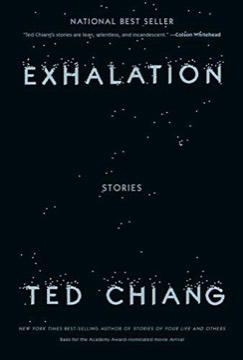
Exhalation
Ted Chiang's second collection — nine stories on free will, memory, parenthood, time travel and what we owe to the things we make, written with the same derivational rigour as the first and with more attention to consequence.
- First published
- 2019
- Publisher
- Alfred A. Knopf
- Pages
- 338
- Shelf
- Fiction
- Level
- Core
- ISBN-13
- 9788381168731
Record checked against
Catalogue note
- Reads as
- ReflectiveChanges how you see rather than what you do.
- Level
- Core / BuildingAssumes general familiarity with the subject.
- Approach
- Theoretical
- Written for
- Readers of literature, Readers with some grounding
Saved in this browser only — no account, nothing sent anywhere. My library
Read this if
- You want a thought experiment you can live inside for a while.
- You read for the writing as much as for the argument.
- You want to examine an assumption you have never examined.
- You want a book that changes how you see things rather than what you do tomorrow.
- You know roughly how the subject works and want the fuller account.
What has changed since the first collection
The method is the same: a premise taken seriously and followed. The emphasis has shifted toward ethics and toward longer engagement with a scenario's consequences over time.
Several stories here are concerned with obligation — to children, to created minds, to one's past self — rather than with the epistemological puzzles that dominated the earlier book.
The method is unchanged and the emphasis has moved from epistemology to obligation.
Devmark’s reading — not a quotation from the book
Exhalation
The title story: a mechanical being in a sealed universe dissects its own brain to understand cognition, and discovers the thermodynamic fact that will end its world.
It is the purest example of Chiang's method. The anatomy, the physics and the conclusion are all derived from a stated premise, and the story functions simultaneously as a scientific investigation, an entropy parable and an unexpectedly moving farewell.
The Merchant and the Alchemist's Gate
A time-travel story in the form of nested tales in a medieval Baghdad setting, using a gate through which past and future are accessible.
Its distinction is a consistent model: the past cannot be changed, and the stories are about what people do with that constraint. Chiang's conclusion — that you cannot alter events but can alter your understanding of them — is worked out through several lives rather than asserted.
The Lifecycle of Software Objects
The collection's longest piece, following two people raising artificial beings over roughly a decade as the platform they run on becomes obsolete.
It is the most sustained argument against the idea that artificial minds could be produced quickly. Chiang's position is that a mind requires years of individual attention and experience, and the story's real subject is what obligation you incur toward something you have raised.
Anxiety Is the Dizziness of Freedom
A device that opens communication with a branch of reality where a recent decision went differently, and the effects on people who can now see what their alternatives produced.
The story is Chiang's most direct treatment of free will, and its resolution — that what matters is the kind of person your choices are making you, regardless of how the branches turned out — is argued through several characters with different responses to the same technology.
What matters is what your choices are making you, regardless of how the other branches turned out.
Devmark’s reading — not a quotation from the book
The Truth of Fact, the Truth of Feeling
Two strands: a near-future society with perfect searchable video memory, and a Tiv community encountering writing for the first time.
The pairing makes the argument. Both technologies replace a flexible remembered account with a fixed record, both change the self that memory constructs, and Chiang refuses to treat either as simply progress or loss.
Omphalos
A world where young-earth creationism is scientifically correct — the evidence is physical and unambiguous — and an archaeologist's faith is tested by a discovery about the universe's actual purpose.
It is the collection's most elegant inversion: a story about the crisis of a believer whose beliefs are demonstrably true, and about what it means for purpose to be located elsewhere.
The shorter pieces
*What's Expected of Us*, a page on a device proving decisions are predetermined and the effect on people who learn it. *Dacey's Patent Automatic Nanny*, a museum-catalogue account of a child-rearing machine. *The Great Silence*, narrated by a parrot, on the Fermi paradox and on listening for intelligence while another intelligence goes extinct nearby.
*The Great Silence* is the collection's most emotionally direct piece and its shortest genuine argument.
The story notes again
As in the first collection, Chiang appends notes on each story's origin.
They are less technical here and more concerned with the ethical questions he was working through, which supports the reading that this collection is his more moral book. Several notes name the specific philosophical argument or news item that set a story going, which makes them a short reading list as well as a record of method.
How it compares
The first collection is more formally dazzling; this one is warmer and more concerned with how people should act.
Readers generally prefer whichever they read first, and the honest position is that they are doing different things well. Both are short, and reading both is a modest commitment for what they contain.
What to take away
- 01Minds take years, not computeThe software objects story argues that an artificial mind requires individual attention over a decade.
- 02You cannot change events, only understandingThe time-travel story keeps a consistent model and asks what remains possible within it.
- 03Free will survives determinismWhat your choices make of you matters regardless of what the other branches show.
- 04Fixed records replace flexible memoryWriting and perfect video do the same thing, and neither is simply progress or simply loss.
- 05A believer whose beliefs are trueOmphalos puts the crisis of faith in a world where the evidence is unambiguous and on his side.