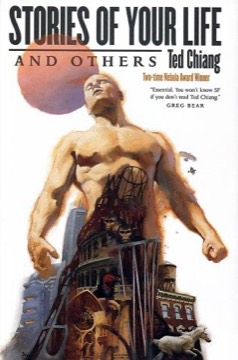
Stories of Your Life and Others
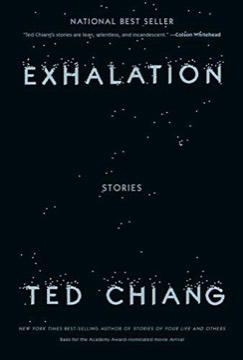
Ted Chiang's first collection — eight stories, each built by taking a premise seriously and following it with unusual rigour, and each concerned with what a different structure of knowledge would do to a person.
- First published
- 2002
- Publisher
- Tor Books
- Pages
- 317
- Shelf
- Fiction
- Level
- Core
- ISBN-13
- 9780525433675
Record checked against
Catalogue note
- Reads as
- ReflectiveChanges how you see rather than what you do.
- Level
- Core / BuildingAssumes general familiarity with the subject.
- Approach
- Theoretical
- Written for
- Readers of literature, Readers with some grounding
Saved in this browser only — no account, nothing sent anywhere. My library
Read this if
- You want a thought experiment you can live inside for a while.
- You read for the writing as much as for the argument.
- You want a book that changes how you see things rather than what you do tomorrow.
- You know roughly how the subject works and want the fuller account.
The method
Chiang's stories begin from a single altered premise — a physical law, a theological fact, a cognitive capacity — and derive consequences with the care of a proof.
He writes slowly and publishes little, and the density is the result. Almost nothing in these stories is decoration; each element is doing work in an argument the story is conducting.
Each story takes one altered premise and derives from it with the care of a proof. Nothing is decoration.
Devmark’s reading — not a quotation from the book
Tower of Babylon
His first published story: miners ascending a tower built to reach the vault of heaven, in a world where the Babylonian cosmology is literally correct.
The physics and engineering of a tower requiring months to climb are worked out thoroughly, and the ending is a genuine formal surprise that recasts the cosmology rather than violating it.
Story of Your Life
The collection's centrepiece and the basis of the film *Arrival*. A linguist learns an alien written language whose structure requires perceiving events as a whole rather than sequentially, and acquires that perception herself.
Its formal achievement is that the story's second-person passages about her daughter are not flashbacks. They are being experienced simultaneously with everything else, and the tense structure of the prose is doing the work the premise describes.
The question that story asks
If you knew your life in full, including its losses, would you live it anyway, and would knowing change what you chose.
Chiang grounds this in the variational principle in physics — Fermat's principle, where light behaves as though it knows its destination — so that the teleological view is not mysticism but an alternative and equally valid formulation.
The teleological reading is grounded in physics, where it is an equally valid formulation rather than mysticism.
Devmark’s reading — not a quotation from the book
Hell Is the Absence of God
His hardest story: a world where angelic visitations occur regularly, causing miraculous healings and deaths indiscriminately, and where heaven and hell are observable facts.
It is a direct treatment of the problem of evil with the uncertainty removed, and its ending is among the bleakest in modern short fiction. It is also, deliberately, an argument rather than a consolation.
Understand
An experimental treatment produces escalating intelligence in a patient, narrated from inside as the narrator's cognition outruns his ability to describe it.
The story's problem is the one every superintelligence story faces — a writer of ordinary intelligence depicting an extraordinary one — and Chiang's solution, focusing on changed relationships to pattern and self-modification rather than on conclusions, is the best available.
Seventy-Two Letters
A Victorian-flavoured story in which golem-animating names are an industrial technology and preformationist biology is correct.
It is the collection's most elaborate world-building, and its interest is in what industrial and labour politics look like when the underlying science is different. The ending turns on a demographic problem that the premise generates.
The remaining stories
*Division by Zero*, in which a mathematician proves arithmetic inconsistent and cannot survive the implication. *The Evolution of Human Science*, a very short piece on what human researchers do once metahumans have surpassed them. *Liking What You See*, a documentary-form story about a technology that suppresses the perception of physical beauty, presented as competing testimony with no authorial verdict.
The last is the most argumentative and the most balanced — Chiang gives the strongest case to each side and declines to settle it.
The story notes
The collection ends with Chiang's notes on each story's origin, and they are worth reading.
They show how much each story began as a specific intellectual problem rather than as a character or a scene, which is the clearest available account of his method. They also make plain how long the gap between the initial idea and the finished story usually was, which explains the small size of his published output.
His position in the field
He has published two collections and no novels, has won most of the major awards in the field repeatedly, and is regarded by many working writers as the strongest short-story writer in contemporary science fiction.
His stories are also unusually well suited to readers who do not otherwise read the genre, because the ideas are philosophical rather than technological.
What to take away
- 01One premise, followed rigorouslyEach story is a derivation, and almost every element is doing work in the argument.
- 02The tense is the techniqueIn Story of Your Life the daughter passages are simultaneous, not flashbacks, and the prose enacts it.
- 03The physics licenses the metaphysicsFermat's principle makes the teleological view an alternative formulation rather than a mystical claim.
- 04Hell removes the uncertaintyThe problem of evil treated in a world where the afterlife is an observable fact, with no consolation offered.
- 05Read the story notesThey show each story beginning as an intellectual problem, which is the clearest account of his method.