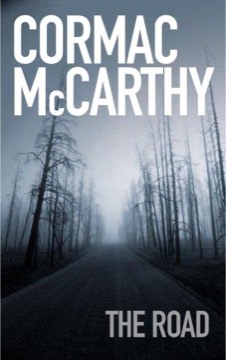
The Road
Cormac McCarthy's novel about a father and son walking south through a burned America after an unnamed catastrophe, with a shopping trolley and a pistol holding two rounds.
- First published
- 2006
- Publisher
- Vintage International
- Pages
- 256
- Shelf
- Fiction
- Level
- Core
- ISBN-13
- 9781436100793
Record checked against
Catalogue note
- Reads as
- ReflectiveChanges how you see rather than what you do.
- Level
- Core / BuildingAssumes general familiarity with the subject.
- Approach
- Theoretical
- Written for
- Readers of literature, Readers with some grounding
Saved in this browser only — no account, nothing sent anywhere. My library
Read this if
- You read for the writing as much as for the argument.
- You want a thought experiment you can live inside for a while.
- You want a life told honestly, at full length.
- You want a book that changes how you see things rather than what you do tomorrow.
- You know roughly how the subject works and want the fuller account.
The premise
Everything is dead. Ash covers the country, nothing grows, and the survivors are mostly predatory. A man and his young son walk toward the coast because there is nothing else to do.
The cause is never given and does not matter. The novel is about the walk and about what the father is trying to preserve in the boy.
The catastrophe is never explained, because the book is not about the catastrophe.
Devmark’s reading — not a quotation from the book
The prose
McCarthy strips punctuation, drops quotation marks and apostrophes, and writes in short declarative fragments. The vocabulary alternates between plain monosyllables and sudden archaic precision.
The effect is a language as reduced as the landscape, with occasional survivals of something more elaborate — which is exactly the book's subject in formal terms.
The prose is as burned-over as the country, with occasional survivals of something ornate.
Devmark’s reading — not a quotation from the book
What it is about
Carrying the fire is the phrase the father uses for whatever they are preserving. The novel is precise that he cannot define it and that the boy understands it better than he does.
The father's moral compromises and the boy's refusal of them is the actual argument: the son is repeatedly the better person, and the father knows it.
What to expect
It is short, relentless and contains a small number of images most readers never lose. There is one scene in a cellar that is among the most disturbing in modern fiction.
It won the Pulitzer and is, unusually for McCarthy, structurally simple. Readers who found Blood Meridian impenetrable generally find this one direct.
What caused it is never said
McCarthy supplies one line about a shear of light and a series of low concussions, and nothing else. There is no explanation, no scientific account and no politics. The refusal concentrates the novel entirely on the consequence, and it is why the book has outlasted the apocalyptic fiction around it.
There is no cause given, no villain and no history. Only afterwards.
Devmark’s reading — not a quotation from the book
Carrying the fire
The phrase the father uses to explain what they are is the book's only moral content, and it is deliberately unexamined — a thing told to a child to keep him going. Whether it means anything is the question the boy keeps pressing, and the father's answers get less confident as they go south.
The boy's conscience
The most important reversal is that the child is the moral authority. He wants to help people the father judges too dangerous to approach, and he keeps asking whether they are still the good guys. The father's love and his willingness to do terrible things are the same faculty, and the boy sees it.
The punctuation
McCarthy uses no quotation marks, few apostrophes and long unbroken conjunctive sentences. The effect is to remove the visual separation between speech, thought and landscape, so that everything arrives in one flat register — which is the appropriate register for a world with nothing left to distinguish.
What they actually carry
The novel is unusually precise about logistics: the shopping trolley, the tarpaulin, the pistol with two rounds, the tinned food, the state of their boots. The inventory is checked constantly, and it supplies the only suspense available, since the threat is mostly hunger rather than confrontation.
The ending
The final pages have been read both as genuine hope and as the bleakest thing in the book, and McCarthy declines to settle it. He dedicated the novel to his young son and has said it came from watching him sleep in a Texas hotel room, which is context most readers find changes the last page considerably.
What to take away
- 01No explanationThe cause is withheld because the novel is about the aftermath.
- 02Stripped punctuationLanguage reduced to match the landscape.
- 03Carrying the fireUndefined on purpose; the boy understands it better.
- 04The son is the better personAnd the father knows it, which is the book's ache.
- 05Structurally simpleUnusually direct for McCarthy, and short.