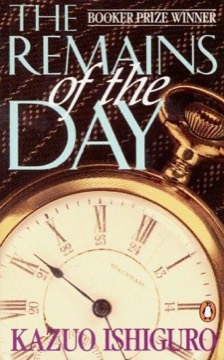
The Remains of the Day
Kazuo Ishiguro's novel narrated by Stevens, an English butler on a short motoring holiday in 1956, looking back on a career of service between the wars — a book built entirely out of what its narrator cannot bring himself to say.
- First published
- 1989
- Publisher
- Faber and Faber
- Pages
- 254
- Shelf
- Fiction
- Level
- Core
- ISBN-13
- 9788673467184
Record checked against
Catalogue note
- Reads as
- ReflectiveChanges how you see rather than what you do.
- Level
- Core / BuildingAssumes general familiarity with the subject.
- Approach
- Theoretical
- Written for
- Readers of literature, Readers with some grounding
Saved in this browser only — no account, nothing sent anywhere. My library
Read this if
- You read for the writing as much as for the argument.
- You want to learn things that stay learned.
- You want to know how we got here.
- You want a book that changes how you see things rather than what you do tomorrow.
- You know roughly how the subject works and want the fuller account.
The premise
Stevens, butler at Darlington Hall, takes a few days' leave to drive across the West Country, ostensibly to discuss a staffing matter with a former colleague. As he travels he recalls his years of service under the previous owner of the house.
That is the entire external plot. Everything the novel is about happens inside the narration, and this summary will not go further, because the book works by controlled withholding.
The unreliable narrator, done precisely
Stevens is not lying to the reader. He is a man whose self-account has been constructed so carefully that he cannot see past it, and the novel's method is to let the reader assemble what he will not.
The technique is remarkable for its restraint. Ishiguro never signals the gap; there is no ironic authorial nudge. The reader arrives at the truth slightly ahead of the narrator, and the small distance between those two points is where the whole book lives.
He is not lying to us. He is telling the version he needs, and we are close enough to see around it.
Devmark’s reading — not a quotation from the book
Dignity, as the book's keyword
Stevens returns obsessively to the question of what constitutes dignity in a great butler, and his answer is the ability to inhabit the professional role completely, without the intrusion of a private self.
The novel does not argue against this directly. It simply follows the principle to its conclusion and lets the reader watch what it costs — which is a far more devastating method than any refutation.
Service and complicity
The political thread is handled with the same indirection. Lord Darlington's activities in the 1930s are revealed gradually, in fragments Stevens supplies while explaining something else.
Stevens's position is that a servant cannot be held responsible for his employer's judgement — that his duty was to serve well. The novel tests this carefully, and its most uncomfortable question is not whether he was complicit but what it means to construct a moral framework in which the question cannot be asked.
What is not said
The book's central relationship is conducted almost entirely in what is avoided. Conversations turn on staffing, on professional standards, on practical arrangements, and something else is present the whole time and never named by either party.
Ishiguro's control here is exceptional. Several scenes derive their force entirely from a sentence that does not appear, and readers frequently report not registering how much has happened until afterwards.
The prose
The voice is the novel's great technical achievement: formal, circumlocutory, scrupulously polite, given to qualification and to small self-corrections. It is the prose of a man who has spent forty years ensuring nothing he says can be held against him.
It reads slowly at first and becomes transparent. By the final section the same register that seemed merely stiff has become almost unbearable, without a single change in the writing.
Englishness, seen from outside
Ishiguro has spoken about arriving at this material partly as a way of examining a mythologised England rather than a historical one, and the novel is knowingly working with an image of the country house.
That distance is part of its intelligence. The book is interested in the idea of English restraint as a cultural export, and in what a person does with a self that has been organised around never being a nuisance.
Where readers struggle
The pace is deliberate and the narrator is, by design, tedious in places. Readers wanting event will find very little, and the novel's habit of circling a subject can feel like evasion — which it is, though it is the character's evasion rather than the author's.
The reward is almost entirely retrospective. It is a book that gets better in the hour after finishing it than it was while being read, which is a genuine property rather than a defence.
Its afterlife
It won the Booker Prize in 1989 and was adapted into a well-known film that is faithful in plot and necessarily different in method — the novel's whole technique is interior, and a camera cannot withhold in the same way.
Ishiguro returned to related concerns repeatedly in later work, and the Nobel citation in 2017 pointed at exactly this: the uncovering of what lies beneath a carefully maintained sense of connection with the world.
What it is about
Finally, it is a book about the cost of a life organised around a principle that turned out not to deserve it — and about the specific kind of loss that can only be recognised too late to act on.
Its lasting effect is a question rather than a lesson: what have you decided not to look at, and what is that decision costing you while it continues to feel like dignity?
What to take away
- 01The gap is the techniqueThe reader arrives at the truth slightly ahead of the narrator, and that distance is the entire book.
- 02Follow a principle to its costThe novel never argues against Stevens's idea of dignity. It just lets it run and shows the bill.
- 03A framework can forbid its own questionThe unsettling part is not the complicity but the self-account built so the question cannot arise.
- 04Absence carries the scenesThe central relationship is conducted almost entirely in sentences neither party will say.
- 05It improves after it endsThe effect is retrospective; the hour after finishing does more work than most of the reading.