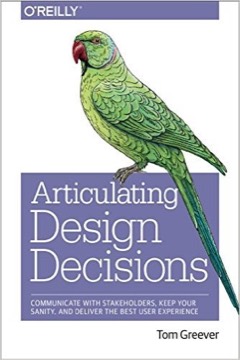
Articulating Design Decisions
Tom Greever's book on the part of design work that happens in meetings — how to present decisions, respond to reactions, and get good work approved by people who are not designers.
- First published
- 2015
- Publisher
- O'Reilly Media, Incorporated
- Pages
- 278
- Shelf
- Design
- Level
- Core
- ISBN-13
- 9781491921524
Record checked against
Only one source carried a publication date for this work, so the year is uncorroborated.
Catalogue note
- Reads as
- PracticalWritten to be applied, not only understood.
- Level
- Core / BuildingAssumes general familiarity with the subject.
- Approach
- Practical
- Written for
- Designers and makers, Readers with some grounding
Saved in this browser only — no account, nothing sent anywhere. My library
Read this if
- You want to be understood the first time.
- You care why some things are obvious to use and others are not.
- You want to learn things that stay learned.
- You want something to apply, not only something to think about.
- You know roughly how the subject works and want the fuller account.
The problem it addresses
Greever's premise is that design work fails more often in the conversation about it than in the work itself, and that most designers are trained for the second and not the first.
His framing — that the ability to explain a decision is part of the decision's quality, not a separate soft skill — is the argument the whole book rests on.
The ability to explain a decision is part of its quality, not a separate soft skill bolted on afterwards.
Devmark’s reading — not a quotation from the book
Understand the stakeholders first
His preparatory work: knowing who will be in the room, what each person is responsible for, what they are measured on, and what they are likely to react to.
His observation that most objections are predictable if you know what a person is accountable for is the practical core of his preparation advice, and it converts a defensive posture into a prepared one.
Two questions every decision must answer
His central test: what problem does this solve, and how does it affect the user. A decision that cannot answer both is not ready to present.
Applying this before a meeting rather than during it is what separates his advice from generic presentation coaching, because it frequently reveals that a decision was made for reasons that will not survive being stated.
Listening before responding
His treatment of reactions: identify the real concern behind the stated objection, acknowledge it genuinely, and restate it before answering.
His point that an objection to a colour is frequently an objection to something else entirely — a worry about a deadline, a stakeholder not consulted, a prior decision being reopened — is accurate and is the single most useful diagnostic in the book.
Responding well
His mechanics: agree where you can, use the stakeholder's own language, defer to evidence where it exists, and be willing to concede points that do not matter in order to hold the ones that do.
His advice to have a prepared alternative ready is practical, because a designer who can offer a second option is negotiating rather than defending.
Saying yes without ruining the work
His chapters on compromise: which changes are cosmetic and can be absorbed, which undermine the solution, and how to distinguish them before agreeing in the room.
His framing that conceding small things buys credibility for the large ones is honest about the politics of the situation rather than pretending the best argument wins.
Conceding the small things buys the credibility to hold the large ones. The best argument does not simply win.
Devmark’s reading — not a quotation from the book
Meetings as a designed artefact
His practical guidance on running the conversation: set the agenda, control the order of reveal, state the decisions you need, and close with explicit agreements and owners.
His insistence on ending with a written record of what was agreed prevents the common failure where a meeting resolves nothing and the same discussion recurs.
Relationships over transactions
His longer-run argument: the goal is a standing relationship in which design judgement is trusted, so that individual decisions require less defending over time.
This is the part that most distinguishes the book from a communication manual, and it is also the part that requires the most patience to apply.
Where it is limited
It assumes a particular organisational context — an in-house design team presenting to business stakeholders — and translates less well to agency work, to solo practice, or to organisations where design has no seat.
Its advice is also almost entirely about persuasion within an existing structure, and it has little to say about when the right response is to escalate or to decline.
What to take from it
The two questions, applied before the meeting rather than during it, which is a quality check on the decision disguised as presentation preparation.
And the discipline of finding the concern behind the objection, which resolves more disagreements than any argument about the merits, because a person whose actual worry has been addressed rarely continues to press the proxy they raised instead of it.
What to take away
- 01What problem does it solve, and how does it affect the userA decision that cannot answer both is not ready to present, which makes this a quality check.
- 02Objections are usually about something elseA complaint about a colour is frequently a worry about a deadline or a person not consulted.
- 03Know what each person is accountable forMost objections become predictable once you do, which turns defence into preparation.
- 04Concede the cosmetic, hold the structuralDecide which is which before the meeting, not while under pressure in it.
- 05Close with a written recordWithout one, the same discussion recurs and the meeting resolved nothing.