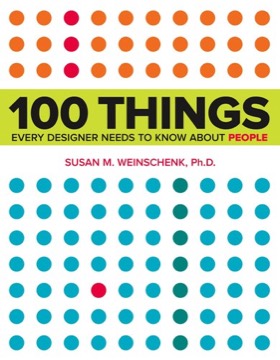
100 Things Every Designer Needs to Know About People
Susan Weinschenk's reference of a hundred short entries on perception, memory, motivation, attention and decision-making, each with its research basis and its design implication.
- First published
- 2011
- Publisher
- New Riders
- Pages
- 249
- Shelf
- Design
- Level
- Core
- ISBN-13
- 9780321767530
Record checked against
Catalogue note
- Reads as
- ReferenceBuilt to be consulted rather than read straight through.
- Level
- Core / BuildingAssumes general familiarity with the subject.
- Approach
- Practical
- Written for
- Designers and makers, Readers with some grounding
- Ideas
Saved in this browser only — no account, nothing sent anywhere. My library
Read this if
- You care why some things are obvious to use and others are not.
- You want evidence about why people behave as they do, not folklore.
- You want something to keep nearby and return to, rather than read once.
- You know roughly how the subject works and want the fuller account.
The format
A hundred entries of one to three pages, grouped by topic: how people see, read, remember, think, focus, feel and decide. Each states a finding, cites its research, and gives the design consequence directly.
Weinschenk holds a PhD in psychology, and the entries are sourced rather than asserted, which distinguishes the book from most design-psychology writing.
A hundred sourced findings, each with the design consequence stated in a sentence.
Devmark’s reading — not a quotation from the book
What is most useful
The chapters on peripheral vision, on reading not being the same as seeing, and on the limits of multitasking are the ones that most often change how a reader designs.
The motivation section — on intrinsic drivers, on progress, and on what actually makes people continue a task — is the least intuitive and the most applicable outside interfaces.
How to use it
It is a reference to consult rather than to read through, and its structure supports that: entries are independent and indexed by question.
Published in 2011 with a later second edition; the perceptual and cognitive material is stable, while the specific interface examples have dated.
The psychology has held; the screenshots have not.
Devmark’s reading — not a quotation from the book
Why a hundred
The number is not arbitrary padding. Weinschenk's argument is that design psychology is usually taught as a handful of memorable principles, which produces designers who apply the same three heuristics to every problem.
A hundred entries is enough that no reader will remember them all, which is the intention: the book is built to be consulted at the moment a specific question arises rather than absorbed as a worldview.
Peripheral vision does more than expected
One of the most practically useful entries concerns the division of labour in sight: central vision resolves detail, while the periphery detects the gist of a scene and directs attention. The design consequence is that what sits outside the point of focus is not ignored — it determines where the eye goes next, which makes surrounding clutter expensive.
Reading is not seeing
Several entries cover the mechanics of text: that reading proceeds in jumps rather than smoothly, that all-capitals is slower because word shape is lost, that line length affects comprehension, and that people do not read pages so much as scan them for a pattern. These are old findings and they are still routinely designed against.
Memory is reconstructive
The entries on memory make a consistent point: people do not retrieve stored records, they rebuild from fragments, so recognition is far easier than recall. Almost every interface convention that works — visible options, recent items, autocomplete — is an application of that single asymmetry.
Showing someone the option is not a convenience. It is the difference between easy and nearly impossible.
Devmark’s reading — not a quotation from the book
People satisfice
A recurring theme is that users do not optimise. They take the first acceptable option, use the path they already know, and stop reading when they have enough to proceed. Designing for a careful evaluator produces products that fail with the actual population, who are busy and doing something else.
Progress motivates
The entries on motivation converge on the finding that people work harder as a goal appears nearer, and that showing progress — even artificially advanced — sustains effort. It is one of the sections where the manipulative application is most obvious and Weinschenk is only lightly cautionary about it.
Where the neuroscience is thin
A number of entries reach for mechanisms — mirror neurons, dopamine, specific brain regions — in the popular-neuroscience register of the period, and those explanations are considerably shakier than the behavioural findings they are attached to. The observed effects are mostly sound; the causal stories underneath several of them are not.
Attention is the scarce input
A cluster of entries makes the same point from different directions: people cannot genuinely attend to two demanding things at once, what looks like multitasking is rapid switching with a measurable cost each time, and an interruption is far more expensive than the seconds it occupies. Every design decision that fragments attention is therefore spending something the user has very little of.
What looks like doing two things is switching between them, and paying a toll each way.
Devmark’s reading — not a quotation from the book
What to take away
- 01A hundred entriesIndependent, indexed, and meant to be consulted.
- 02Sourced by a psychologistFindings cited rather than asserted, which is unusual in the genre.
- 03Peripheral visionOne of the entries most likely to change a layout decision.
- 04MotivationThe least intuitive section and the most transferable.
- 05Stable psychology, dated examplesThe research holds; the interfaces shown do not.