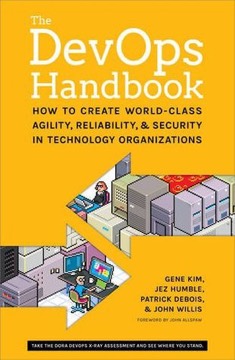
The DevOps Handbook
Kim, Humble, Debois and Willis's prescriptive companion to The Phoenix Project — the detailed practices behind the Three Ways, with case material from organisations that implemented them.
- First published
- 2016
- Publisher
- IT Revolution Press
- Pages
- 460
- Shelf
- Technology
- Level
- Core
- ISBN-13
- 9781942788003
Record checked against
Catalogue note
- Reads as
- ReferenceBuilt to be consulted rather than read straight through.
- Level
- Core / BuildingAssumes general familiarity with the subject.
- Approach
- Practical
- Written for
- Engineers, Readers with some grounding
- Ideas
Saved in this browser only — no account, nothing sent anywhere. My library
Read this if
- You build software and want the ideas under the tools.
- You are responsible for other people's work as well as your own.
- You want something to keep nearby and return to, rather than read once.
- You know roughly how the subject works and want the fuller account.
What it adds to the novel
*The Phoenix Project* dramatises the problem and gestures at principles. This is the implementation manual: what to actually do, in what order, with what practices.
Its structure follows the Three Ways — flow, feedback, continual learning — and each is developed into concrete technical and organisational practices rather than left as a principle.
The novel gestures at the principles. This is the part that says what to actually do, in what order.
Devmark’s reading — not a quotation from the book
The First Way: flow
Practices for making work flow from development to operations: making work visible, limiting work in progress, reducing batch sizes, reducing handoffs, and identifying and elevating constraints.
Their technical practices follow: a deployment pipeline, automated testing, continuous integration, low-risk release patterns, and architectures that allow teams to release independently of each other.
The Second Way: feedback
Practices for shortening and amplifying feedback loops: telemetry everywhere, information radiators, peer review instead of external approval, and the ability to detect and recover from failure quickly.
Their argument about approval is the sharpest: that external change approval boards are a form of slow, weak feedback, and that peer review with automated testing is both faster and more effective — a claim later supported by the *Accelerate* research.
The Third Way: continual learning
Practices for institutionalising improvement: blameless post-mortems, injecting failure deliberately to build resilience, converting local discoveries into global improvements, and reserving time for improvement work.
Their treatment of blameless post-mortems is the most practically valuable — specifically the argument that a culture which punishes error gets less information about error, not less error.
Low-risk release patterns
Their technical core: separating deployment from release, feature toggles, dark launching, canary releases, blue-green deployment.
The conceptual move that makes this work is decoupling the act of putting code on a server from the act of exposing it to users, which turns a high-stakes event into two low-stakes ones.
Deploying and releasing are different acts. Separating them turns one high-stakes event into two low-stakes ones.
Devmark’s reading — not a quotation from the book
Information security as part of flow
A section frequently skipped and genuinely valuable: integrating security into the pipeline rather than as a gate at the end.
Their argument mirrors the change-approval one — a security review positioned as a final checkpoint provides slow feedback on decisions made months earlier, and moving the checks into the pipeline makes them both faster and more effective.
The case material
A substantial portion is case studies from organisations that implemented these practices, including large enterprises and regulated industries.
The selection problem applies — these are organisations that succeeded and agreed to be featured — but the inclusion of banks, government and manufacturing is useful, because it addresses the common objection that these practices only suit technology companies.
Where it is limited
It is long, encyclopaedic and somewhat repetitive, and it reads as a reference rather than an argument. Few people read it end to end.
Its prescriptions also assume a degree of organisational autonomy and tooling investment that many teams lack, and the book is more useful for someone with a mandate to change how software is delivered than for someone working inside a system they cannot alter.
Its place in the sequence
Read after *The Phoenix Project* for the narrative and alongside *Accelerate* for the evidence, this is the middle and most practical of the three.
There is substantial overlap between them, and a reader who wants only one should choose by what they need: story, practice, or research.
What to take from it
The separation of deployment from release, which is the single highest-leverage technical practice in the book and reframes the whole question of release risk.
And the blameless post-mortem discipline, which is organisational rather than technical and which determines whether an organisation learns anything from its failures at all.
What to take away
- 01Separate deploying from releasingPutting code on a server and exposing it to users are different acts, and decoupling them removes most release risk.
- 02Approval gates are slow weak feedbackPeer review with automated testing is faster and more effective, as the later research confirmed.
- 03Punishing error reduces information, not errorWhich is the entire case for the blameless post-mortem, and it is an organisational choice rather than a technical one.
- 04Move security into the pipelineA final-checkpoint review gives slow feedback on decisions made months earlier.
- 05Reserve time for improvementWithout a standing allocation, improvement work is always displaced by delivery work.