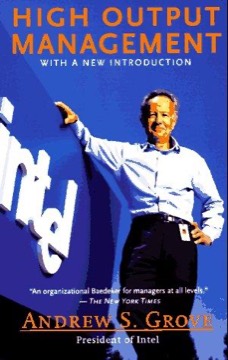
High Output Management
Andrew Grove's manual for running an organisation, written while he was president of Intel, which treats management as a production problem and a manager's output as the output of the teams under and around them — not as anything they personally produce.
- First published
- 1983
- Publisher
- Souvenir
- Pages
- 235
- Shelf
- Leadership
- Level
- Core
- ISBN-13
- 9780330289634
Record checked against
Only one source carried a publication date for this work, so the year is uncorroborated.
Catalogue note
- Reads as
- PracticalWritten to be applied, not only understood.
- Level
- Core / BuildingAssumes general familiarity with the subject.
- Approach
- Practical
- Written for
- Managers, Readers with some grounding
- Ideas
Saved in this browser only — no account, nothing sent anywhere. My library
Read this if
- You are responsible for other people's work as well as your own.
- You want something to apply, not only something to think about.
- You know roughly how the subject works and want the fuller account.
The core idea
Grove's definition is the whole book in a sentence: a manager's output is the output of their organisation plus the output of the neighbouring organisations they influence. Nothing a manager personally produces counts.
This sounds obvious and almost nobody acts on it. It means time spent on your own work is only justified by its effect on other people's output, and it makes the question "what did I do today?" the wrong question.
A manager's output is the output of their teams. Personal productivity does not appear in the equation.
Devmark’s reading — not a quotation from the book
Management as production
Grove opens with a breakfast factory — eggs, toast, coffee, delivered together and hot — and uses it for the rest of the book. The device is not whimsy; it lets him introduce limiting steps, work-in-progress, capacity, variability and quality-control placement without organisational politics clouding any of it.
The key production idea is to catch problems at the lowest-value stage. Rejecting a bad egg costs a penny; rejecting a finished breakfast costs the whole breakfast. Applied to knowledge work, this argues for early, cheap checks rather than late, thorough ones.
Leverage
Managerial leverage is the ratio of output produced to time invested, and Grove treats increasing it as the only real path to managerial productivity.
High-leverage activities share properties: they affect many people, they influence a long period, or they supply information that changes many subsequent decisions. Low-leverage activity is doing the work yourself. Negative leverage — micromanaging, delaying a decision others are waiting on, transmitting anxiety — is real, and Grove names it.
Indicators
Grove's treatment of measurement is unusually sharp. He insists on paired indicators, because any single measure will be gamed in the direction it points: volume paired with quality, speed paired with error rate.
He also distinguishes leading from trailing indicators and argues that a manager's daily attention belongs on the leading ones — the indicators that give warning while there is still time to act.
The one-on-one
The chapter most widely adopted. Grove's one-on-one belongs to the subordinate, not the manager: they set the agenda, they do most of the talking, and the manager's job is to ask questions and listen.
His reasoning is informational rather than pastoral. A one-on-one is the highest-leverage hour available because it transfers context in both directions, and he estimates it affects two weeks of the subordinate's work — a return no other meeting matches.
The meeting belongs to the person being managed. The manager's job in it is to listen.
Devmark’s reading — not a quotation from the book
Meetings are the medium, not the enemy
Grove pushes back directly on the idea that meetings are waste. Meetings are the medium through which managerial work happens; the question is whether a given one is process-oriented (regular, information-sharing) or mission-oriented (ad hoc, producing a decision).
His rule for the second is strict: a mission-oriented meeting needs a single clear owner, and if a decision was not made, it failed. He also puts a ceiling on how much of a manager's week should be ad hoc, on the grounds that a high proportion indicates a broken process somewhere upstream.
Decision-making and constructive confrontation
Grove's model has three stages: free discussion, in which every view is genuinely aired; clear decision; and full support, whether or not you agreed. The third is the one organisations fail.
This is where Intel's culture of constructive confrontation sits. Grove's argument is that disagreement expressed before the decision is a contribution and disagreement expressed after it is sabotage, and that a culture which suppresses the first guarantees the second.
Task-relevant maturity
Grove's answer to how closely to manage someone is not a personality question but a task question. Task-relevant maturity is specific to the work, not the person: the same capable individual needs close structure on an unfamiliar task and none on a familiar one.
The practical consequence is that management style should change with the task, not be set once per person — and that a promotion resets it, which is why capable people flounder after moving up and are often misdiagnosed.
Motivation and the performance review
Grove's view of motivation is that a manager cannot supply it, only create conditions in which it appears. His treatment of performance reviews is blunt: the purpose is to improve performance, not to record a verdict, and the hardest ones are with valued people who are doing adequately.
He is also candid that most managers deliver reviews badly by avoiding the message, and that a review whose recipient is surprised represents a failure in the preceding months, not in the meeting.
How it has aged
Remarkably well, which is striking for a management book written in 1983 by a semiconductor executive. The reason is that Grove reasons from first principles about information, capacity and leverage rather than from the fashions of his decade.
What has dated is context rather than argument: the hardware manufacturing detail, the assumption of long employee tenure, and a hierarchical frame with little to say about distributed or contract work. The one-on-one, the leverage framing and paired indicators are now standard practice, often via people who have never heard of the book.
What to take away
- 01Your output is your team's outputNothing you personally produce counts toward it, which changes what a good day looks like.
- 02Catch problems at the cheapest stageRejecting a bad input costs almost nothing; rejecting a finished product costs everything before it.
- 03Pair every indicatorA single measure gets optimised in exactly the direction it points. Volume needs quality beside it.
- 04Match style to the task, not the personTask-relevant maturity resets with every unfamiliar task — including a promotion.
- 05Disagree before, support afterA culture that suppresses disagreement before the decision guarantees it after.